
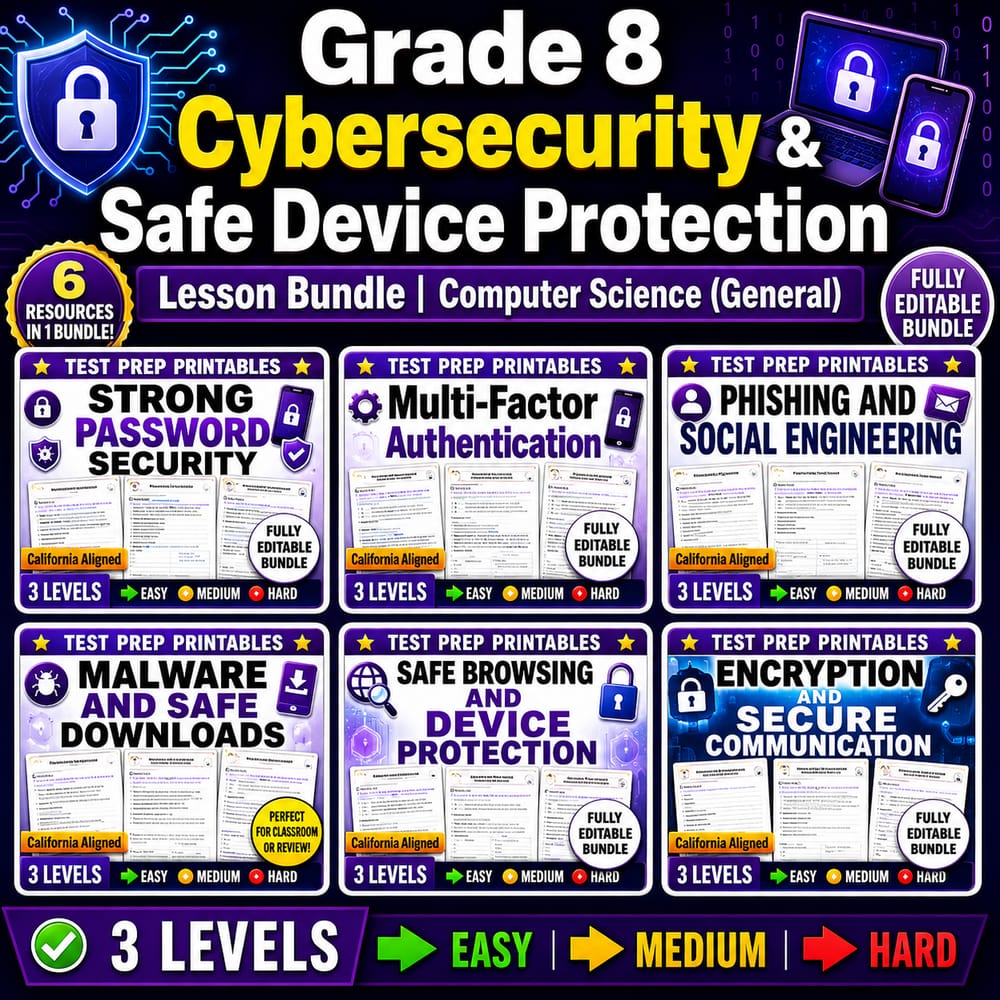
Grade 8 Cybersecurity & Safe Device Protection Lesson Bundle | Computer Science (General)
$24.00$30.00Save $6.00
Prism Point Learning
·2 followers·13 sales
SubjectComputer ScienceGradeGrade 8Pages180 Pages
What’s included
6 worksheets · 180 pages · Save $6.00 (20%) · prices shown inside the bundle
 Grade 8 Strong Password Security Worksheet | Computer Science Activity
- Explain why strong, unique passwords improve account security.
- Use key vocabulary (password, authentication, secure, credential) correctly in context.
- Apply safe login habits and describe how a password manager can help.
$4.00$5.00 Multi-Factor Authentication and Account Security Worksheet Grade 8
- Define multi-factor authentication and explain why it improves security
- Identify common factors (something you know, have, or are) used in verification
- Compare a single-step login process with a multi-step MFA process
$4.00$5.00 Phishing and Social Engineering Safety Worksheet for Grade 8 Students
- Explain how phishing and social engineering try to trick people into sharing private information.
- Identify warning signs of scams, including urgency, suspicious links, and requests for personal data.
- Apply strategies to respond safely to suspicious messages.
$4.00$5.00 Grade 8 Malware and Safe Downloads Worksheet | Computer Science Activity
- Explain what malware is and identify common types such as viruses, spyware, and ransomware.
- Describe warning signs in files, links, and attachments that may indicate malware.
- Use safe download habits to reduce the risk of infection and data loss.
$4.00$5.00 Grade 8 Safe Browsing and Device Protection Worksheet | Computer Science
- Use browser and URL checks to decide whether a link is trustworthy
- Explain how updates and secure settings protect devices from common threats
- Identify safe behaviors that reduce risk while browsing and downloading
$4.00$5.00 Grade 8 Encryption and Secure Communication Worksheet | Computer Science
- Explain how encryption helps protect digital information from unauthorized reading.
- Use key vocabulary (encryption, decryption, key, secure communication) accurately in context.
- Identify correct statements about secure communication and the role of keys.
$4.00$5.00
Reviews & Feedback
Loading reviews...
Questions & Answers
Loading questions…
About this bundle
Related categories
Frequently asked questions
Who is Grade 8 Cybersecurity & Safe Device Protection Lesson Bundle | Computer Science (General) designed for?
Grade 8 Cybersecurity & Safe Device Protection Lesson Bundle | Computer Science (General) is designed for Grade 8 students and Computer Science learners and can be used in classrooms, homeschool, or independent practice.
How do I download Grade 8 Cybersecurity & Safe Device Protection Lesson Bundle | Computer Science (General)?
Add it to your cart and complete checkout. After payment, you can download immediately from your account, and you'll also receive a download link by email.


