
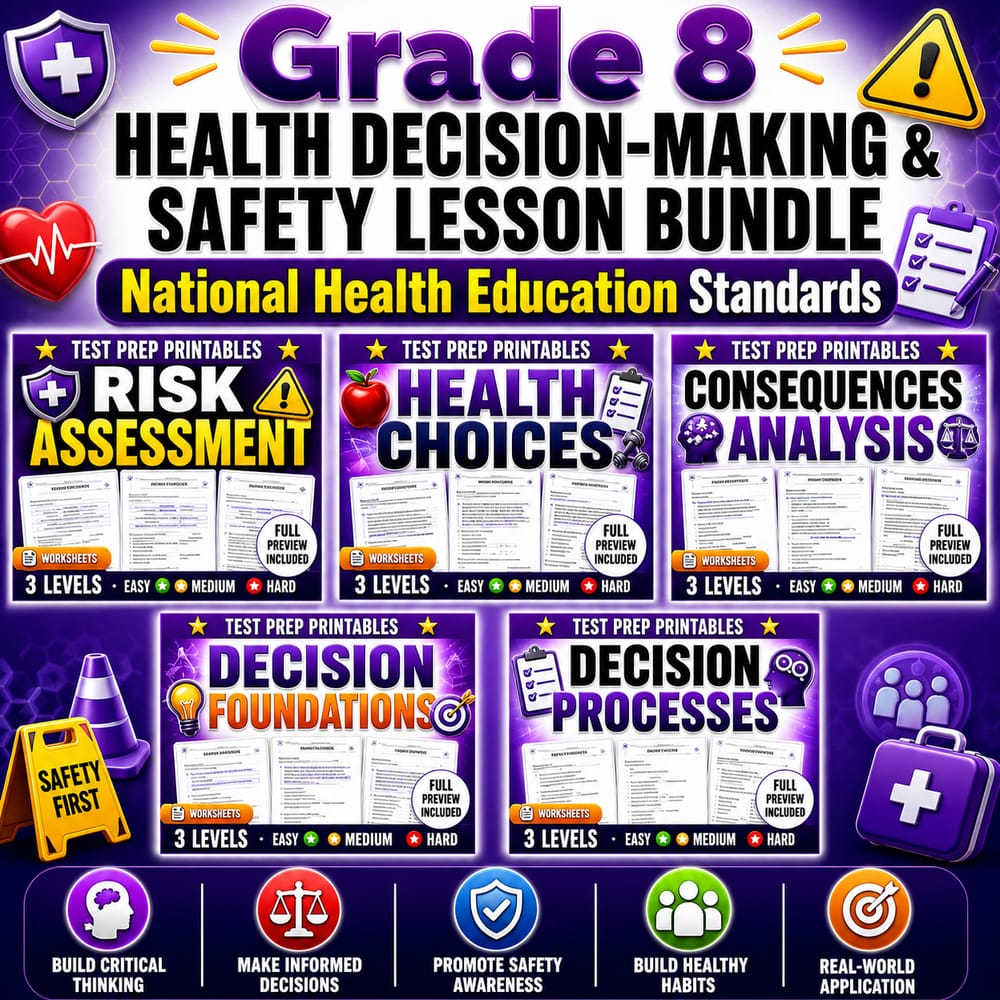
Grade 8 Health Decision-Making & Safety Lesson Bundle | National Health Education Standards
$20.00$25.00Save $5.00
Prism Point Learning
·2 followers·13 sales
SubjectHealthGradeGrade 8Pages152 Pages
What’s included
5 worksheets · 152 pages · Save $5.00 (20%) · prices shown inside the bundle
 Health Risk Assessment Worksheet Grade 8 | NHES Spot Hazards Safely
- Identify hazards connected to health-related choices.
- Estimate likelihood and impact to assess overall risk.
- Use risk assessment to compare options and make safer decisions over time.
$4.00$5.00 Health Choices Decision-Making Worksheet Grade 8 | NHES Safety Skills
- Use a simple decision framework to evaluate health choices by weighing risks and benefits.
- Analyze consequences of health behaviors for both short-term and long-term outcomes.
- Recognize how social influences and environmental factors can affect health decision-making.
$4.00$5.00 Grade 8 Health Consequences Analysis Worksheet | NHES Decision-Making
- Analyze immediate and future consequences of health-related decisions
- Compare positive and negative outcomes to support responsible decision-making
- Use a cause-and-effect chain to plan safer choices for personal health
$4.00$5.00 Health Decision Foundations Worksheet Grade 8 Health | NHES Activity
- Explain key steps in a simple decision-making framework for health choices.
- Use criteria to compare options based on likely benefits and risks.
- Practice applying a structured approach to make more responsible personal decisions.
$4.00$5.00 Grade 8 Health Decision Making Worksheet | NHES Health Skills
- Use a step-by-step decision process to evaluate health choices involving peer pressure or media influence.
- Compare risks and benefits to predict possible outcomes and choose safer, healthier actions.
- Explain how critical thinking and logical reasoning support responsible health decisions.
$4.00$5.00
Reviews & Feedback
Loading reviews...
Questions & Answers
Loading questions…
About this bundle
Related categories
Frequently asked questions
Who is Grade 8 Health Decision-Making & Safety Lesson Bundle | National Health Education Standards designed for?
Grade 8 Health Decision-Making & Safety Lesson Bundle | National Health Education Standards is designed for Grade 8 students and Health learners and can be used in classrooms, homeschool, or independent practice.
How do I download Grade 8 Health Decision-Making & Safety Lesson Bundle | National Health Education Standards?
Add it to your cart and complete checkout. After payment, you can download immediately from your account, and you'll also receive a download link by email.
Similar Products

Grade 4 Health Lesson Bundle: Personal Safety & Decision Making Ontario
$16.00$20.00

Grade 7 Health Unit Bundle | Risk Assessment & Decision-Making Worksheets
$9.60$12.00

Health Decision Making Lesson Bundle | Grade 6 Health | National Health Education Standards
$16.00$20.00

Grade 3 Decision-Making Skills in Health Lesson Bundle: National Health Education Standards
$9.60$12.00

Grade 10 Decision-Making Health Lesson Bundle | Ontario Framework
$38.40$48.00