
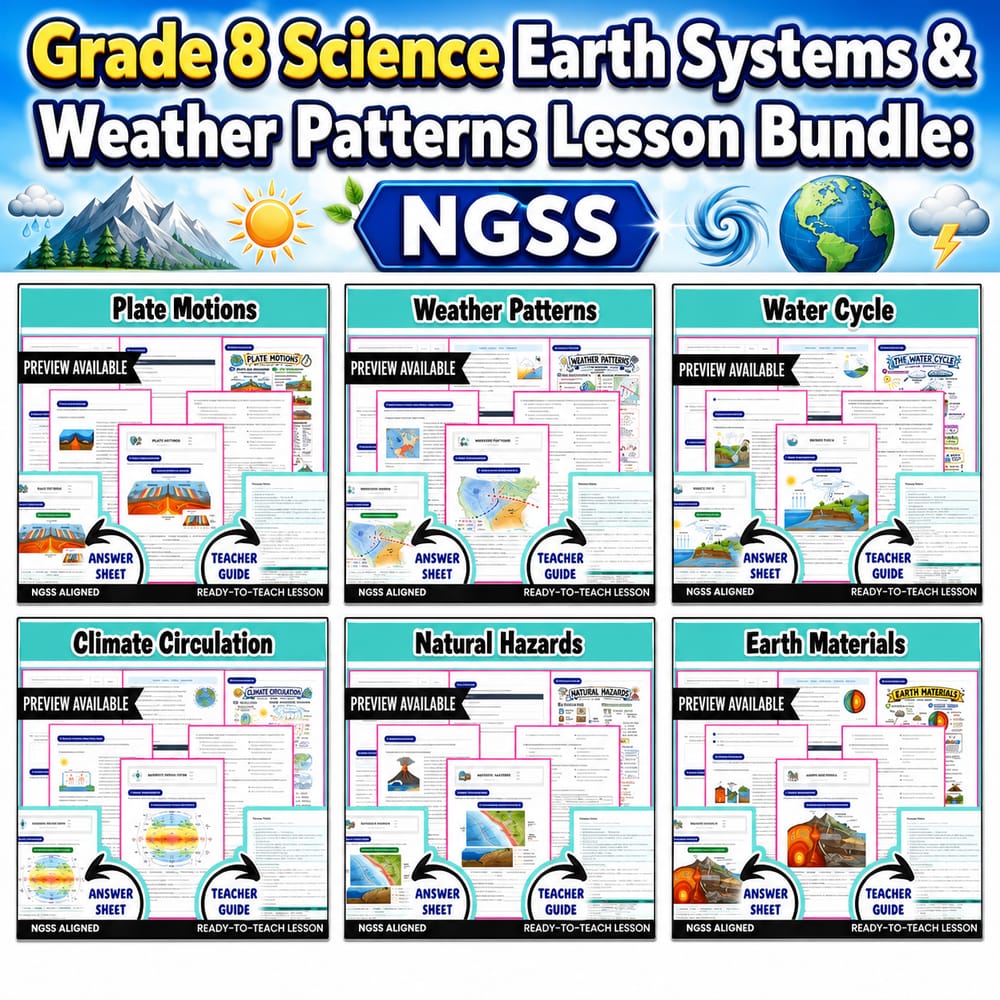
Grade 8 Science Earth Systems & Weather Patterns Lesson Bundle: NGSS
$24.00$30.00Save $6.00
Amber Owl Education
New·0 followers·1 sales
SubjectScienceGradeGrade 8
What’s included
6 worksheets · Save $6.00 (20%) · prices shown inside the bundle
 Plate Motions Worksheet Grade 8 NGSS | Plate Tectonics Activity & Guide
- Explain how seafloor spreading and magnetic striping provide evidence for plate motion.
- Describe how subduction, rifting, and continental collision shape major landforms like ocean basins and mountain belts.
- Interpret how paleomagnetic records and continental fit help reconstruct past continental configurations.
$4.00$5.00 Grade 8 Weather Patterns Worksheet | NGSS Science Maps & Forecasting
- Explain how moving air masses and pressure differences affect wind, temperature, humidity, and precipitation
- Interpret surface pressure maps and weather symbols to predict likely weather changes
- Use evidence from time-series and synoptic patterns to connect fronts and storms to atmospheric dynamics
$4.00$5.00 Water Cycle Worksheet Grade 8 NGSS Science with Doodle Note & Guide
- Explain the main stages of the water cycle, including evaporation, condensation, precipitation, infiltration, runoff, and groundwater flow.
- Describe how sunlight and gravity drive global and local hydrologic cycling.
- Connect water-cycle processes to weathering and erosion, such as river incision, karst formation, and coastal erosion.
$4.00$5.00 Grade 8 Climate Circulation Worksheet | NGSS Atmosphere & Global Winds
- Explain how unequal solar heating and Earth’s rotation help drive atmospheric circulation patterns (Hadley, Ferrel, and polar cells).
- Describe how the Coriolis effect influences wind direction and contributes to trade winds, monsoons, and other regional weather patterns.
- Connect major ocean circulation (gyres and thermohaline circulation) to regional climates and multi-year variability such as El Niño–Southern Oscillation.
$4.00$5.00 Natural Hazards Science Worksheet Grade 8 | NGSS Earth Science Activity
- Explain how scientists use natural hazard records to estimate recurrence intervals and compare short-term events with long-term geologic change.
- Interpret relationships between earthquake, faulting, volcanic activity, and tsunami risk using basic statistical and spatial reasoning.
- Describe how monitoring and modeling support hazard forecasts and early-warning decision-making.
$4.00$5.00 Grade 8 Earth Materials Worksheet | NGSS Rock Cycle & Earth Systems Activity
- Model how Earth's rock cycle transfers mass between reservoirs using processes such as melting, crystallization, uplift, weathering, transport, and deposition
- Explain how Earth's internal heat and gravitational potential energy influence energy flow and observable surface features
- Interpret how mantle convection drives long-term changes that interact with faster surface processes
$4.00$5.00
Reviews & Feedback
Loading reviews...
Questions & Answers
Loading questions…
About this bundle
Related categories
Frequently asked questions
Who is Grade 8 Science Earth Systems & Weather Patterns Lesson Bundle: NGSS designed for?
Grade 8 Science Earth Systems & Weather Patterns Lesson Bundle: NGSS is designed for Grade 8 students and Science learners and can be used in classrooms, homeschool, or independent practice.
How do I download Grade 8 Science Earth Systems & Weather Patterns Lesson Bundle: NGSS?
Add it to your cart and complete checkout. After payment, you can download immediately from your account, and you'll also receive a download link by email.
Similar Products

Grade 10 Earth Science Worksheets | NGSS Earth’s Systems Bundle
$16.80$21.00

Grade 7 Earth Science Worksheets Bundle | Weather, Climate & Earth Systems
$16.80$21.00

Weather, Earth Systems & Human Feedbacks Grade 7 Science Lesson Bundle | General
$22.40$28.00

Grade 7 Human Impacts on Earth Systems Science Lesson Bundle – NGSS
$20.00$25.00

Grade 8 Science Unit | Earth Systems & Weather Worksheets (NGSS-Aligned Bundle)
$9.60$12.00