
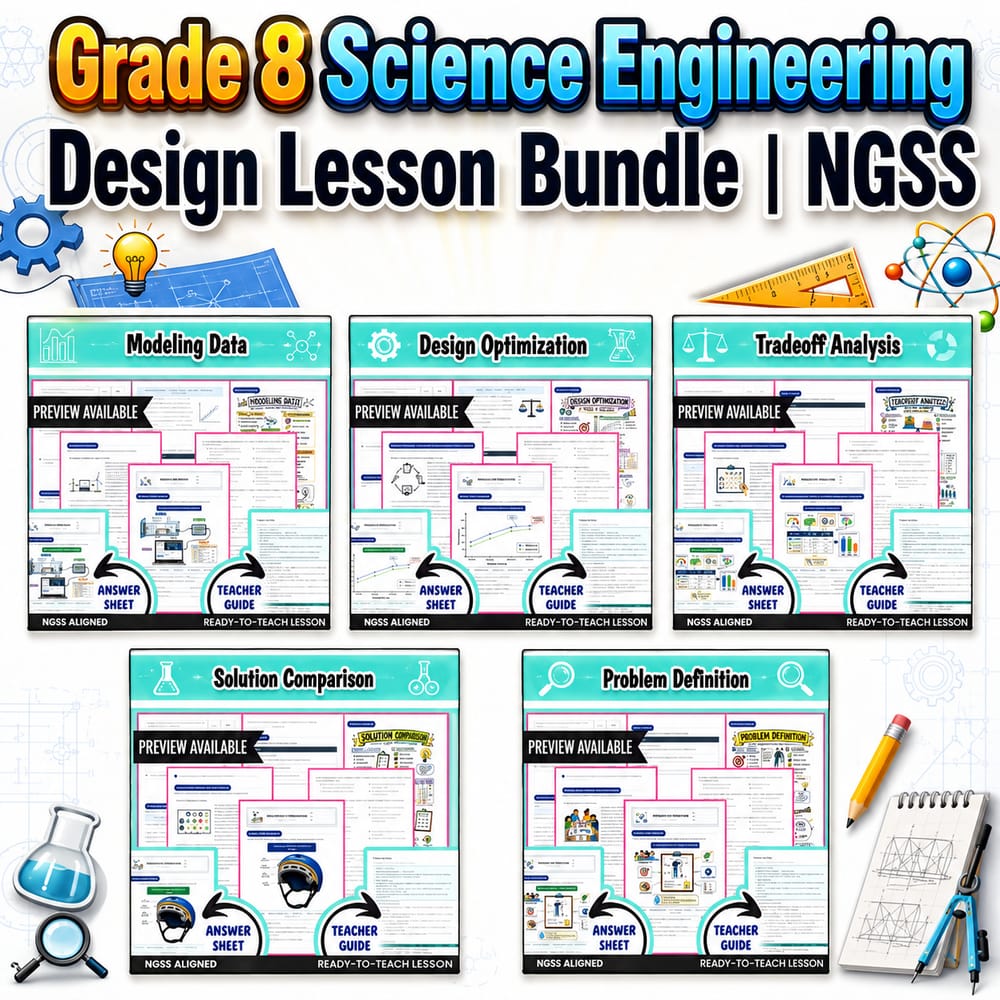
Grade 8 Science Engineering Design Lesson Bundle | NGSS
$20.00$25.00Save $5.00
Amber Owl Education
New·0 followers·1 sales
SubjectScienceGradeGrade 8Pages75 Pages
What’s included
5 worksheets · 75 pages · Save $5.00 (20%) · prices shown inside the bundle
 Grade 8 Modeling Data Science Worksheet | NGSS Engineering & Data Analysis
- Explain how physical and computational models can generate quantitative data for comparing design solutions.
- Identify key measurement practices that improve repeatability and support fair comparisons.
- Describe common sources of model limitations and measurement uncertainty.
$4.00$5.00 Design Optimization Science Worksheet | Grade 8 NGSS with Doodle Notes
- Analyze test data to identify performance trends and explain why they occur in design cycles.
- Use quantitative comparisons to evaluate trade-offs among competing metrics such as strength, efficiency, and durability.
- Interpret graphs and summaries to justify which design modifications improve performance and where diminishing returns begin.
$4.00$5.00 Tradeoff Analysis Science Worksheet | Grade 8 NGSS Engineering Design Activity
- Use weighted scoring and Pareto comparisons to prioritize design options under competing constraints.
- Estimate costs and benefits to justify a chosen solution using tradeoff reasoning.
- Perform basic sensitivity analysis to understand how changes in assumptions affect decisions.
$4.00$5.00 Solution Comparison Worksheet | Grade 8 NGSS Science Engineering Design
- Use solution-comparison criteria, constraints, and measurable performance indicators to evaluate design alternatives.
- Create and interpret trade-off matrices that compare multiple concepts using both qualitative and quantitative information.
- Explain how evidence from tests supports a final selection and identifies limitations for each candidate solution.
$4.00$5.00 Grade 8 NGSS Problem Definition Engineering Design Science Worksheet
- Identify measurable performance goals and translate them into criteria for an engineering solution.
- Recognize constraints such as cost, materials, safety requirements, and environmental conditions.
- Write a clear problem statement that includes stakeholder needs and acceptable failure modes.
$4.00$5.00
Reviews & Feedback
Loading reviews...
Questions & Answers
Loading questions…
About this bundle
Related categories
Frequently asked questions
Who is Grade 8 Science Engineering Design Lesson Bundle | NGSS designed for?
Grade 8 Science Engineering Design Lesson Bundle | NGSS is designed for Grade 8 students and Science learners and can be used in classrooms, homeschool, or independent practice.
How do I download Grade 8 Science Engineering Design Lesson Bundle | NGSS?
Add it to your cart and complete checkout. After payment, you can download immediately from your account, and you'll also receive a download link by email.
Similar Products

Grade 10 Science Engineering Design Worksheets NGSS Lesson Bundle | STEM Skills
$4.80$6.00

Grade 6 Science Engineering Design Lesson Bundle | NGSS Worksheets
$9.60$12.00

Grade 11 Engineering Design Lesson Bundle | ngss Science
$11.20$16.00

Grade 5 Engineering Design NGSS Worksheets & Science Bundle
$7.20$9.00

Grade 9 Science Engineering Design Lesson Bundle | NGSS Framework
$16.00$20.00