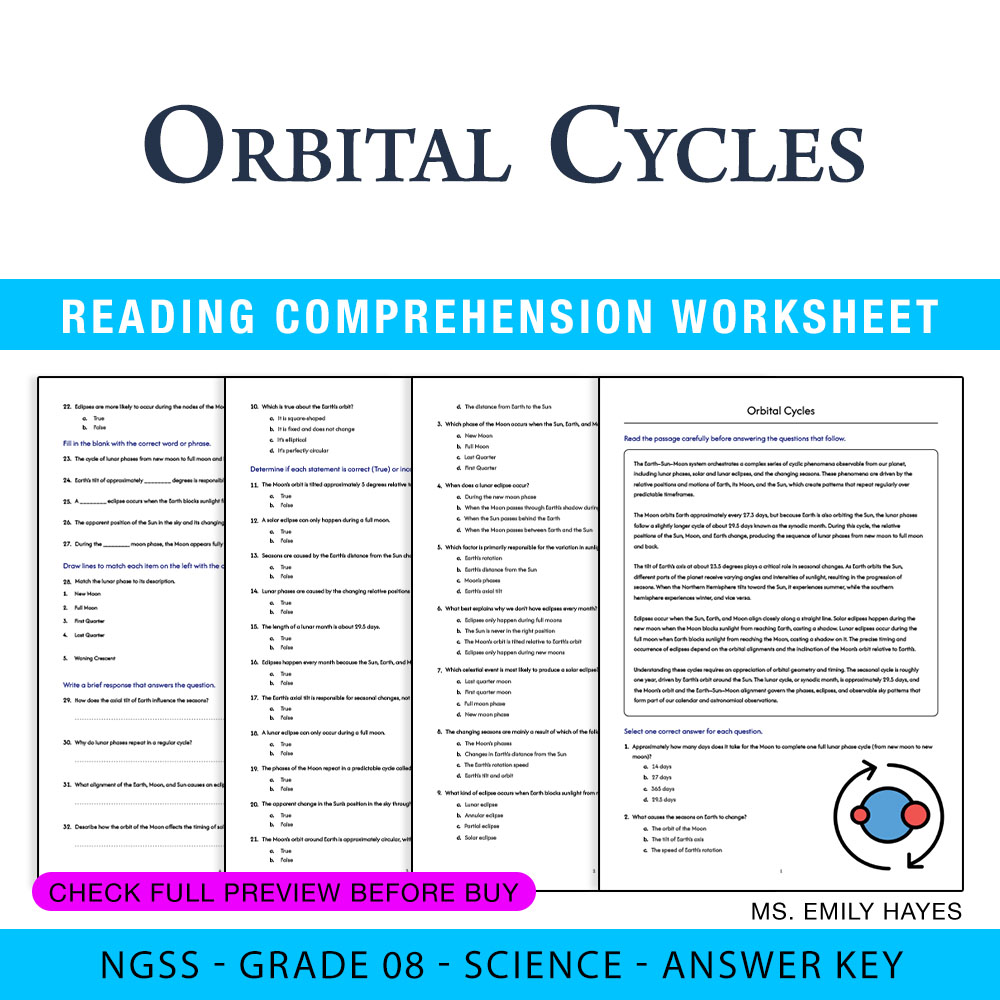
Teachers often face the challenge of making complex celestial phenomena engaging and understandable for Grade 8 students. This Orbital Cycles worksheet provides a comprehensive, print-ready resource that helps students explore and master key concepts related to the Earth's and Moon's movements, orbital mechanics, seasonal changes, and cyclic phenomena like lunar phases and eclipses. With this carefully designed worksheet, educators can confidently facilitate interactive lessons that promote critical thinking, reinforce scientific understanding, and align with Next Generation Science Standards (NGSS).
Why Teachers Love This
✅ Saves valuable prep time with ready-to-print, high-quality content specifically designed for classroom use
✅ Enables seamless, easy implementation—print-and-go materials that fit into busy schedules
✅ Encourages active student engagement through varied question formats
✅ Fully aligned with NGSS, ensuring coverage of essential standards and concepts
Why Students Succeed With This
✅ Clear, concise instructions guide students through complex topics like orbital mechanics and lunar cycles without confusion
✅ Diverse question types reading passages, multiple choice, true/false, fill-in-the-blank, matching, and short answer cater to different learning styles and deepen understanding
✅ Contextual examples and real-world scenarios connect science concepts to everyday life and celestial events
✅ Builds confidence through scaffolded learning, culminating in analytical essays where students synthesize ideas and demonstrate comprehension
What You Get
Prepared, printable PDF worksheet and PDF answer key with rubric, including:
• Engaging reading passage explaining the Earth–Sun–Moon system and cyclic phenomena
• 10 multiple choice questions testing knowledge of lunar cycles, seasons, and orbital dynamics
• 12 true/false questions to clarify common misconceptions about lunar and solar eclipses
• 5 fill-in-the-blank activities reinforcing key facts about lunar phases and Earth's tilt
• 1 matching exercise to review lunar phases and their descriptions
• 5 short answer questions encouraging critical thinking on orbital influences and cyclic repetition
• 2 essay prompts for deep synthesis of orbital motion, cyclic phenomena, and celestial event prediction
Key Learning Objectives
Students will master these core skills:
➡️ Describe the orbital relationship between Earth, Moon, and Sun
➡️ Explain the causes of lunar phases and seasons on Earth
➡️ Identify factors influencing eclipse timings and occurrences
➡️ Analyze the importance of orbital geometry for predicting celestial phenomena
Ideal Usage
This worksheet is perfect for classroom practice, homework, or review sessions. Its print-ready format ensures quick, easy deployment in in-person lessons, whether used for whole-class instruction, small-group activities, or individual student work. It also supports reinforcement during science stations or as a formative assessment to gauge understanding of complex orbital concepts.
Boost student mastery of orbital cycles and celestial phenomena with this practical, stand-alone worksheet that promotes critical thinking and deepens understanding. Prepare students for more advanced astronomy topics and help them connect celestial mechanics to real-world observations! 🚀