
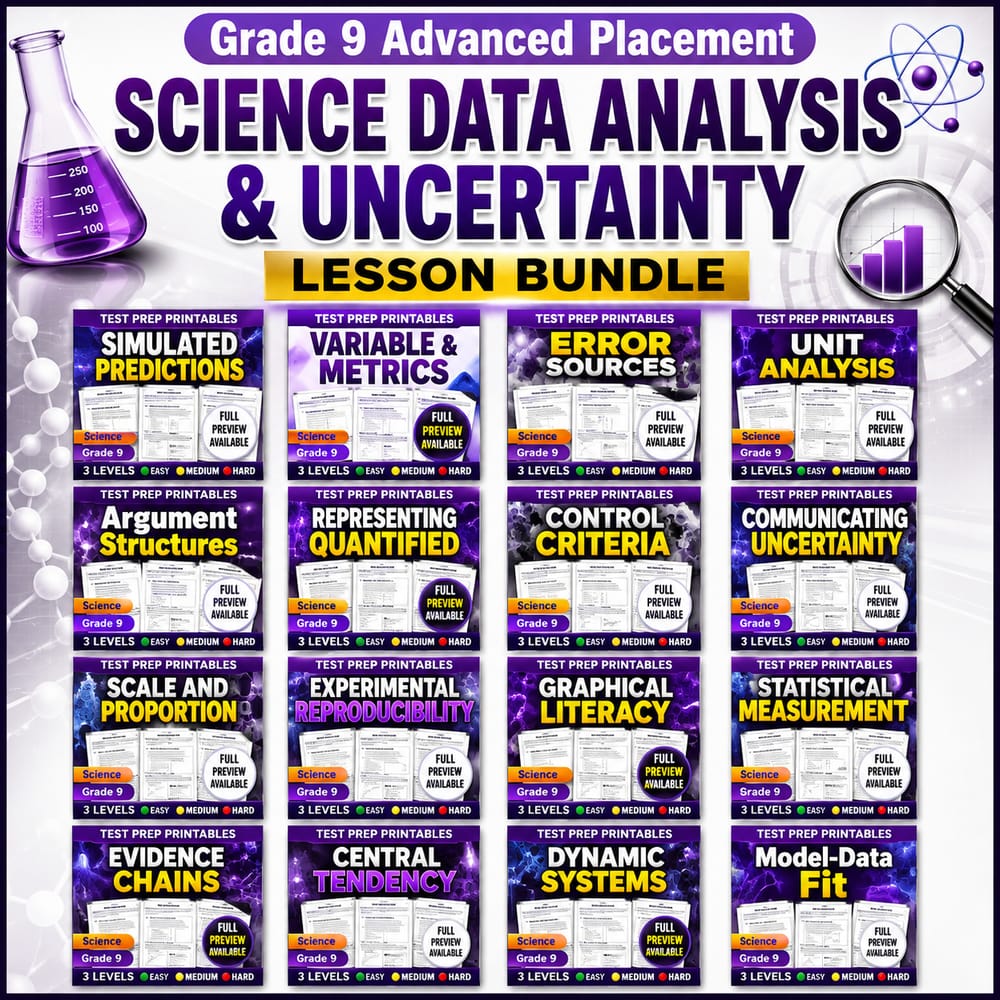


Grade 9 Advanced Placement Science Data Analysis & Uncertainty Lesson Bundle
$64.00$80.00Save $16.00
Prism Point Learning
·2 followers·13 sales
SubjectScienceGradeGrade 9
What’s included
16 worksheets · Save $16.00 (20%) · prices shown inside the bundle
 Simulated Predictions Worksheet | AP Science Modeling & Data Analysis
- Explain how computational simulations use hypothesized mechanisms to generate testable predictions.
- Describe how changing model parameters affects outcomes and how ensembles represent uncertainty.
- Compare simulation outputs with empirical data to refine models and evaluate robustness.
$4.00$5.00 Variability Metrics Worksheet | AP Science Data Analysis Grade 9
- Explain how variance, standard deviation, range, and interquartile range measure spread in data
- Use the coefficient of variation to compare variability across measurements with different units or scales
- Interpret how overlapping distributions and quantified variability affect the strength of evidence in sampling and hypothesis comparisons
$4.00$5.00 Error Sources Worksheet | Scientific Uncertainty & Bias AP Science
- Identify common sources of systematic and random error in scientific measurements and studies, including instrument bias, sampling limitations, confounding, and model mis-specification.
- Use evidence such as cross-method comparisons and residual patterns to detect bias and assess how robust conclusions are to error sources.
- Explain how quantified errors contribute to overall uncertainty and compare support for alternative explanations transparently.
$4.00$5.00 Unit Analysis Worksheet | Dimensional Analysis & AP Science Practice
- Use dimensional analysis to check whether a derived formula is consistent with the units of each quantity.
- Derive relationships between physical quantities by forming ratios and ensuring unit cancellation.
- Identify algebraic or modeling mistakes by tracking units during scaling and rate calculations.
$4.00$5.00 Argument Structures Science Worksheet | CER Claims Evidence Reasoning AP
- Construct scientific arguments using claim, evidence, and reasoning with clear logical links.
- Critique arguments by checking relevance of evidence, coherence of reasoning, and consideration of alternatives.
- Evaluate scientific explanations using quantitative evidence, model comparisons, and stated uncertainty and assumptions.
$4.00$5.00 Uncertainty Quantified Worksheet | AP Science Data Analysis Grade 9
- Explain the difference between random and systematic uncertainty using statistical descriptors.
- Compute and interpret standard deviation, standard error, and confidence intervals.
- Use basic error propagation rules to estimate uncertainty in derived quantities.
$4.00$5.00 Control Criteria Worksheet | Experimental Design AP Science Grade 9
- Explain how isolating variables and using reference conditions support causal interpretation.
- Describe why replication and baseline characterization increase the credibility of results.
- Identify how residual confounding and uncontrolled variation weaken causal claims, even when patterns appear.
$4.00$5.00 Communicating Uncertainty Worksheet | AP Science Data Analysis Grade 9
- Describe how to report quantitative uncertainty using confidence/interval language in scientific claims.
- Use and interpret effect sizes, likelihood statements, and variability visualizations to avoid misleading conclusions.
- Identify assumptions, limits of extrapolation, and alternative explanations when interpreting data and models.
$4.00$5.00 Scale and Proportion Worksheet | AP Science Modeling & Scaling Laws
- Explain how scaling affects relationships between physical quantities when moving between small and large systems.
- Use dimensional similarity and proportional reasoning to predict how a model’s measurements should change with size.
- Interpret data trends while accounting for scale-dependent effects such as nonlinearity and diffusion limits.
$4.00$5.00 Representation Models Worksheet | AP Science Modeling Skills Grade 9
- Describe how different model representations (equations, graphs, schematic diagrams, and computational approximations) capture system behavior.
- Evaluate models using criteria such as representational fidelity, parsimony, and predictive scope.
- Explain how mapping between model components and measurable observables supports interpretation of evidence.
$4.00$5.00
Reviews & Feedback
Loading reviews...
Questions & Answers
Loading questions…
About this bundle
Related categories
Frequently asked questions
Who is Grade 9 Advanced Placement Science Data Analysis & Uncertainty Lesson Bundle designed for?
Grade 9 Advanced Placement Science Data Analysis & Uncertainty Lesson Bundle is designed for Grade 9 students and Science learners and can be used in classrooms, homeschool, or independent practice.
How do I download Grade 9 Advanced Placement Science Data Analysis & Uncertainty Lesson Bundle?
Add it to your cart and complete checkout. After payment, you can download immediately from your account, and you'll also receive a download link by email.
Similar Products

Scientific Reasoning & Data Analysis Lesson Bundle Grade 11 Science Advanced Placement
$48.00$60.00

Grade 11 Physics Principles Science Lesson Bundle | Advanced Placement (AP)
$38.40$48.00

Grade 10 Earth Systems Science lesson bundle | Advanced Placement (AP) Practice
$36.00$45.00

Grade 11 Physics Motion & Energy Science Lesson Bundle | Advanced Placement (AP)
$48.00$60.00

Physics Principles Reading Lesson Bundle Grade 10 Science Advanced placement
$52.00$65.00