
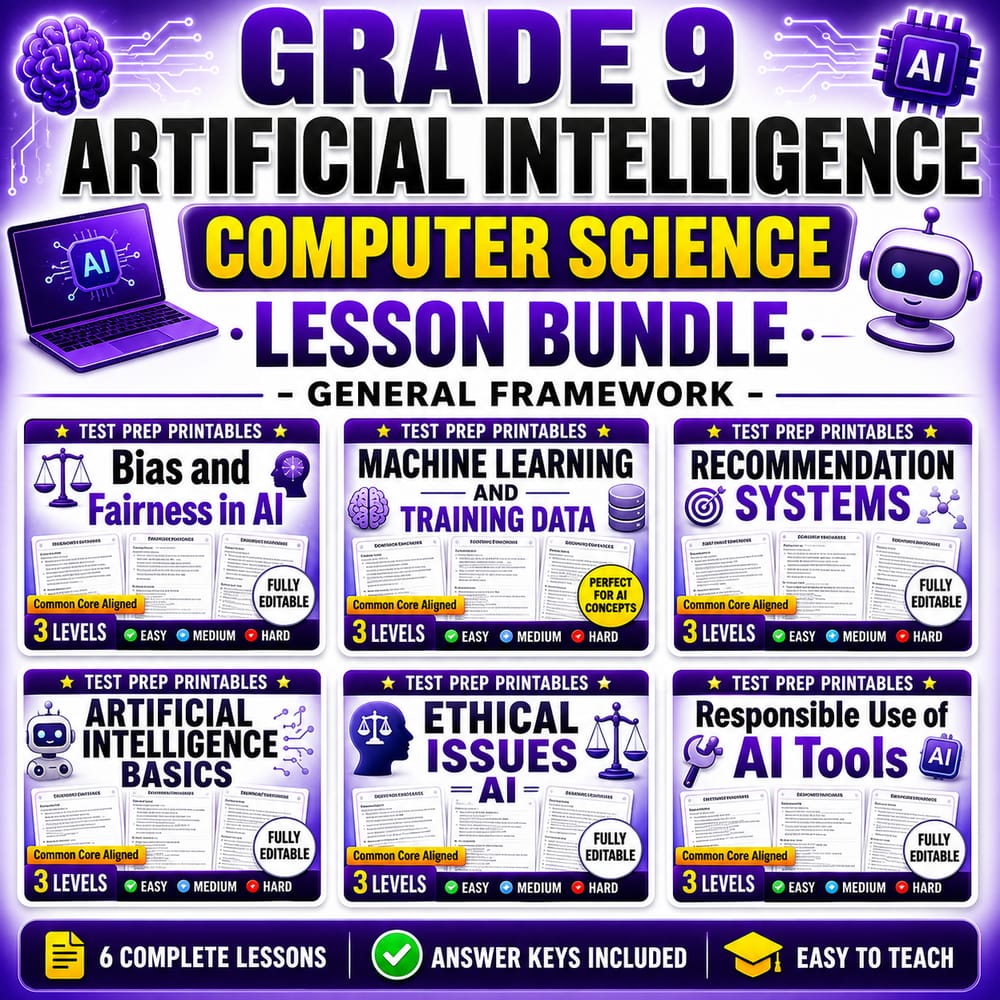
Grade 9 Artificial Intelligence Computer Science Lesson Bundle – General Framework
$24.00$30.00Save $6.00
Prism Point Learning
·2 followers·13 sales
SubjectComputer ScienceGradeGrade 9
What’s included
6 worksheets · Save $6.00 (20%) · prices shown inside the bundle
 Bias and Fairness in AI Computer Science Worksheet Grade 9
- Explain how bias can appear in AI when training data is incomplete or unbalanced.
- Use key vocabulary (bias, fairness, representation, outcome) to describe AI results.
- Identify ways to improve fairness by changing data collection and evaluation.
$4.00$5.00 Machine Learning and Training Data Computer Science Worksheet Grade 9
- Explain how machine learning uses training data to learn patterns for a model.
- Describe how the quality and variety of training data affect model results.
- Use key vocabulary such as machine learning, training data, model, and pattern in accurate statements.
$4.00$5.00 Recommendation Systems Worksheet | Grade 9 Computer Science Activity
- Explain how recommendation systems use data patterns to suggest content and products.
- Use key vocabulary (recommendation, preference, suggestion, algorithm) accurately in context.
- Evaluate whether a statement about recommendation systems is true or false.
$4.00$5.00 Grade 9 Artificial Intelligence Basics Computer Science Worksheet
- Define artificial intelligence and describe how it can recognize patterns and make predictions.
- Identify common real-world examples of AI, such as recommendation systems and search tools.
- Explain key AI vocabulary terms: artificial intelligence, prediction, and pattern.
$4.00$5.00 Ethical Issues in AI Worksheet Grade 9 Computer Science Lesson
- Explain how privacy, transparency, accountability, and responsibility relate to ethical AI use
- Identify ethical risks when AI is used for decisions in school and society
- Describe steps that support responsible AI development and safer outcomes
$4.00$5.00 Grade 9 Responsible Use of AI Tools Computer Science Worksheet
- Explain why responsible AI use requires accuracy checks, critical thinking, and human judgment.
- Identify privacy risks and describe safe actions to protect personal information when using AI tools.
- Use key vocabulary (responsible, judgment, accuracy, privacy) to discuss ethical and safe AI practices.
$4.00$5.00
Reviews & Feedback
Loading reviews...
Questions & Answers
Loading questions…
About this bundle
Related categories
Frequently asked questions
Who is Grade 9 Artificial Intelligence Computer Science Lesson Bundle – General Framework designed for?
Grade 9 Artificial Intelligence Computer Science Lesson Bundle – General Framework is designed for Grade 9 students and Computer Science learners and can be used in classrooms, homeschool, or independent practice.
How do I download Grade 9 Artificial Intelligence Computer Science Lesson Bundle – General Framework?
Add it to your cart and complete checkout. After payment, you can download immediately from your account, and you'll also receive a download link by email.
Similar Products

Artificial Intelligence Worksheets Bundle | Grade 3 Computer Science
$14.40$18.00

Artificial Intelligence Ethics & AI Algorithms Lesson Bundle | Grade 7 CS | General
$24.00$30.00

Grade 10 Artificial Intelligence Lesson Bundle - Computer Science General
$24.00$30.00

Artificial Intelligence & Digital Ethics Lesson Bundle — Grade 6 Computer Science, General
$24.00$30.00

Grade 8 Computer Science AI & Responsible Use Lesson Bundle | General
$24.00$30.00