
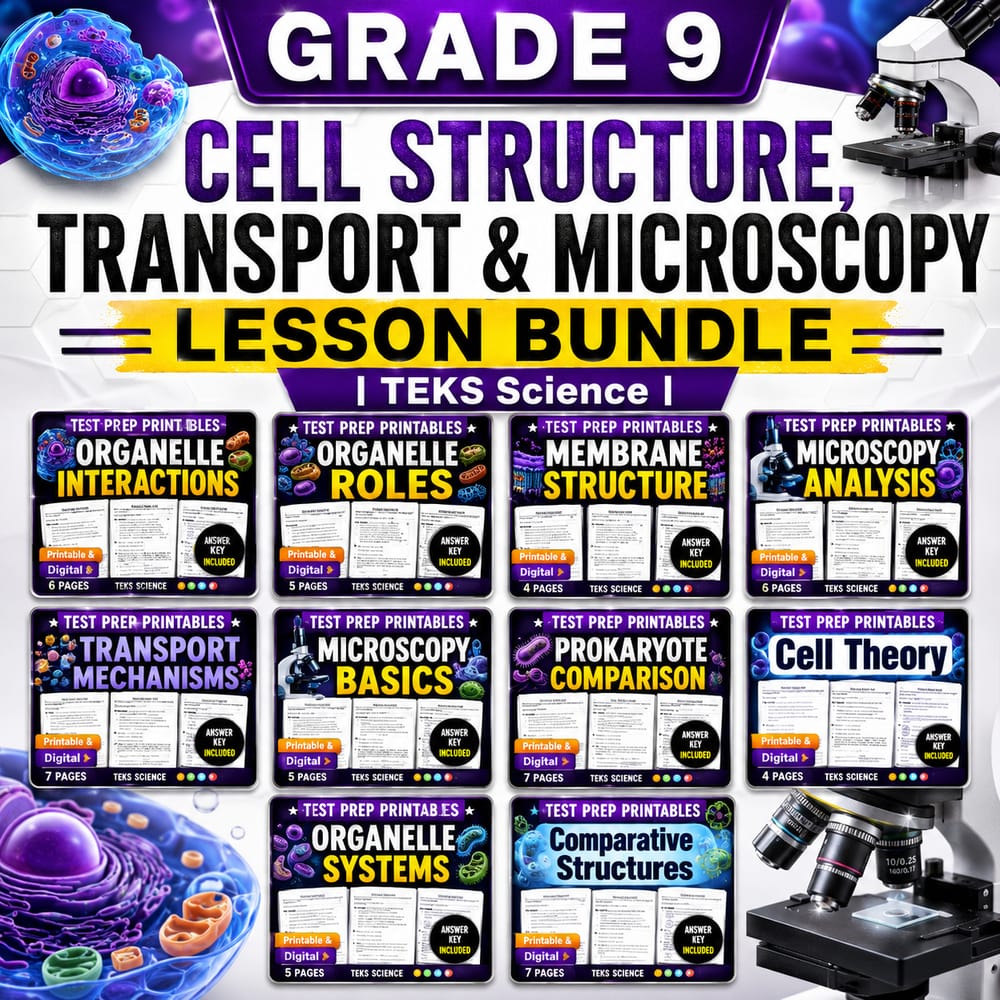
Grade 9 Cell Structure, Transport & Microscopy Lesson Bundle | TEKS Science
$40.00$50.00Save $10.00
Prism Point Learning
·2 followers·14 sales
SubjectScienceGradeGrade 9Pages310 Pages
What’s included
10 worksheets · 310 pages · Save $10.00 (20%) · prices shown inside the bundle
 Organelle Interactions Worksheet | Grade 9 Science Activities
- Explain how information and proteins move between the nucleus, rough endoplasmic reticulum, Golgi apparatus, and vesicles
- Describe how mitochondria, lysosomes, and peroxisomes support cellular energy, recycling, and detoxification
- Connect organelle interactions to maintaining cellular homeostasis
$4.00$5.00 Organelle Roles Worksheet | Grade 9 Science Activities
- Identify major eukaryotic organelles and describe their specific functions
- Explain how organelle structure and molecular composition support cellular tasks
- Connect organelle roles to how different tissues carry out specialized activities
$4.00$5.00 Membrane Structure Worksheet | Grade 9 Science Activities
- Explain how the phospholipid bilayer creates a selective barrier using hydrophobic and hydrophilic regions.
- Describe how integral and peripheral proteins support transport, signaling, and structure in membranes.
- Connect membrane fluidity and selective permeability to cholesterol and the fluid mosaic model.
$4.00$5.00 Microscopy Analysis Worksheet | Grade 9 Science Activities
- Interpret microscopy images using resolution limits, scale bars, and contrast features
- Use staining and fluorescence patterns to infer specific cellular structures or molecules
- Evaluate image sets over time while accounting for artifacts and measurement errors
$4.00$5.00 Transport Mechanisms Worksheet | Grade 9 Science Practice
- Explain how passive transport, facilitated diffusion, and osmosis move substances across cell membranes using concentration gradients.
- Describe how active transport uses membrane proteins and ATP to move substances against gradients.
- Compare vesicular transport (endocytosis and exocytosis) with transport through membrane proteins.
$4.00$5.00 Microscopy Basics Worksheet | Grade 9 Science Activities
- Explain how magnification, resolution, and contrast affect how microscope images appear.
- Compare how light microscopes and electron microscopes form magnified images.
- Interpret microscope images by using scale bars and recognizing how specimen preparation affects results.
$4.00$5.00 Prokaryote Comparison Worksheet | Grade 9 Science Activities
- Compare prokaryotic (bacteria and archaea) cell structures with eukaryotic cell structures.
- Explain how differences in compartmentalization and genetic arrangement affect cell organization.
- Identify key features such as nucleoid, nucleus, organelles, and chromosome type.
$4.00$5.00 Cell Theory Worksheet | Grade 9 Science Practice TEKS Standards
- Explain the three main ideas of cell theory and how they connect to living organisms
- Compare unicellular and multicellular organization in terms of structure and function
- Distinguish prokaryotic and eukaryotic cell features and relate structure to function
$4.00$5.00 Organelle Systems Worksheet | Grade 9 Science Activities
- Explain how multiple organelles work together as an integrated system rather than in isolation.
- Describe how transport and cell structure help move materials between organelles.
- Connect organelle cooperation to metabolism, cell maintenance, and cellular responses.
$4.00$5.00 Comparative Structures Worksheet | Grade 9 Science Activities
- Explain how organelle form and abundance vary across cell types and taxa.
- Connect structural adaptations (e.g., ER, mitochondria, vacuoles, cilia) to specialized cellular functions.
- Use comparative reasoning to predict how cell structure supports physiological roles and ecological strategies.
$4.00$5.00
Reviews & Feedback
Loading reviews...
Questions & Answers
Loading questions…
About this bundle
Related categories
Frequently asked questions
Who is Grade 9 Cell Structure, Transport & Microscopy Lesson Bundle | TEKS Science designed for?
Grade 9 Cell Structure, Transport & Microscopy Lesson Bundle | TEKS Science is designed for Grade 9 students and Science learners and can be used in classrooms, homeschool, or independent practice.
How do I download Grade 9 Cell Structure, Transport & Microscopy Lesson Bundle | TEKS Science?
Add it to your cart and complete checkout. After payment, you can download immediately from your account, and you'll also receive a download link by email.
Similar Products

Grade 9 Science Unit | Cell Structures & Transport Mechanisms Pack(TEKS-Aligned)
$24.00$30.00

Grade 10 Cell Structure & Function Science Worksheets Bundle | TEKS Biology
$32.00$40.00

Grade 10 Science Lesson Bundle: Photosynthesis & Cellular Respiration TEKS
$24.00$30.00

Grade 9 Cell Structure and Function Biology Worksheets Bundle | TEKS
$40.00$50.00

Grade 9 Science Lesson Bundle: Photosynthesis & Cellular Respiration TEKS
$40.00$50.00