
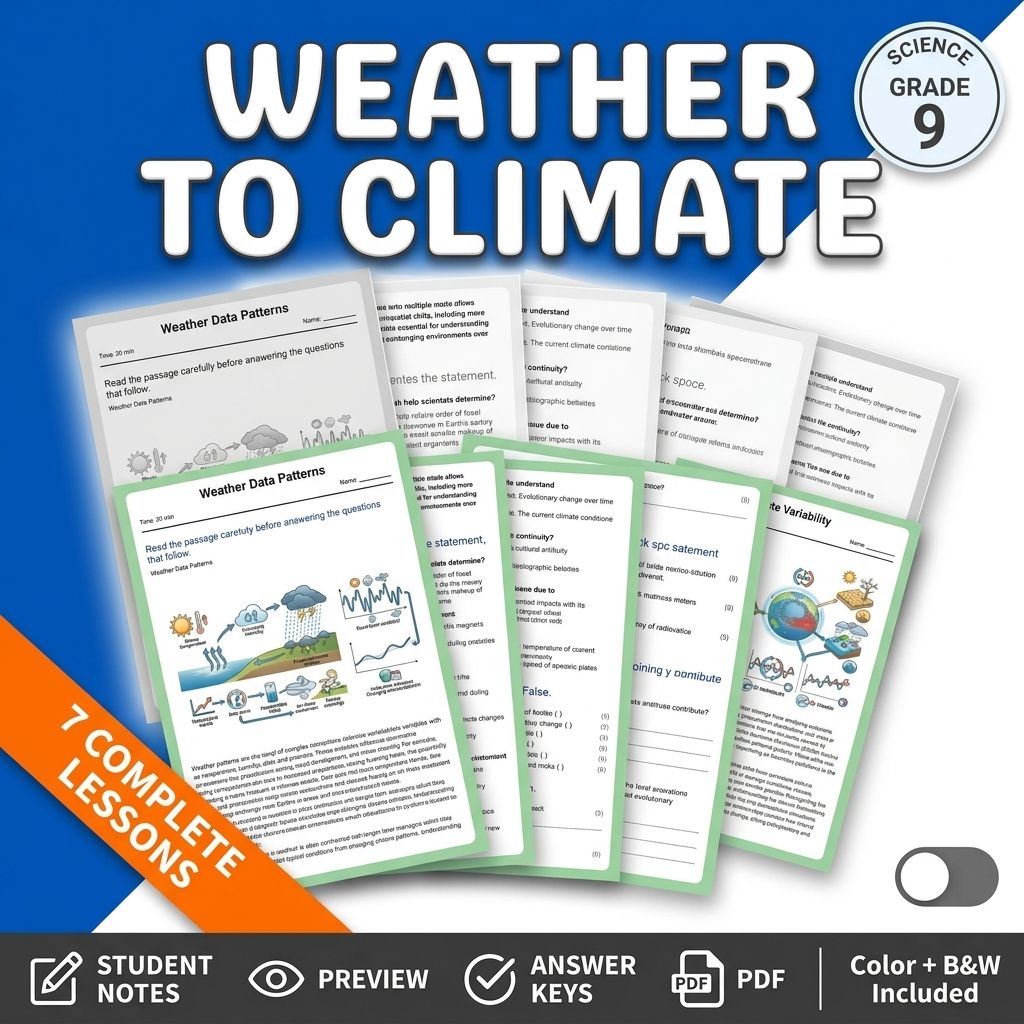
Grade 9 Earth & Space Science Lesson Bundle | General Framework Assessments
$28.00$35.00Save $7.00
Prism Point Learning
·2 followers·13 sales
SubjectScienceGradeGrade 9
What’s included
7 worksheets · Save $7.00 (20%) · prices shown inside the bundle
 Reservoirs and Feedback Assessment for Grade 9 Science | General
- Understand how reservoirs in the carbon and water cycles influence environmental processes.
- Explain the role of feedback mechanisms in climate systems.
- Analyze the impact of energy flow on evaporation, winds, and temperature.
$4.00$5.00 Weather Data Patterns Assessment | General Grade 9 Science Standards
- Understand how atmospheric conditions relate to observable weather patterns.
- Analyze data sets including temperature, humidity, and precipitation to identify relationships.
- Explain the impact of air mass movement and energy exchange on weather variability.
$4.00$5.00 Earth System Cycles Assessment | General Grade 9 Science Standards
- Describe the processes involved in water and carbon cycles within Earth's systems.
- Explain how solar radiation and Earth's radiation balance influence climate and weather.
- Identify reservoirs and pathways of matter and energy in Earth's cycles.
$4.00$5.00 Gravity and Orbits Assessment for Grade 9 Science | Standards-Aligned
- Understand how gravity influences planetary and lunar motion in the solar system.
- Describe the relationship between orbital speed, distance from the Sun, and gravitational force.
- Explain how gravitational attraction provides the centripetal force for orbiting bodies.
$4.00$5.00 Seasons and Day Length Assessment | General Grade 9 Science Standards
- Understand how Earth's axial tilt and orbit around the Sun cause seasonal changes.
- Explain how the angle of sunlight and day length vary with Earth's position in its orbit.
- Describe the relationship between solar energy received and Earth's seasons.
$4.00$5.00 Moon Phases and Eclipses Assessment | General Standards | Grade 9 Science
- Understand the relative motions of the Moon, Earth, and Sun that produce different Moon phases.
- Explain how the geometry of the Earth-Moon-Sun system causes eclipses.
- Describe the reasons why eclipses do not happen every month.
$4.00$5.00 Climate Variability Assessment for Grade 9 Science | Standards-Aligned
- Understand the concept of longer-term climate patterns and their significance.
- Interpret weather-related data such as temperature, precipitation, and wind to identify trends.
- Explain how phenomena like El Niño influence regional weather and climate variability.
$4.00$5.00
Reviews & Feedback
Loading reviews...
Questions & Answers
Loading questions…
About this bundle
Related categories
Frequently asked questions
Who is Grade 9 Earth & Space Science Lesson Bundle | General Framework Assessments designed for?
Grade 9 Earth & Space Science Lesson Bundle | General Framework Assessments is designed for Grade 9 students and Science learners and can be used in classrooms, homeschool, or independent practice.
How do I download Grade 9 Earth & Space Science Lesson Bundle | General Framework Assessments?
Add it to your cart and complete checkout. After payment, you can download immediately from your account, and you'll also receive a download link by email.
Similar Products

Grade 8 Weather and Earth-Space Science Assessment Lesson Bundle TEKS
$36.00$45.00

Grade 7 Science Space, Gravity, and Earth History Lesson Bundle | NGSS
$16.00$20.00

Grade 11 Space & Earth Systems Science Daily Reading Lesson Bundle | General
$22.40$28.00

Grade 12 Science Lesson Bundle: Space, Earth Systems, and Climate (General)
$16.00$20.00

Grade 7 Space, Gravity & Earth Processes Science Lesson Bundle (NGSS)
$12.80$16.00