
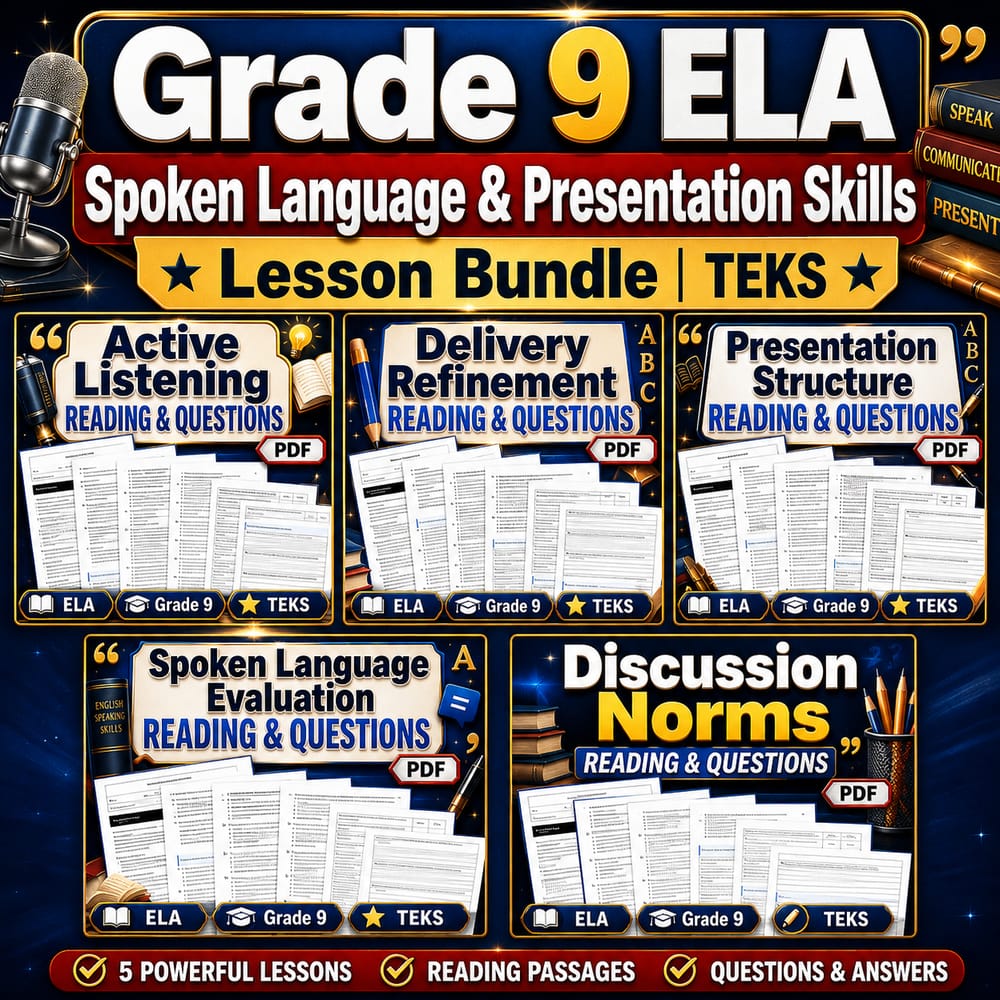
Grade 9 ELA Spoken Language & Presentation Skills Lesson Bundle | TEKS
$16.00$20.00Save $4.00
Golden Apple Studio
New·2 followers·3 sales
SubjectELAGradeGrade 9Pages80 Pages
What’s included
5 worksheets · 80 pages · Save $4.00 (20%) · prices shown inside the bundle
 Active Listening Worksheet for Grade 9 ELA | TEKS Speaking Skills
- Identify a speaker’s main idea and distinguish it from supporting details during conversations or interviews.
- Use active listening clarification strategies (e.g., asking “Do you mean…?” and briefly restating) to confirm understanding.
- Recognize how tone shifts, emphasis, and organization (cause vs. solution) affect meaning.
$3.20$4.00 Grade 9 Delivery Refinement Worksheet | TEKS Speaking & Presentation
- Refine delivery by aligning vocal expression, pacing, and emphasis with a spoken message
- Use intentional pauses to highlight key ideas and maintain audience attention
- Strengthen presentations by connecting evidence to conclusions and responding to feedback
$3.20$4.00 Grade 9 Presentation Structure Worksheet | TEKS Speaking & ELA
- Identify the parts of an effective presentation (introduction, organized main points, transitions, and conclusion).
- Use topic sentences and logical sequencing to make relationships among ideas clear.
- Connect evidence to a claim through brief explanations and effective transitions.
$3.20$4.00 Spoken Language Evaluation Worksheet for Grade 9 ELA | TEKS Skills
- Evaluate spoken claims by checking whether evidence, examples, or data support the stated purpose.
- Assess how accurately a speaker uses key terms and whether reasoning stays coherent and logically connected.
- Identify bias, loaded wording, and missing context when evaluating credibility in spoken messages.
$3.20$4.00 Discussion Norms Worksheet for Grade 9 ELA | TEKS Speaking Skills
- Explain how effective discussion norms support turn-taking, staying on topic, and respectful communication.
- Use precise language to address the discussion prompt and connect ideas to previous remarks.
- Evaluate sample discussion statements and revise them to better meet audience needs and conversation goals.
$3.20$4.00
Reviews & Feedback
Loading reviews...
Questions & Answers
Loading questions…
About this bundle
Related categories
Frequently asked questions
Who is Grade 9 ELA Spoken Language & Presentation Skills Lesson Bundle | TEKS designed for?
Grade 9 ELA Spoken Language & Presentation Skills Lesson Bundle | TEKS is designed for Grade 9 students and ELA learners and can be used in classrooms, homeschool, or independent practice.
How do I download Grade 9 ELA Spoken Language & Presentation Skills Lesson Bundle | TEKS?
Add it to your cart and complete checkout. After payment, you can download immediately from your account, and you'll also receive a download link by email.
