
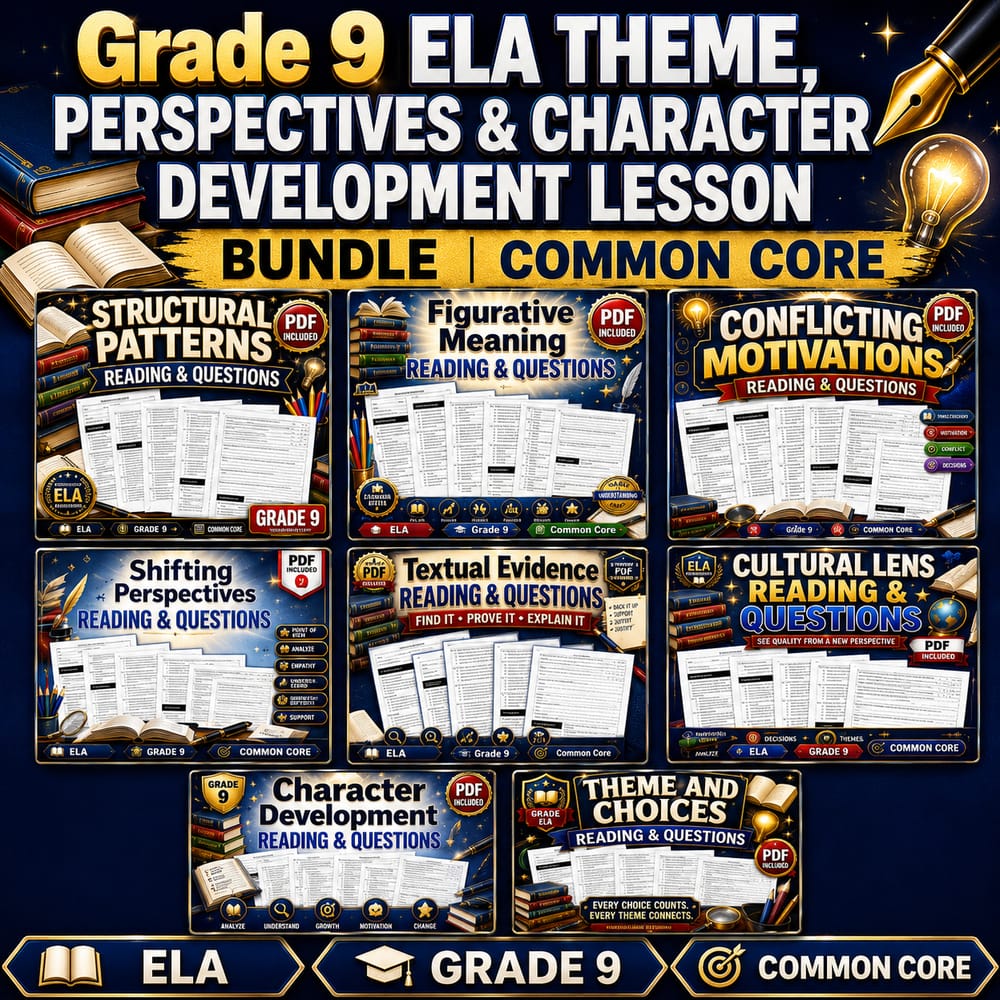
Grade 9 ELA Theme, Perspectives & Character Development Lessons | Common Core
$25.60$32.00Save $6.40
Golden Apple Studio
New·2 followers·3 sales
SubjectELAGradeGrade 9
What’s included
8 worksheets · Save $6.40 (20%) · prices shown inside the bundle
 Grade 9 ELA Worksheets | Understanding Structural Patterns (PDF)
- Analyze how an author’s structural choices (ordering, division into scenes/chapters, and recurring patterns) shape meaning.
- Explain how pacing changes when information is revealed early versus delayed for suspense.
- Use evidence from a text to describe connections between parts and the whole structure.
$3.20$4.00 Grade 9 ELA | Figurative Language Worksheet (CCSS) with Answer Key (Worksheet + Answer Key)
- Identify how word choice and figurative language create meanings beyond the literal level.
- Analyze how metaphors, similes, personification, symbolism, and imagery connect to mood, theme, and character perspective.
- Explain how diction choices (sensory verbs, concrete nouns, and charged abstract words) shape interpretation.
$3.20$4.00 Grade 9 ELA | Conflicting Motivations Worksheet (PDF) for Reading & Analysis
- Analyze how conflicting motivations shape a character’s decisions and reveal deeper purpose.
- Use textual evidence from dialogue, tone, and emotional reactions to track shifts in motivation.
- Evaluate how pressure changes what a character chooses to protect or pursue.
$3.20$4.00 Grade 9 ELA - Shifting Perspectives Worksheet (PDF) – CCSS Aligned
- Analyze how changes in perspective (narration, focalization, and character viewpoints) alter a reader’s interpretation of events.
- Compare two accounts of the same moment to identify what each perspective emphasizes or omits.
- Develop a claim about theme or author intent supported by evidence from viewpoint shifts.
$3.20$4.00 Grade 9 ELA Textual Evidence Worksheet – Common Core (PDF)
- Use close reading to identify claims and select the strongest textual evidence that matches the claim.
- Evaluate quotations, paraphrases, and specific references (plot, setting, dialogue) for accuracy and relevance.
- Explain how evidence supports reasoning by describing the effect of exact wording in a scene.
$3.20$4.00 Grade 9 ELA Worksheet | Analyzing Cultural Lens & Point of View (CCSS)
- Analyze how point of view shapes meaning, including motives, stakes, and values in a text.
- Evaluate how cultural experience and identity influence what a narrator emphasizes, withholds, or frames as normal.
- Use evidence from narration and speaker perspective to make interpretations about bias and social pressure.
$3.20$4.00 Grade 9 ELA Character Development Worksheet | Common Core (PDF)
- Analyze how a character’s actions and relationships reveal traits and change over time.
- Explain how internal and external forces influence motivation, beliefs, and moral boundaries.
- Evaluate how author craft—especially changing language in dramatic scenes—signals growth or contradiction.
$3.20$4.00 Grade 9 ELA | Theme and Choices Worksheet (PDF) – CCSS Aligned
- Explain how an author’s choices shape theme (especially through conflict, imagery, pacing, and character development)
- Trace how a central idea becomes clearer across a text by citing patterns in decisions and events
- Analyze how a text’s structure supports its theme by connecting turning points to later outcomes
$3.20$4.00
Reviews & Feedback
Loading reviews...
Questions & Answers
Loading questions…
About this bundle
Related categories
Frequently asked questions
Who is Grade 9 ELA Theme, Perspectives & Character Development Lessons | Common Core designed for?
Grade 9 ELA Theme, Perspectives & Character Development Lessons | Common Core is designed for Grade 9 students and ELA learners and can be used in classrooms, homeschool, or independent practice.
How do I download Grade 9 ELA Theme, Perspectives & Character Development Lessons | Common Core?
Add it to your cart and complete checkout. After payment, you can download immediately from your account, and you'll also receive a download link by email.
Similar Products

Grade 9 Theme, Choices & Character Development Lesson Bundle | CCSS ELA
$19.20$24.00

Grade 10 Theme, Evidence & Character: ELA Lesson Bundle, Common Core (CCSS)
$19.20$24.00

Theme, Text Evidence & Character Development Lesson Bundle | Grade 4 ELA | Common Core
$19.20$24.00

Theme, Plot, & Character Development Lesson Bundle | Grade 4 ELA | Common Core
$25.60$32.00

Grade 5 Theme, Characters, and Text Evidence ELA Lesson Bundle (CCSS)
$26.40$33.00