
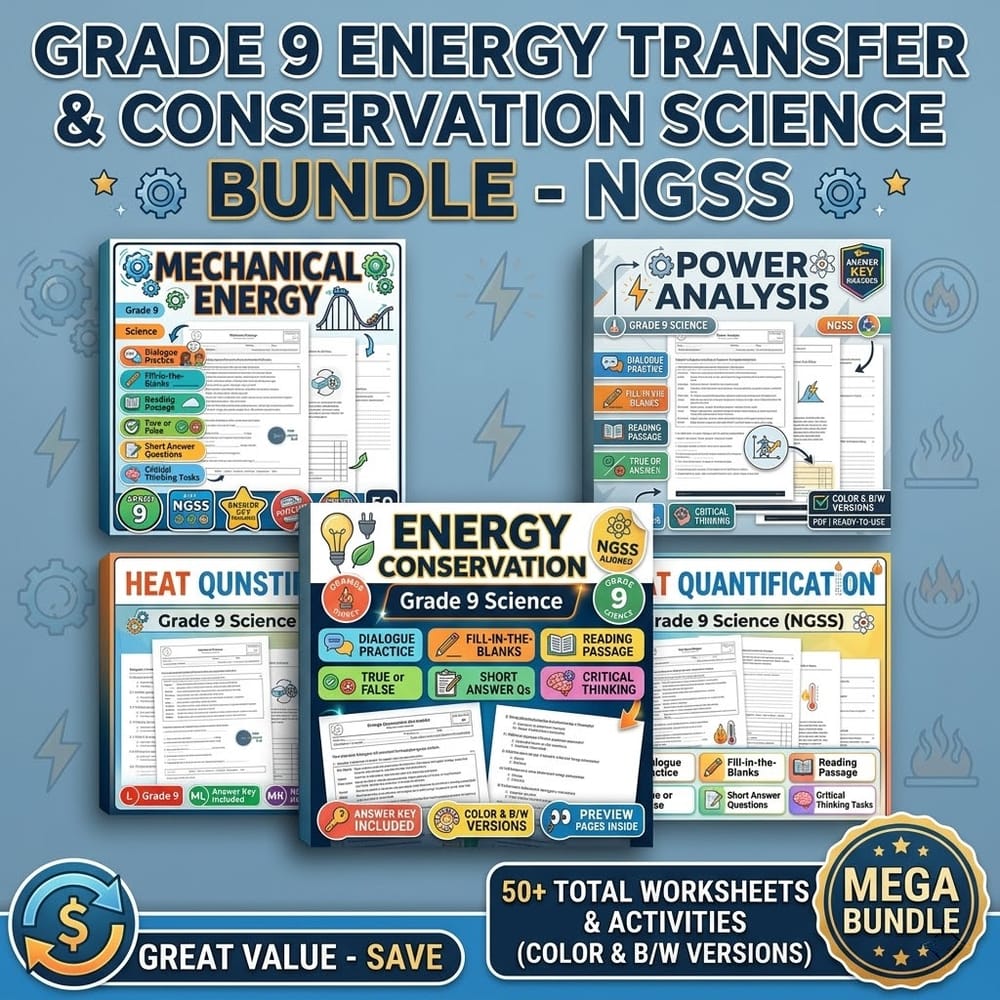
Grade 9 Energy Transfer & Conservation Science Lesson Bundle – NGSS
$16.00$20.00Save $4.00
J.S Sheets
New·3 followers·24 sales
SubjectScienceGradeGrade 9Pages36 Pages
What’s included
4 worksheets · 36 pages · Save $4.00 (20%) · prices shown inside the bundle
 Mechanical Energy Worksheet for Grade 9 Science | NGSS Aligned Practice
- Understand the concepts of kinetic and potential energy and their mathematical relationships.
- Apply the work-energy principle to analyze mechanical systems involving motion and height.
- Explain the role of power as the rate of energy transfer in mechanical processes.
$4.00$5.00 Power Analysis Worksheet for Grade 9 Science | NGSS-aligned Assessment
- Understand the distinction between power and energy in systems.
- Calculate energy demand over time considering efficiency and losses.
- Compare power ratings of household appliances and their energy consumption.
$4.00$5.00 Energy Conservation Worksheet | NGSS-Aligned Grade 9 Science Practice
- Understand the concept of energy conservation in closed and open systems.
- Identify and interpret energy flow diagrams and mathematical representations of energy transfers.
- Explain how energy reservoirs and system boundaries relate to total energy constancy.
$4.00$5.00 Heat Quantification Worksheet | NGSS Grade 9 Science Assessment
- Understand the mathematical representations of heat transfer and internal energy changes.
- Apply specific heat capacity, mass, and temperature change formulas to calculate thermal energy transfer.
- Explain sign conventions for energy flow in heat transfer processes.
$4.00$5.00
Reviews & Feedback
Loading reviews...
Questions & Answers
Loading questions…
About this bundle
Related categories
Frequently asked questions
Who is Grade 9 Energy Transfer & Conservation Science Lesson Bundle – NGSS designed for?
Grade 9 Energy Transfer & Conservation Science Lesson Bundle – NGSS is designed for Grade 9 students and Science learners and can be used in classrooms, homeschool, or independent practice.
How do I download Grade 9 Energy Transfer & Conservation Science Lesson Bundle – NGSS?
Add it to your cart and complete checkout. After payment, you can download immediately from your account, and you'll also receive a download link by email.
Similar Products

Energy Transfer, Conversion & Conservation Lesson Bundle | Grade 11 Science | NGSS
$14.00$20.00

Grade 9 Science Energy Conservation & Transfer Lesson Bundle – NGSS
$20.00$25.00

Grade 11 Energy Transfer & Conservation Science Lesson Bundle (NGSS)
$20.00$25.00

Grade 8 Energy Conservation and Transfer Science Lesson Bundle: NGSS
$20.00$25.00

Grade 8 Science Thermal Transfer & Energy Conservation Lesson Bundle | NGSS
$20.00$25.00