
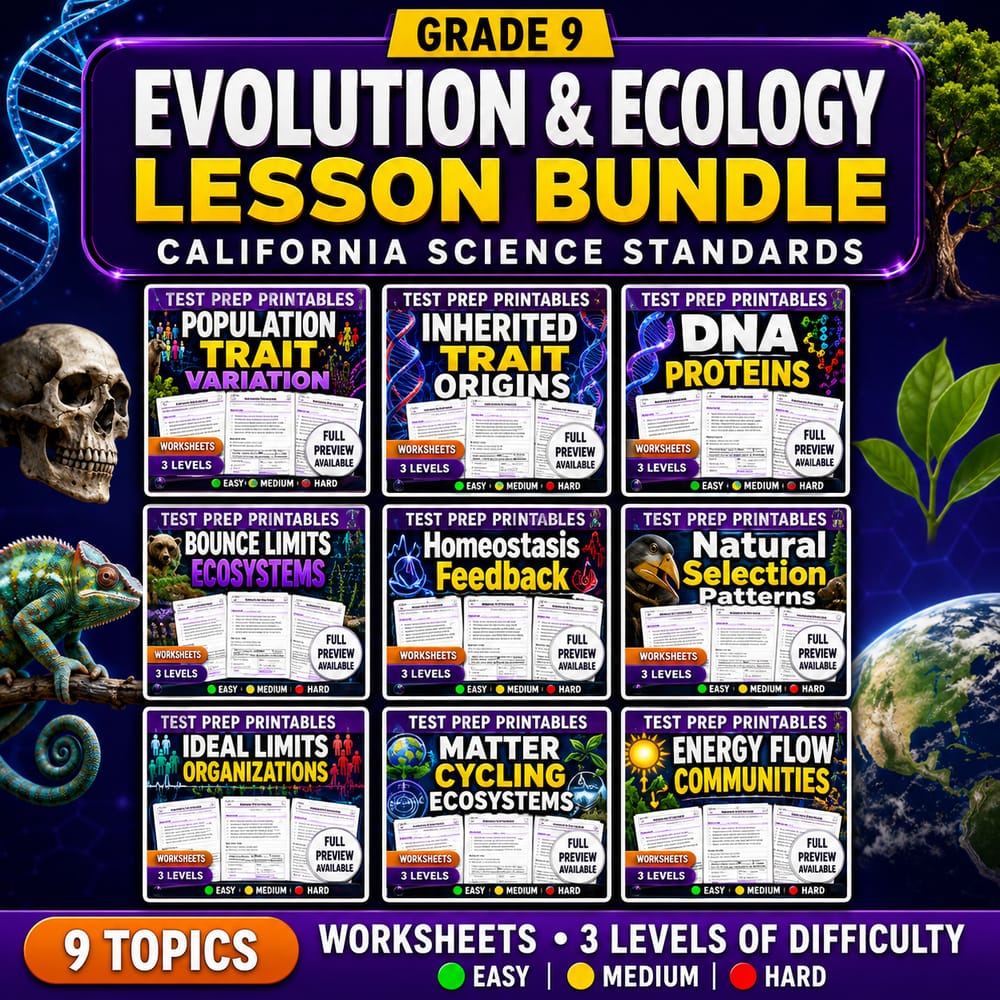
Grade 9 Evolution & Ecology Lesson Bundle | California Science Standards
$40.00$50.00Save $10.00
Prism Point Learning
·2 followers·14 sales
SubjectScienceGradeGrade 9Pages307 Pages
What’s included
10 worksheets · 307 pages · Save $10.00 (20%) · prices shown inside the bundle
 Population Trait Variation Worksheet | Evolution & Genetics Grade 9
- Explain how allele frequency and trait variation can appear as statistical patterns in populations
- Describe how mutations, gene interactions, and random processes create genetic diversity
- Connect natural selection to changes in trait representation from one generation to the next
$4.00$5.00 Inherited Trait Origins Worksheet | Genetics & Meiosis Grade 9 Science
- Explain how meiosis creates gametes with combinations of alleles from parents
- Describe how chromosome behavior during sexual reproduction contributes to inherited traits
- Connect genetic variation from recombination and heritable mutations to differences in offspring genotypes
$4.00$5.00 DNA to Proteins Worksheet | Grade 9 Genetics & Protein Synthesis Activity
- Explain how DNA sequences guide the production of proteins through transcription and translation.
- Describe how protein structure affects protein function inside cells.
- Connect changes in DNA (genotype) to changes in cell behavior and observable traits (phenotype).
$4.00$5.00 Biodiversity Limits Worksheet | Grade 9 Ecology Science Practice Activity
- Explain how limiting resources and ecological factors affect survival and reproduction in a community.
- Describe carrying capacity and how biotic interactions (competition and predation) influence population size.
- Predict how changes in environmental conditions can shift species abundance and community composition.
$4.00$5.00 Common Ancestry Evidence Worksheet | Grade 9 Evolution Science Activity
- Explain how anatomical, fossil, and molecular evidence support common ancestry.
- Describe how similarities and differences among traits can result from evolutionary divergence.
- Interpret molecular similarities as clues to evolutionary relationships.
$4.00$5.00 Homeostasis Feedback Systems Worksheet | Grade 9 Science Practice
- Explain how negative feedback helps maintain homeostasis when internal conditions change
- Identify the key parts of a feedback loop (set point, sensors, control center, effector)
- Compare homeostasis examples such as temperature, blood glucose, and oxygen delivery
$4.00$5.00 Natural Selection Patterns Worksheet | Evolution & Adaptation Grade 9
- Explain how heritable traits can affect survival and reproduction in a specific environment
- Describe how natural selection changes allele frequencies over multiple generations
- Interpret patterns in phenotypes across generations using simple population models
$4.00$5.00 Hierarchical Organization Worksheet | Grade 9 Biology Systems & Levels
- Explain how cells, tissues, organs, and organ systems form a hierarchy in multicellular organisms.
- Describe how functions at one level depend on functions at smaller levels.
- Use examples to connect structure to specific processes such as transport, support, regulation, and coordination.
$4.00$5.00 Matter Cycling in Ecosystems Worksheet | Grade 9 Ecology Science Activity
- Explain how matter moves through producers, consumers, and decomposers in an ecosystem.
- Describe how chemical elements are transformed and recycled while matter is conserved across trophic levels.
- Identify where nutrients and organic material enter and leave the cycling process (soil, water, and organisms).
$4.00$5.00 Energy Flow in Ecosystems Worksheet | Grade 9 Food Webs & Trophic Levels
- Explain how energy enters ecosystems and moves through trophic levels
- Describe why energy availability decreases at each trophic level
- Analyze how energy loss (such as heat and metabolism) limits biomass higher in food webs
$4.00$5.00
Reviews & Feedback
Loading reviews...
Questions & Answers
Loading questions…
About this bundle
Related categories
Frequently asked questions
Who is Grade 9 Evolution & Ecology Lesson Bundle | California Science Standards designed for?
Grade 9 Evolution & Ecology Lesson Bundle | California Science Standards is designed for Grade 9 students and Science learners and can be used in classrooms, homeschool, or independent practice.
How do I download Grade 9 Evolution & Ecology Lesson Bundle | California Science Standards?
Add it to your cart and complete checkout. After payment, you can download immediately from your account, and you'll also receive a download link by email.
Similar Products

Evolution, Genetics & Ecology Lesson Bundle | Grade 12 Science | California Standards
$56.00$70.00

Grade 10 Genetics & Evolution Science Lesson Bundle | California Standards
$44.80$56.00

Grade 12 Science UNIT Bundle: Molecular Genetics, Evolution & Ecology Activities
$36.00$45.00

Grade 7 Science Lesson Bundle | Biological Evolution: Unity and Diversity
$24.00$30.00

Grade 10 Genetic Variation and Evolution Science Lesson Bundle
$56.00$70.00