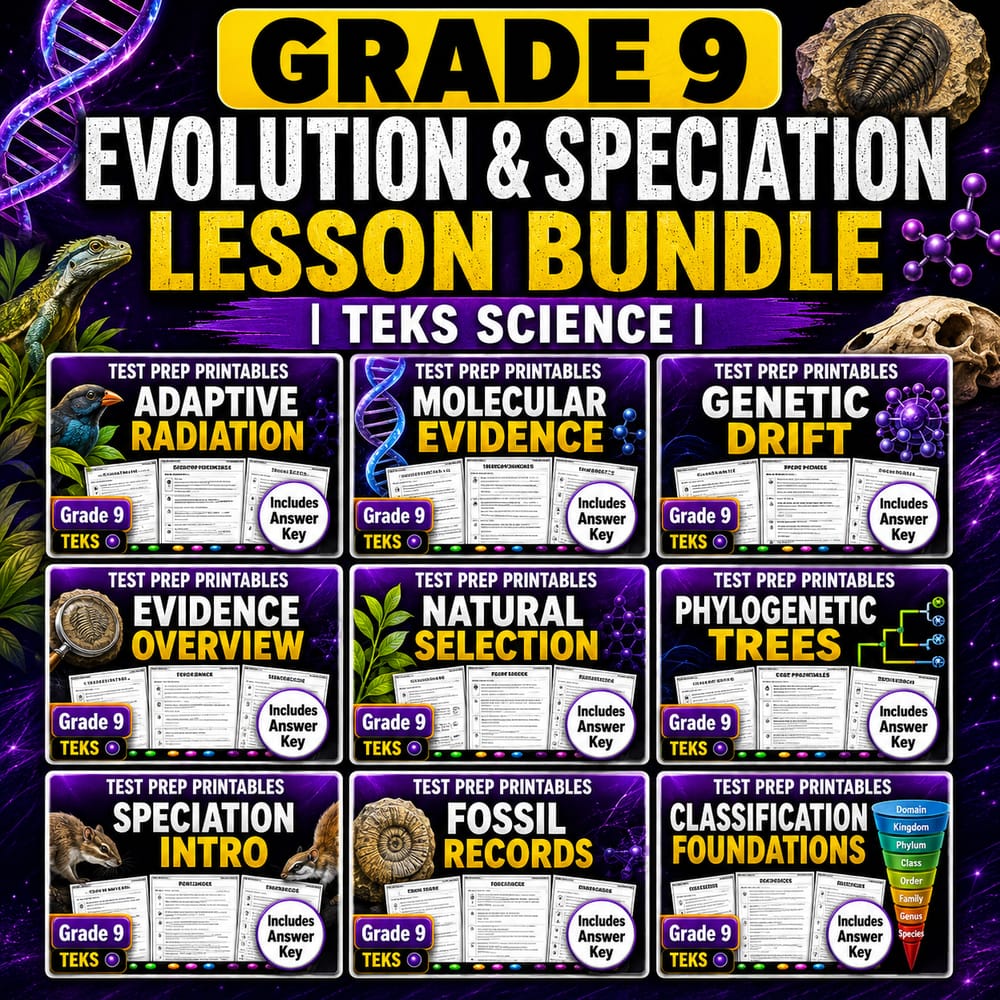
Grade 9 Evolution & Speciation Lesson Bundle | TEKS Science — bundle cover
Grade 9 Evolution & Speciation Lesson Bundle | TEKS Science — included worksheet 1
Grade 9 Evolution & Speciation Lesson Bundle | TEKS Science — included worksheet 2
Grade 9 Evolution & Speciation Lesson Bundle | TEKS Science — included worksheet 3
Grade 9 Evolution & Speciation Lesson Bundle | TEKS Science — included worksheet 4
Grade 9 Evolution & Speciation Lesson Bundle | TEKS Science — included worksheet 5
Grade 9 Evolution & Speciation Lesson Bundle | TEKS Science — included worksheet 6
Grade 9 Evolution & Speciation Lesson Bundle | TEKS Science — included worksheet 7
Grade 9 Evolution & Speciation Lesson Bundle | TEKS Science — included worksheet 8
Grade 9 Evolution & Speciation Lesson Bundle | TEKS Science — included worksheet 9
Grade 9 Evolution & Speciation Lesson Bundle | TEKS Science — included worksheet 10
Grade 9 Science worksheet — Grade 9 Evolution & Speciation Lesson Bundle | TEKS Science

Description

Overview


Grade 9 Evolution & Speciation sets students up to explain how species change over time using evidence-based evolution. This TEKS-aligned Science Lesson Bundle includes 11 worksheets that move from foundational terms to models of phylogeny, natural selection, genetic drift, and fossil evidence.

Designed for class-ready pacing, each worksheet supports reading, reasoning, and evidence-based explanations so students can connect patterns they observe (trees, traits, rocks, and data) to claims about how populations evolve.

What students learn

  • How speciation can result from different evolutionary processes.
  • How multiple types of evidence support evolutionary conclusions.
  • How to interpret and construct models such as phylogenetic trees.

Worksheets included: 11

What's Included


  • ✅ Speciation Intro Worksheet | Grade 9 Science Activities – Activates prior knowledge and introduces core vocabulary for explaining how new species form.
  • ✅ Phylogenetic Trees Worksheet | Grade 9 Science Practice – Builds skills to read tree diagrams and infer relationships among organisms.
  • ✅ Natural Selection Worksheet | Grade 9 Science Activities – Guides students through scenarios that show how differential survival changes traits.
  • ✅ Molecular Evidence Worksheet | Grade 9 Science Activities – Helps students use DNA/protein comparisons to make evidence-based claims.
  • ✅ Genetic Drift Worksheet | Grade 9 Science Activities – Explores how random events shift allele frequencies, especially in small populations.
  • ✅ Fossil Records Worksheet | Grade 9 Science Activities – Strengthens interpretation of fossil patterns to support explanations for evolutionary change.
  • ✅ Evolution Basics Worksheet | Grade 9 Science Activities – Reviews foundational ideas and helps students distinguish evolutionary change from individual change.
  • ✅ Evidence Overview Worksheet | Grade 9 Science Activities – Organizes multiple evidence sources into structured arguments about evolutionary relationships.
  • ✅ Classification Foundations Worksheet | Grade 9 Science Activities – Builds understanding of classification systems and how shared traits guide grouping.
  • ✅ Adaptive Radiation Worksheet | Grade 9 Science Practice TEKS – Applies TEKS-aligned reasoning to predict how one ancestor can diversify into many niches.
  • ✅ Adaptive Radiation Worksheet | Grade 9 Science Practice – Provides additional guided practice to reinforce adaptation and diversification across habitats.

Skills & Standards


Aligned to TEKS expectations for Grade 9 science, this unit emphasizes three dimensions: crosscutting concepts, disciplinary core ideas, and science practices. Students develop proficiency in modeling and analytical reasoning by interpreting phylogenetic trees, using evidence to support conclusions, and connecting patterns across time (fossil records), organisms (classification), and data sources (molecular comparisons).

Throughout the bundle, students practice making evidence-based explanations by identifying relevant information from each worksheet type, comparing how different processes (natural selection, genetic drift, and speciation pathways) influence populations, and justifying claims with observations from models and provided datasets. Students also strengthen core reasoning skills such as sequencing evolutionary ideas, distinguishing mechanisms from outcomes, and using multiple evidence types to evaluate evolutionary relationships.

Perfect For


  • Teachers seeking structured instruction
  • Sub plans
  • Homework or review
  • Intervention or centers
  • Assessment preparation

How to Use


Plan for 1–3 weeks of multi-day instruction focused on this single unit of Grade 9 Evolution & Speciation. Use the worksheets in sequence to build concepts first, then increase application with tree interpretation, evidence synthesis, and adaptive radiation.

  • Start each day with a 5-minute warm-up that revisits one evidence type (molecular, fossil, classification traits) and asks for a quick claim-and-evidence statement.
  • During guided practice, model one complete reasoning cycle (claim → evidence → explanation) using the Evidence Overview Worksheet, then have students complete the same structure on a new prompt.
  • End lessons with exit tickets that require students to interpret a diagram or select the best explanation for why speciation or diversification occurred.

Closing


When you use these 11 worksheets together, students build clear, TEKS-aligned reasoning about evidence-based evolution and speciation—from mechanisms to models to real-world patterns.

Grade 9 Evolution & Speciation Lesson Bundle | TEKS Science

$40.00$50.00Save $10.00
Prism Point Learning
·2 followers·14 sales
SubjectScienceGradeGrade 9Pages313 Pages

What’s included

10 worksheets · 313 pages · Save $10.00 (20%) · prices shown inside the bundle

  1. Adaptive Radiation Worksheet | Grade 9 Science Practice TEKS
    Adaptive Radiation Worksheet | Grade 9 Science Practice TEKS

    Grade 9 · Science · 32 Pages

    • Explain how adaptive radiation leads to rapid diversification from a single lineage into multiple species.
    • Identify key mechanisms that contribute to speciation, including ecological niches, natural selection, and geographic isolation.
    • Use models and cause-effect reasoning to predict patterns of biodiversity over time and space.
    $4.00$5.00
  2. Molecular Evidence Worksheet | Grade 9 Science Activities
    Molecular Evidence Worksheet | Grade 9 Science Activities

    Grade 9 · Science · 32 Pages

    • Explain how comparative DNA, RNA, and protein sequences can support hypotheses about common ancestry.
    • Describe how sequence divergence can be used with a molecular clock to estimate divergence times.
    • Connect patterns in comparative genomics (shared changes, gene duplication, conserved regulatory elements) to evolutionary relationships.
    $4.00$5.00
  3. Genetic Drift Worksheet | Grade 9 Science Activities
    Genetic Drift Worksheet | Grade 9 Science Activities

    Grade 9 · Science · 32 Pages

    • Explain how genetic drift changes allele frequencies through chance events, especially in small populations
    • Identify how bottlenecks and founder effects can reduce genetic diversity and alter evolutionary outcomes
    • Compare the roles of genetic drift, natural selection, and gene flow in shaping allele frequencies
    $4.00$5.00
  4. Evidence Overview Worksheet | Grade 9 Science Activities
    Evidence Overview Worksheet | Grade 9 Science Activities

    Grade 9 · Science · 32 Pages

    • Explain how multiple lines of evidence (fossils, anatomy, and molecules) support evolutionary relationships.
    • Describe how homologous and analogous structures provide different clues about shared ancestry versus convergent evolution.
    • Use fossil sequences and molecular comparisons to infer patterns of descent with modification and timing of divergence.
    $4.00$5.00
  5. Natural Selection Worksheet | Grade 9 Science Activities
    Natural Selection Worksheet | Grade 9 Science Activities

    Grade 9 · Science · 30 Pages

    • Explain how natural selection changes allele frequencies over generations through differential survival and reproduction.
    • Distinguish directional, stabilizing, and disruptive selection using trait distributions.
    • Connect phenotypic variation to heritable genetic variation in populations.
    $4.00$5.00
  6. Phylogenetic Trees Worksheet | Grade 9 Science Practice
    Phylogenetic Trees Worksheet | Grade 9 Science Practice

    Grade 9 · Science · 31 Pages

    • Explain how phylogenetic trees represent hypothesized evolutionary relationships using branching patterns and common ancestors.
    • Differentiate monophyletic, paraphyletic, and polyphyletic groups and predict what each implies about sampling.
    • Interpret rooted vs. unrooted trees and describe how characters (including synapomorphies) help determine tree topology.
    $4.00$5.00
  7. Evolution Basics Worksheet | Grade 9 Science Activities
    Evolution Basics Worksheet | Grade 9 Science Activities

    Grade 9 · Science · 30 Pages

    • Define evolution in terms of changes in heritable traits and allele frequencies over generations
    • Explain how natural selection and genetic drift affect allele frequencies
    • Describe how mutation and gene flow introduce variation and transfer alleles between populations
    $4.00$5.00
  8. Speciation Intro Worksheet | Grade 9 Science Activities
    Speciation Intro Worksheet | Grade 9 Science Activities

    Grade 9 · Science · 32 Pages

    • Explain how speciation can occur through reproductive isolating mechanisms over time
    • Distinguish between allopatric and sympatric speciation in terms of gene flow and separation
    • Classify reproductive barriers as prezygotic or postzygotic and describe examples of each
    $4.00$5.00
  9. Fossil Records Worksheet | Grade 9 Science Activities
    Fossil Records Worksheet | Grade 9 Science Activities

    Grade 9 · Science · 32 Pages

    • Explain how fossil records and stratigraphic layers can provide evidence about the timing of past life.
    • Distinguish relative age (stratigraphy) from absolute age (radiometric dating) in fossil interpretation.
    • Describe how taphonomy and preservation bias affect which organisms appear in the fossil record.
    $4.00$5.00
  10. Classification Foundations Worksheet | Grade 9 Science Activities
    Classification Foundations Worksheet | Grade 9 Science Activities

    Grade 9 · Science · 30 Pages

    • Explain how hierarchical biological classification helps organize biodiversity.
    • Describe traditional taxonomic ranks and how binomial nomenclature supports clear communication.
    • Compare how evolutionary relationships and clades are used in modern classification.
    $4.00$5.00

Reviews & Feedback

Loading reviews...

Questions & Answers

Loading questions…

About this bundle

Related categories

Frequently asked questions

Who is Grade 9 Evolution & Speciation Lesson Bundle | TEKS Science designed for?
Grade 9 Evolution & Speciation Lesson Bundle | TEKS Science is designed for Grade 9 students and Science learners and can be used in classrooms, homeschool, or independent practice.
How do I download Grade 9 Evolution & Speciation Lesson Bundle | TEKS Science?
Add it to your cart and complete checkout. After payment, you can download immediately from your account, and you'll also receive a download link by email.