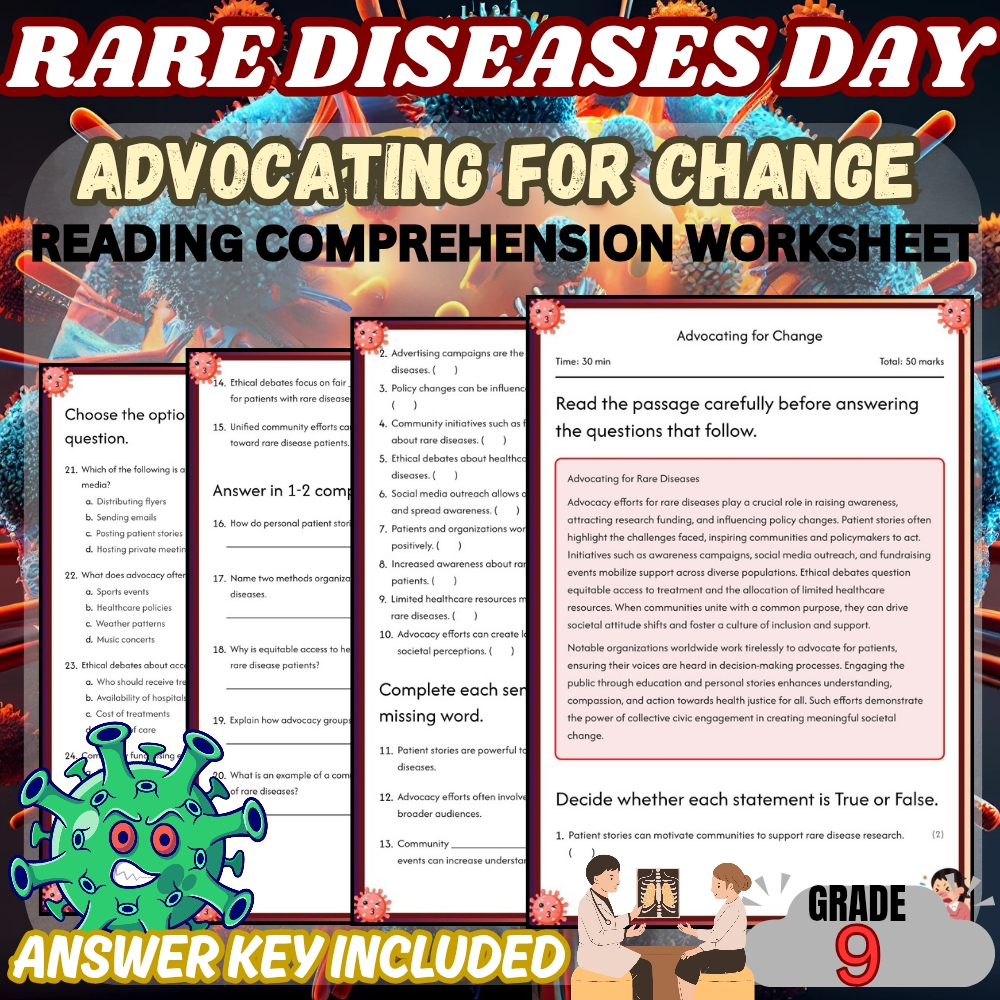
Imagine walking into a classroom where students are quietly engaged, each working through a worksheet that challenges them to think critically about advocating for rare diseases. The room is focused, and you notice how this activity provides clear direction for understanding the importance of awareness efforts and advocacy. This worksheet is designed to support teachers in guiding students through the key concepts related to rare disease awareness day, simplifying complex ideas with a well-structured, print-ready format. Its straightforward layout helps students grasp the significance of advocacy efforts while practicing various skills, making it a practical addition to any lesson plan.
What This Resource Helps Students Do
This worksheet encourages students to deepen their understanding of advocacy for rare diseases by engaging with a range of question types. From reading a passage about advocacy efforts to answering true/false, fill-in-the-blank, short answer, and multiple-choice questions, students develop reading comprehension, critical thinking, and reasoning skills. The activity prompts them to analyze how stories and awareness campaigns influence public support, enhancing their ability to connect factual information with real-world impact. By working through these questions independently or in small groups, students reinforce their knowledge and build confidence in discussing health advocacy topics.
Inside the PDF
- 0 structured questions designed for step-by-step learning
- A print-ready format that requires no preparation
- PDF answer key with rubric
- Layout designed for easy photocopying and classroom use
How It Improves Learning
This worksheet supports meaningful learning by guiding students through clear, focused questions that reinforce core ideas about advocacy and awareness campaigns. The diverse question formats cater to different learning styles, helping students process and articulate their understanding effectively. With the worksheet's emphasis on critical reasoning and evidence-based responses, students learn to evaluate information thoughtfully, fostering confidence in their ability to discuss complex social issues. The answer key provides quick feedback, allowing teachers to assess comprehension efficiently and address any misconceptions early on. Overall, this resource helps students connect theory with real-world applications, strengthening their comprehension and communication skills in a supportive, structured way.
Core Skills Students Will Develop
- ➡️ Reading comprehension of advocacy-related texts
- ➡️ Critical thinking and analysis of social issues
- ➡️ Writing and short answer reasoning skills
- ➡️ Understanding of health awareness campaigns
Ways Teachers Use This Worksheet
This worksheet can be integrated into classroom activities for a variety of instructional purposes. It works well as an independent classwork assignment, a homework task to reinforce lesson content, or as part of an assessment review to gauge understanding of advocacy and awareness efforts. Teachers can also use it in small-group settings for focused discussion or as an early finisher activity to keep students engaged after completing other assignments. Its print-and-go format makes it simple to implement, providing a practical tool to support student learning about social responsibility and health awareness in an accessible way.
Why This PDF Saves Time
This resource is designed to be printed and used immediately, eliminating prep work and reducing classroom management challenges. Its clear layout allows for quick photocopying, and the organized structure ensures consistent delivery of content. The inclusion of an answer key streamlines grading, giving teachers an efficient way to assess student understanding without additional preparation. With this ready-to-use worksheet, teachers gain a dependable, time-saving tool that ensures meaningful learning without sacrificing instructional quality.
Remember, this worksheet is fully classroom-ready, easy to distribute, and aimed at helping students develop a deep understanding of advocacy for rare diseases. It encourages thoughtful engagement and discussion, inspiring students to see how their voices can contribute to making a difference. 😊