Are your Grade 9 students exploring the intricacies of evolutionary relationships through phylogenetics?
🌿 This comprehensive worksheet, aligned with TEKS standards, provides students with an engaging exploration of phylogenetic trees that aids in building foundational understanding of evolutionary biology principles. Designed specifically for science educators, this PDF worksheet offers a structured approach to teaching students how to interpret and analyze phylogenetic diagrams, fostering critical thinking and data analysis skills essential for understanding biodiversity and the evolutionary history of organisms.
What’s Included
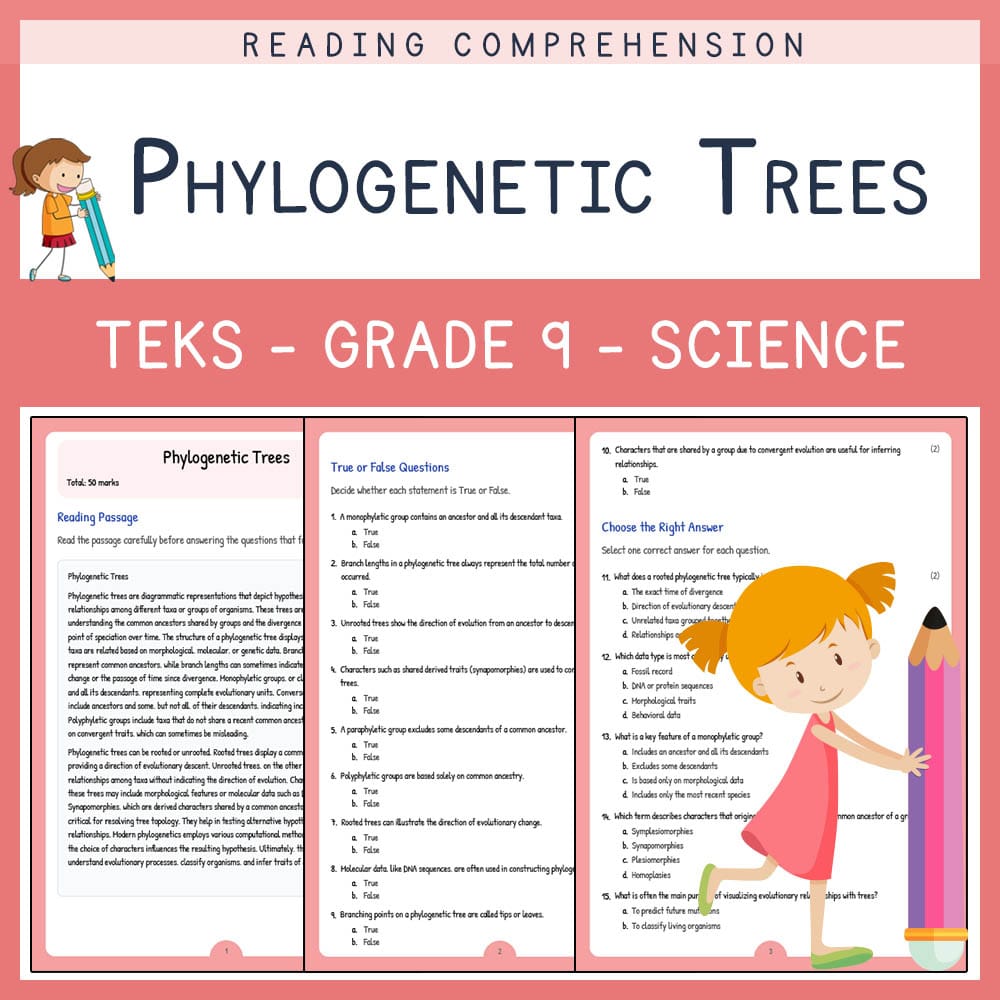
✅ Reading passage that introduces the concept of phylogenetic trees and their significance in evolutionary biology
✅ 10 true/false questions to assess comprehension of fundamental concepts
✅ 5 multiple-choice questions focusing on interpretation of phylogenetic data and tree structures
✅ 5 fill-in-the-blank questions to reinforce terminology and key concepts
✅ 5 short-answer questions encouraging deeper reflection on phylogenetic analysis and evolutionary inference
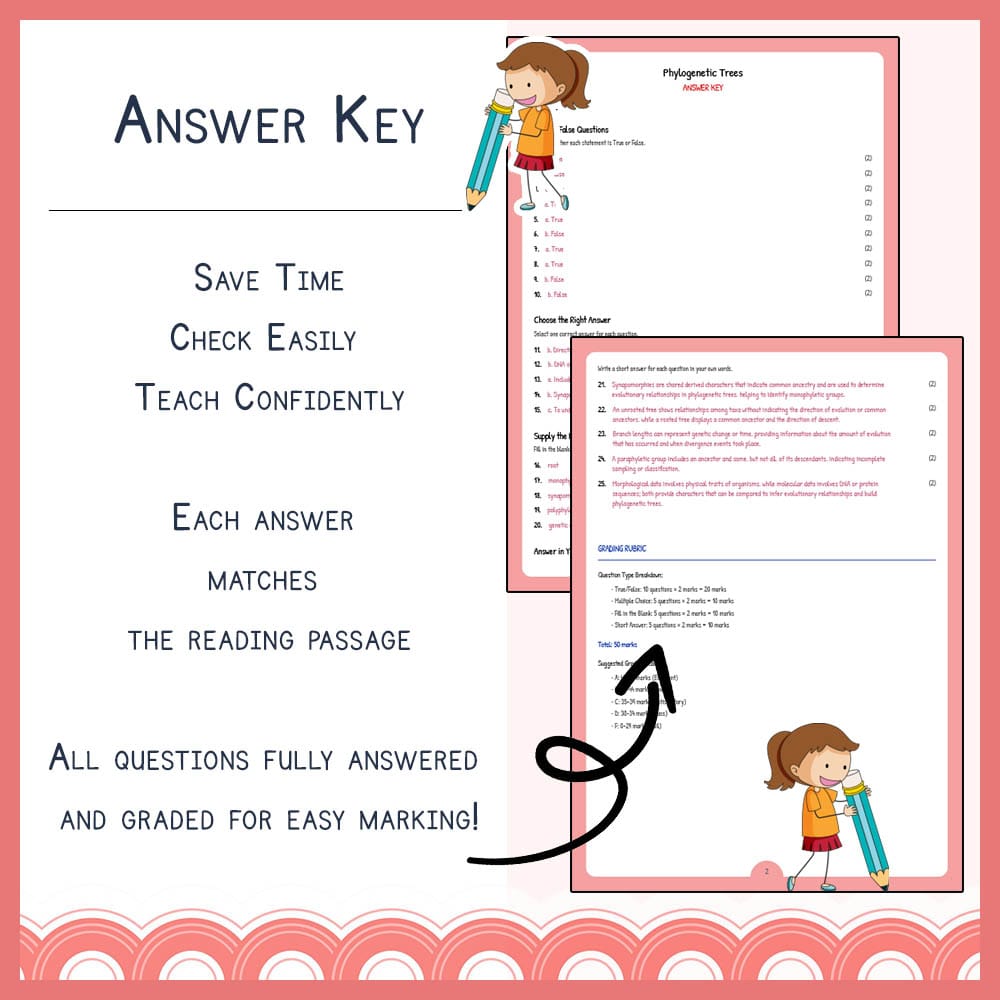
✅ PDF worksheet and PDF answer key with rubric for quick, easy grading
(Note: This product includes only PDF worksheets and answer keys; no digital or editable formats are provided.)
Key Concepts Covered
➡️ Evolutionary relationships – Understanding how species are diagrammatically related through common ancestors
➡️ Phylogenetic tree – Visual representation of hypothesized evolutionary connections among species
➡️ Monophyletic group – A group that contains an ancestor and all its descendants
➡️ Rooted vs. unrooted trees – Differentiating between the types of phylogenetic diagrams and their interpretations
➡️ Synapomorphies – Shared derived characteristics used to infer common ancestry
Question Types / Formats
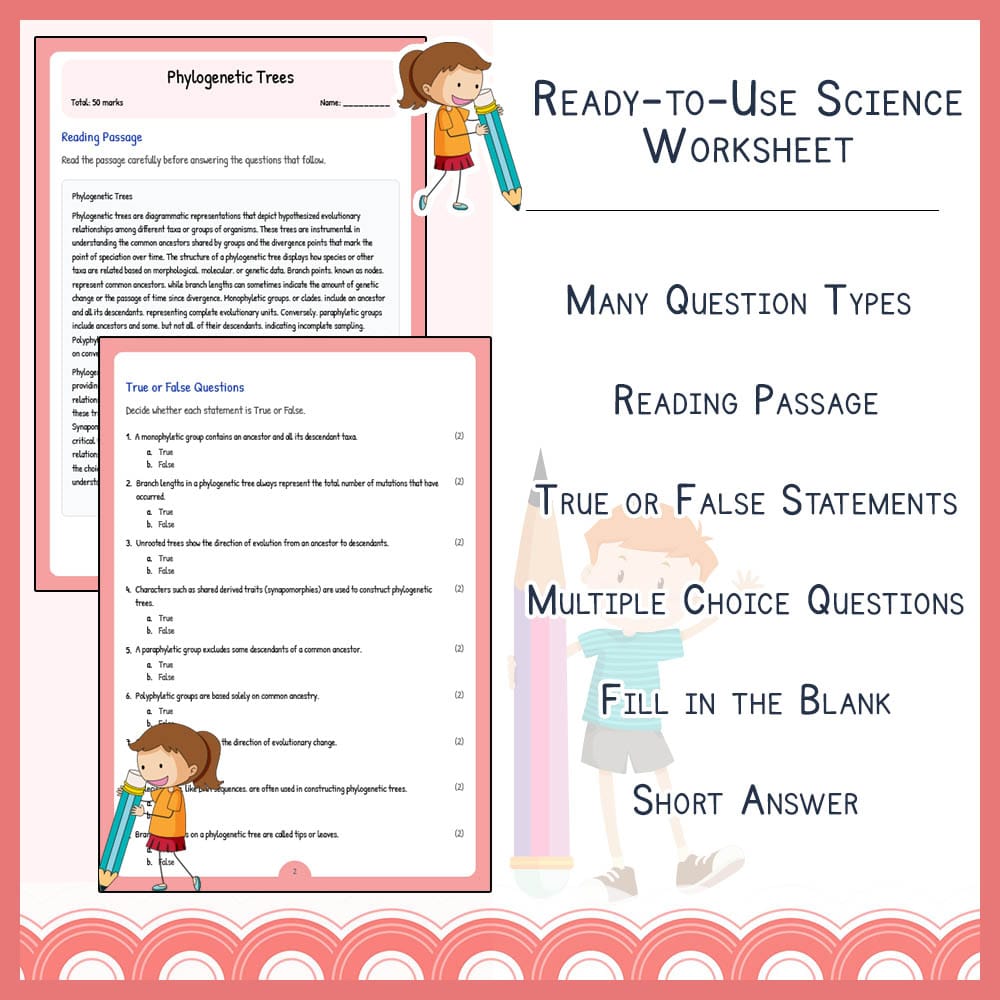
1. Reading comprehension passage to set context and introduce terminology
2. True or false questions for quick assessment of key ideas
3. Multiple choice questions to analyze data interpretation skills
4. Fill-in-the-blank prompts for reinforcing specific vocabulary
5. Short answer questions that promote critical thinking and written explanation
Teacher Benefits
✅ Easy-to-use PDF format allows for quick printing and distribution in the classroom
✅ Structured questions help streamline lesson planning and assessment
✅ Includes answer key with rubrics for efficient grading and feedback
✅ Supports diverse learning styles through varied question formats
✅ Enhances understanding of complex biological concepts aligned with TEKS standards
Student Benefits
✅ Improves comprehension of evolutionary concepts and phylogenetic analysis
✅ Develops skills in interpreting scientific diagrams and data
✅ Reinforces vocabulary and terminology essential for biology
✅ Encourages critical thinking through explanatory questions
✅ Builds confidence in understanding complex biological relationships
Perfect For
➡️ Classroom instruction during lessons on evolution and biodiversity
✅ Homework assignments to reinforce lesson content
➡️ Substituting or supplementing lecture with interactive student practice
✅ Review sessions before exams or assessments
➡️ Independent study or reinforcement activities for students needing additional support
Ready to enhance your Science teaching? Download this dynamic worksheet today and inspire your students to deepen their understanding of evolutionary relationships! 🚀