
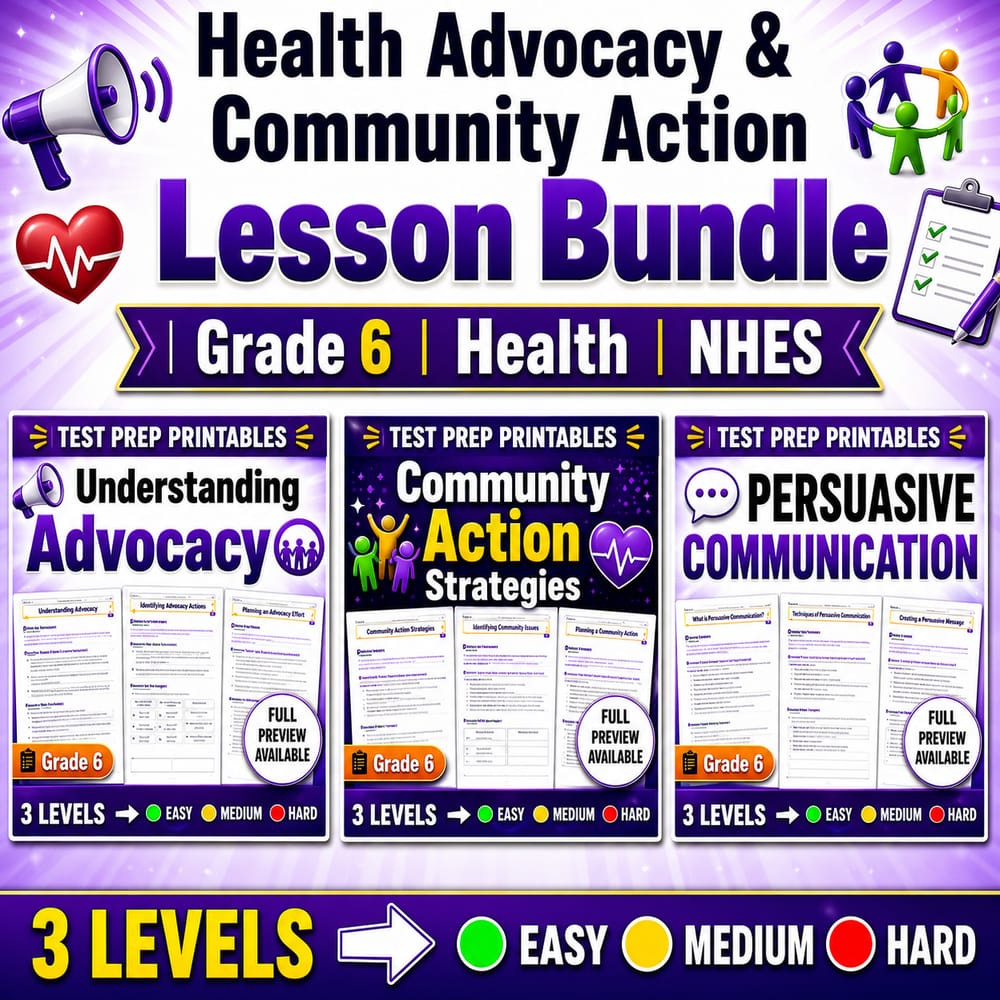
Health Advocacy & Community Action Lesson Bundle | Grade 6 Health | NHES
$12.00$15.00Save $3.00
Prism Point Learning
·2 followers·13 sales
SubjectHealthGradeGrade 6Pages91 Pages
What’s included
3 worksheets · 91 pages · Save $3.00 (20%) · prices shown inside the bundle
 Health Advocacy Worksheet | Grade 6 Community Change NHES Activities
- Define health advocacy and explain how it can improve community health.
- Identify how individuals and groups influence decision-making through persuasive communication.
- Use persuasive, respectful communication to propose a health improvement idea.
$4.00$5.00 Community Action Strategies for Health Worksheet | Grade 6 NHES
- Explain how communities can take action to address health concerns.
- Identify ways to coordinate teamwork and resources when planning a health initiative.
- Use persuasive communication to encourage healthy behaviors and supportive policies.
$4.00$5.00 Health Persuasion and Communication Worksheet Grade 6 NHES Activity
- Identify key persuasive techniques used in health messages
- Compare how audience and context affect message choices
- Evaluate whether a statement is likely to persuade using evidence and appropriate tone
$4.00$5.00
Reviews & Feedback
Loading reviews...
Questions & Answers
Loading questions…
About this bundle
Related categories
Frequently asked questions
Who is Health Advocacy & Community Action Lesson Bundle | Grade 6 Health | NHES designed for?
Health Advocacy & Community Action Lesson Bundle | Grade 6 Health | NHES is designed for Grade 6 students and Health learners and can be used in classrooms, homeschool, or independent practice.
How do I download Health Advocacy & Community Action Lesson Bundle | Grade 6 Health | NHES?
Add it to your cart and complete checkout. After payment, you can download immediately from your account, and you'll also receive a download link by email.
Similar Products

Grade 12 Health Advocacy Lesson Bundle (NHES): Campaigns & Community Action
$16.00$20.00

Grade 11 Health Advocacy: Community Health Lesson Bundle | NHES Worksheets
$16.00$20.00

Grade 10 Health Advocacy Unit | NHES-Aligned Worksheet Collection
$12.00$15.00

Grade 10 Health Social Influences & Advocacy Lesson Bundle (NHES)
$16.00$20.00

Grade 12 Health Lesson Bundle: Wellness, Communication, Advocacy (NHES)
$16.00$20.00