
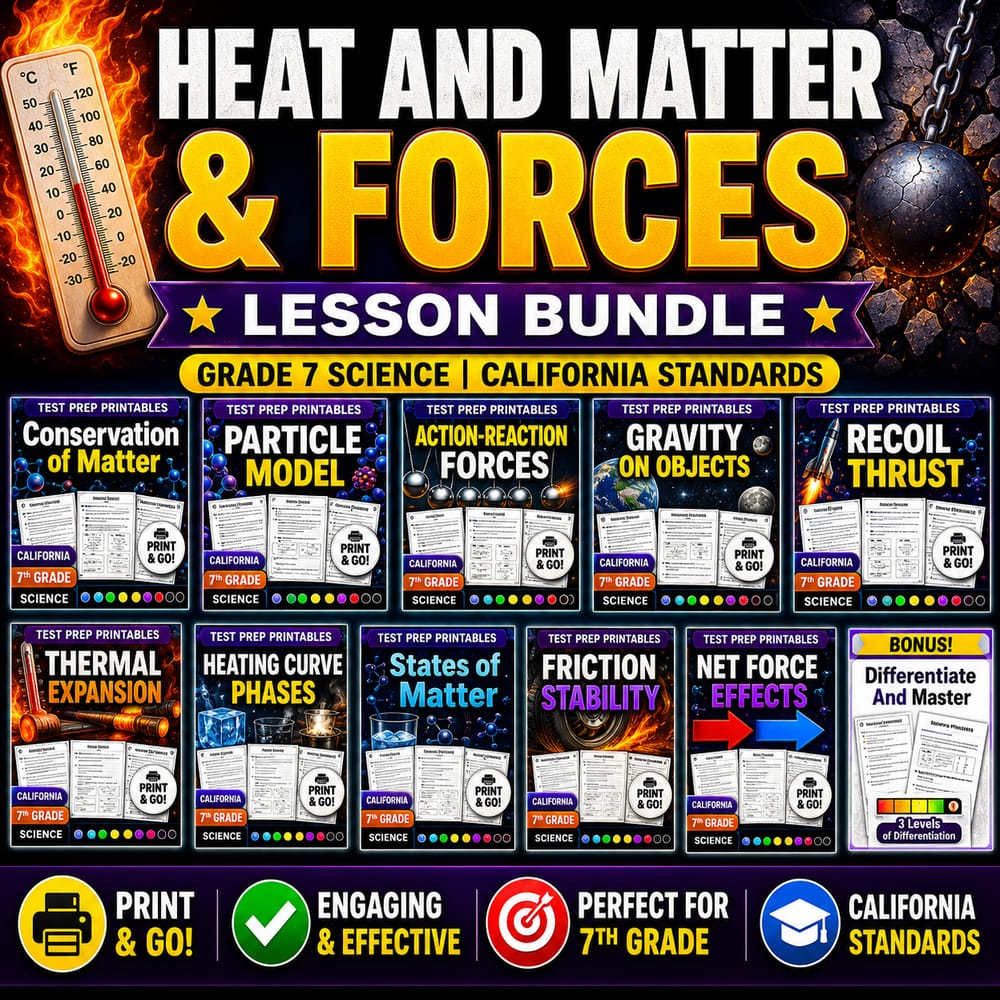


Heat and Matter & Forces Lesson Bundle | Grade 7 Science | California Standards
$48.00$60.00Save $12.00
Prism Point Learning
·2 followers·13 sales
SubjectScienceGradeGrade 7
What’s included
12 worksheets · Save $12.00 (20%) · prices shown inside the bundle
 Grade 7 Conservation of Matter Worksheet | Mass Conservation & Reactions
- Explain conservation of matter in a closed system using the idea that atoms are rearranged, not created or destroyed.
- Use evidence from comparing the mass of reactants and products to support the law of conservation of mass.
- Distinguish between physical changes (mixing/dissolving) and chemical changes (new substances) while tracking total matter.
$4.00$5.00 Particle Model Worksheet Grade 7 Science | Matter and Particle Theory
- Explain how matter can be described using particles too small to see
- Describe how particle motion relates to temperature
- Use the particle model to predict changes in macroscopic properties like pressure and diffusion
$4.00$5.00 Action-Reaction Forces Worksheet Grade 7 Science | Newton’s Third Law
- Explain the action-reaction relationship between two interacting objects.
- Identify action-reaction force pairs in real-world examples (contact and noncontact).
- Relate acceleration to net force and mass when forces come from interactions.
$4.00$5.00 Gravity on Objects Worksheet Grade 7 Science | Forces, Weight & Motion
- Explain how gravitational force relates to an object's mass and how it affects motion near Earth.
- Describe how support forces (normal forces) balance weight for objects at rest, and predict what happens when support changes.
- Use evidence and vocabulary such as weight, gravitational force, normal force, and acceleration correctly.
$4.00$5.00 Recoil and Thrust Worksheet Grade 7 Science | Forces and Motion
- Explain recoil and thrust using Newton’s third law (action-reaction forces).
- Describe how equal and opposite forces cause different accelerations for different masses.
- Connect action-reaction force pairs to momentum changes in real situations.
$4.00$5.00 Thermal Expansion Worksheet Grade 7 Science | Heat and Matter
- Explain how increasing temperature increases particle motion and average spacing, causing thermal expansion in solids and liquids.
- Describe how heating changes gas particle motion and increases pressure in a confined space.
- Use particle theory to predict contraction when temperature decreases.
$4.00$5.00 Heating Curve Phases Worksheet Grade 7 Science | States of Matter
- Describe the temperature-time behavior during heating and link it to changes of state.
- Explain why phase changes create plateaus on a heating curve.
- Use heating curve stages to interpret particle motion and energy transfer.
$4.00$5.00 Diffusion and Mixing Worksheet Grade 7 Science | Matter & Particles
- Explain how diffusion happens due to the random motion of particles moving from higher concentration to lower concentration.
- Describe how mixing occurs without particles stopping or changing into new substances.
- Predict how temperature affects the rate of diffusion using the particle model.
$4.00$5.00 States of Matter Worksheet Grade 7 Science | Matter and Phase Changes
- Explain how energy transfer during phase changes affects particle motion and arrangement
- Distinguish melting, freezing, evaporation, and condensation using the particle model
- Describe why temperature stays relatively steady during a phase change
$4.00$5.00 Friction and Stability Worksheet Grade 7 Science | Forces and Motion
- Explain how friction affects whether forces balance or are unbalanced.
- Predict how changing friction changes motion (constant speed, speeding up, or slowing down).
- Describe how surface texture influences friction and stability.
$4.00$5.00
Reviews & Feedback
Loading reviews...
Questions & Answers
Loading questions…
About this bundle
Related categories
Frequently asked questions
Who is Heat and Matter & Forces Lesson Bundle | Grade 7 Science | California Standards designed for?
Heat and Matter & Forces Lesson Bundle | Grade 7 Science | California Standards is designed for Grade 7 students and Science learners and can be used in classrooms, homeschool, or independent practice.
How do I download Heat and Matter & Forces Lesson Bundle | Grade 7 Science | California Standards?
Add it to your cart and complete checkout. After payment, you can download immediately from your account, and you'll also receive a download link by email.
Similar Products

Matter, Heat & Forces Lesson Bundle | Grade 6 Science | General
$28.80$36.00

Grade 6 Physical Science Worksheets Bundle | Heat, Matter & Forces
$21.60$27.00

Grade 6 Matter, Motion, and Heat Science Lesson Bundle – General Framework
$36.00$45.00

Grade 11 Energy & Heat Transfer Science Lesson Bundle (Worksheet B) | NGSS
$20.00$25.00

Grade 7 Thermal Energy & Heat Transfer Science Lesson Bundle: Ontario
$48.00$60.00