
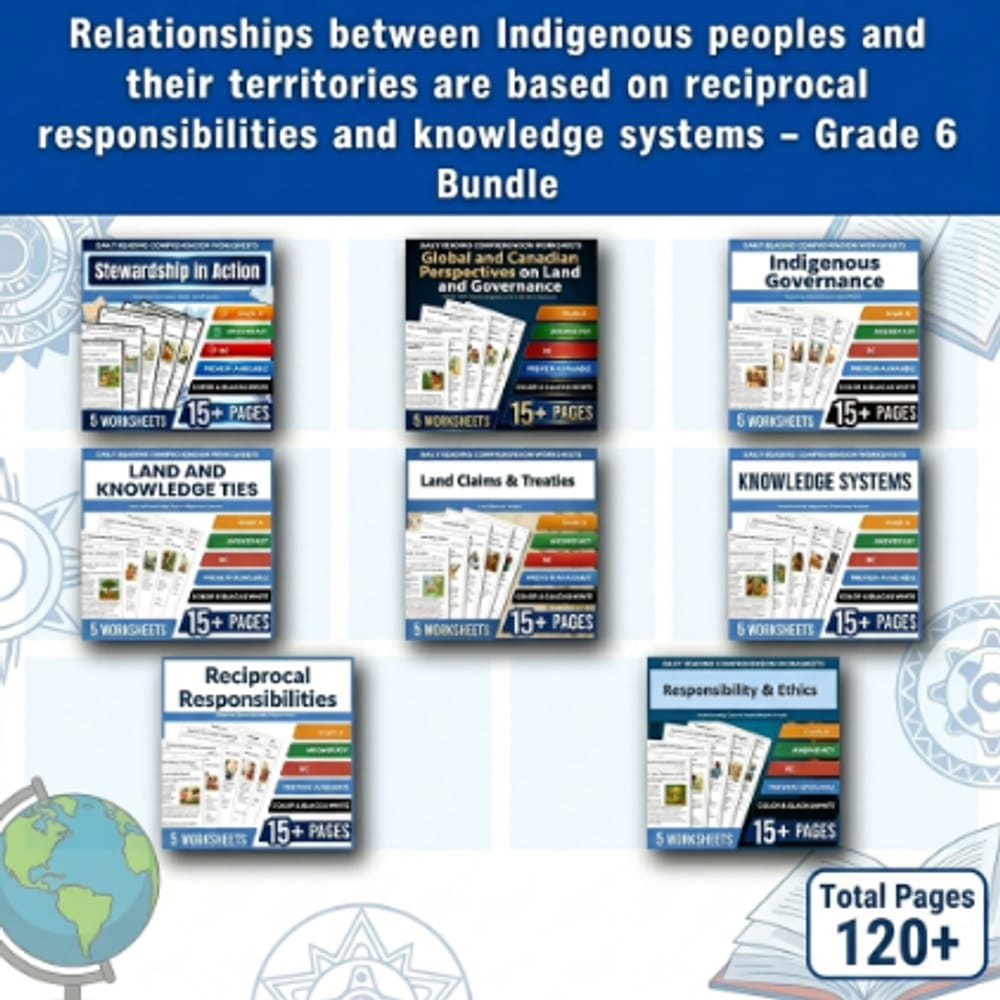
Indigenous Territories & Responsibilities Bundle | Grade 6 Social Studies | BC
$25.60$32.00Save $6.40
Quiet Forest Education
·3 followers·20 sales
SubjectSocial StudiesGradeGrade 6Pages281 Pages
What’s included
8 worksheets · 281 pages · Save $6.40 (20%) · prices shown inside the bundle
 Stewardship in Action Social Studies Grade 6 BC Curriculum Worksheet + Key
- Understand the Indigenous values of land stewardship.
- Recognize ecological responsibility practices in Indigenous communities.
- Explain the importance of sustainable resource management and conservation.
$3.20$4.00 Global & Canadian Perspectives on Land & Governance | Grade 6 Social Studies BC
- Understand indigenous land stewardship values and principles.
- Compare land governance structures between Indigenous communities and other cultures.
- Reflect on themes of stewardship, responsibility, and sovereignty in land management.
$3.20$4.00 Indigenous Governance Social Studies Grade 6 BC Worksheet + Answer Key
- Identify and describe traditional Indigenous leadership roles
- Understand the relationship between Indigenous governance structures and colonial administrations
- Recognize forms of self-governance and treaty agreements
$3.20$4.00 Land and Knowledge Ties in Indigenous Cultures | Grade 6 BC Social Studies
- Understand the Indigenous worldview of land as a source of identity, spirituality, and knowledge
- Recognize traditional stories and ceremonies that demonstrate land's significance
- Explore how land acts as a living entity providing guidance and teaching
$3.20$4.00 Land Claims & Treaties Grade 6 Social Studies BC Worksheet + Answer Key
- Understand key concepts related to Social Studies
- Apply knowledge through practice questions
- Demonstrate comprehension of the material
$3.20$4.00 Understanding Indigenous Knowledge Systems Worksheet – Grade 6 Social Studies BC
- Recognize key aspects of Indigenous land stewardship and ecological practices
- Understand the interconnectedness of land, water, and animals in Indigenous worldviews
- Reflect on the importance of traditional ecological knowledge and responsibilities
$3.20$4.00 Reciprocal Responsibilities in Community Worksheet | Grade 6 Social Studies BC
- Understand the concept of reciprocity and mutual responsibilities.
- Identify examples of reciprocal responsibilities within Indigenous communities.
- Reflect on personal roles and responsibilities in their own communities.
$3.20$4.00 Understanding Cultural Values Related to Land | Grade 6 SS BC + Answer Key
- Learn about the importance of land in Indigenous cultures
- Understand ethical considerations tied to land care
- Reflect on personal connections to respecting land
$3.20$4.00
Reviews & Feedback
Loading reviews...
Questions & Answers
Loading questions…
About this bundle
Related categories
Frequently asked questions
Who is Indigenous Territories & Responsibilities Bundle | Grade 6 Social Studies | BC designed for?
Indigenous Territories & Responsibilities Bundle | Grade 6 Social Studies | BC is designed for Grade 6 students and Social Studies learners and can be used in classrooms, homeschool, or independent practice.
How do I download Indigenous Territories & Responsibilities Bundle | Grade 6 Social Studies | BC?
Add it to your cart and complete checkout. After payment, you can download immediately from your account, and you'll also receive a download link by email.
