
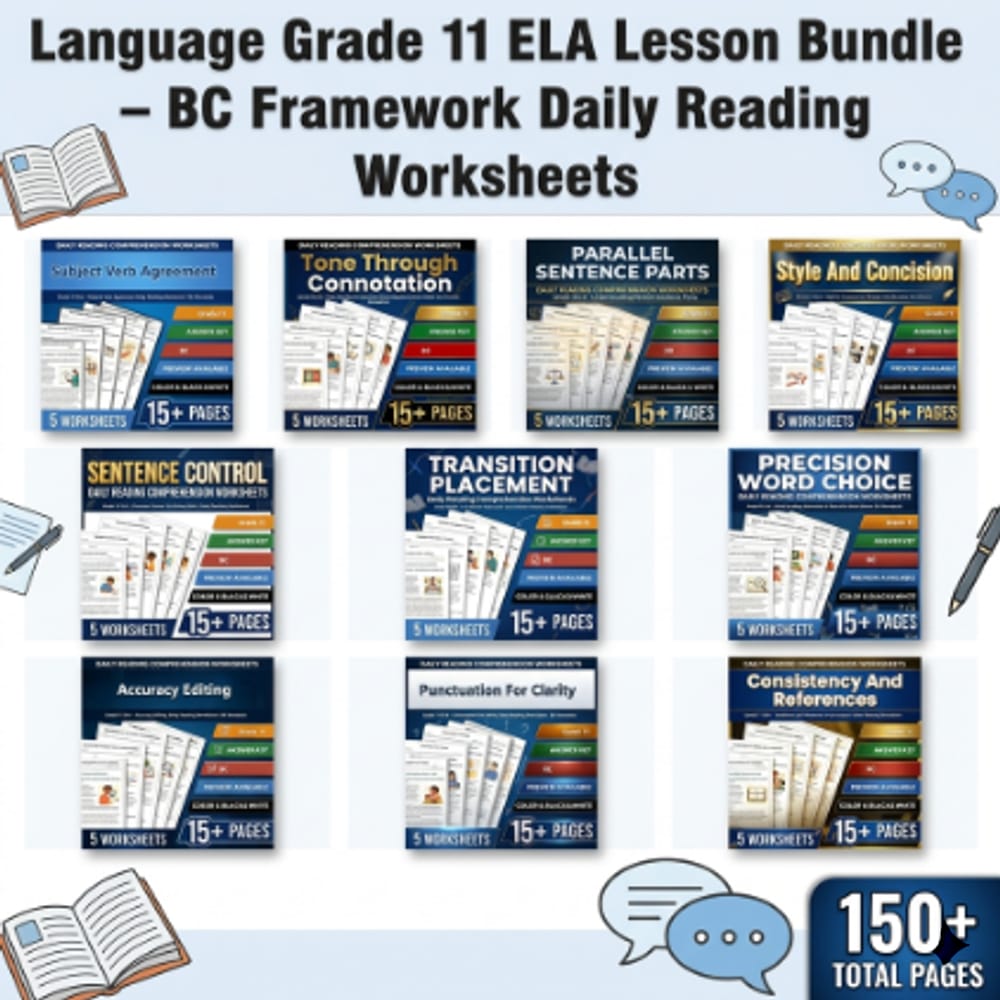
Language Grade 11 ELA Lesson Bundle – BC Framework Daily Reading Worksheets
$32.00$40.00Save $8.00
Quiet Forest Education
·3 followers·20 sales
SubjectELAGradeGrade 11Pages308 Pages
What’s included
10 worksheets · 308 pages · Save $8.00 (20%) · prices shown inside the bundle
 Grade 11 ELA – Subject-Verb Agreement Daily Reading Worksheet | BC Standards
- Understand key concepts related to ELA
- Apply knowledge through practice questions
- Demonstrate comprehension of the material
$3.20$4.00 Grade 11 ELA – Daily Worksheet | Exploring Word Connotations & Tone BC Standards
- Understand key concepts related to ELA
- Apply knowledge through practice questions
- Demonstrate comprehension of the material
$3.20$4.00 Grade 11 ELA – Understanding Parallel Sentence Parts | Daily Reading Worksheet
- Understand key concepts related to ELA
- Apply knowledge through practice questions
- Demonstrate comprehension of the material
$3.20$4.00 Grade 11 ELA – Style & Concision in Writing Daily Reading Worksheet
- Identify redundant phrases and wordiness in sentences
- Understand how to refine style for clarity and impact
- Practice editing sentences to improve concision
$3.20$4.00 Grade 11 ELA – Sentence Control & Writing Skills | Daily Reading Worksheet
- Understand key concepts related to ELA
- Apply knowledge through practice questions
- Demonstrate comprehension of the material
$3.20$4.00 Grade 11 ELA – Transition Placement & Use | Daily Reading Worksheet
- Identify appropriate transition words and phrases for cause and contrast
- Distinguish between cause, contrast, comparison, and emphasis in text
- Understand how transitions improve coherence in writing
$3.20$4.00 Grade 11 ELA – Daily Reading Worksheet & Precision Word Choice BC Standards
- Identify precise and specific words in context
- Distinguish between vague and exact vocabulary
- Understand how word choice affects tone and clarity
$3.20$4.00 Grade 11 ELA – Accuracy Editing Daily Reading Worksheet | BC Standards
- Identify common verb tense and agreement errors in writing
- Correctly revise sentences to improve grammatical accuracy
- Recognize errors that disrupt the clarity and professionalism of writing
$3.20$4.00 Grade 11 ELA – Punctuation For Clarity Daily Reading Worksheet | BC Standards
- Understand how commas improve clarity in lists
- Recognize the correct placement of commas in complex sentences
- Differentiate between necessary and nonessential information with punctuation
$3.20$4.00 Grade 11 ELA – Consistency & References in Literature | Daily Reading Worksheet
- Understand the importance of maintaining consistent verb tense in writing.
- Identify shifts in tense and point of view that can confuse readers.
- Recognize how reference consistency clarifies pronoun and source relationships.
$3.20$4.00
Reviews & Feedback
Loading reviews...
Questions & Answers
Loading questions…
About this bundle
Related categories
Frequently asked questions
Who is Language Grade 11 ELA Lesson Bundle – BC Framework Daily Reading Worksheets designed for?
Language Grade 11 ELA Lesson Bundle – BC Framework Daily Reading Worksheets is designed for Grade 11 students and ELA learners and can be used in classrooms, homeschool, or independent practice.
How do I download Language Grade 11 ELA Lesson Bundle – BC Framework Daily Reading Worksheets?
Add it to your cart and complete checkout. After payment, you can download immediately from your account, and you'll also receive a download link by email.
Similar Products

Grade 10 ELA Language Lesson Bundle | TEKS Daily Reading & Writing Skills
$44.80$56.00

Language Grade 11 Ela Daily Reading Worksheets Lesson Bundle | Ontario
$25.60$32.00

Grade 10 Language ELA Daily Reading Worksheets Lesson Bundle | Ontario
$32.00$40.00

English Language Lesson Bundle | Grade 12 ELA | BC Framework
$14.40$18.00

Grade 10 Tone & Language ELA Daily Reading Worksheets Lesson Bundle | BC
$28.80$36.00