
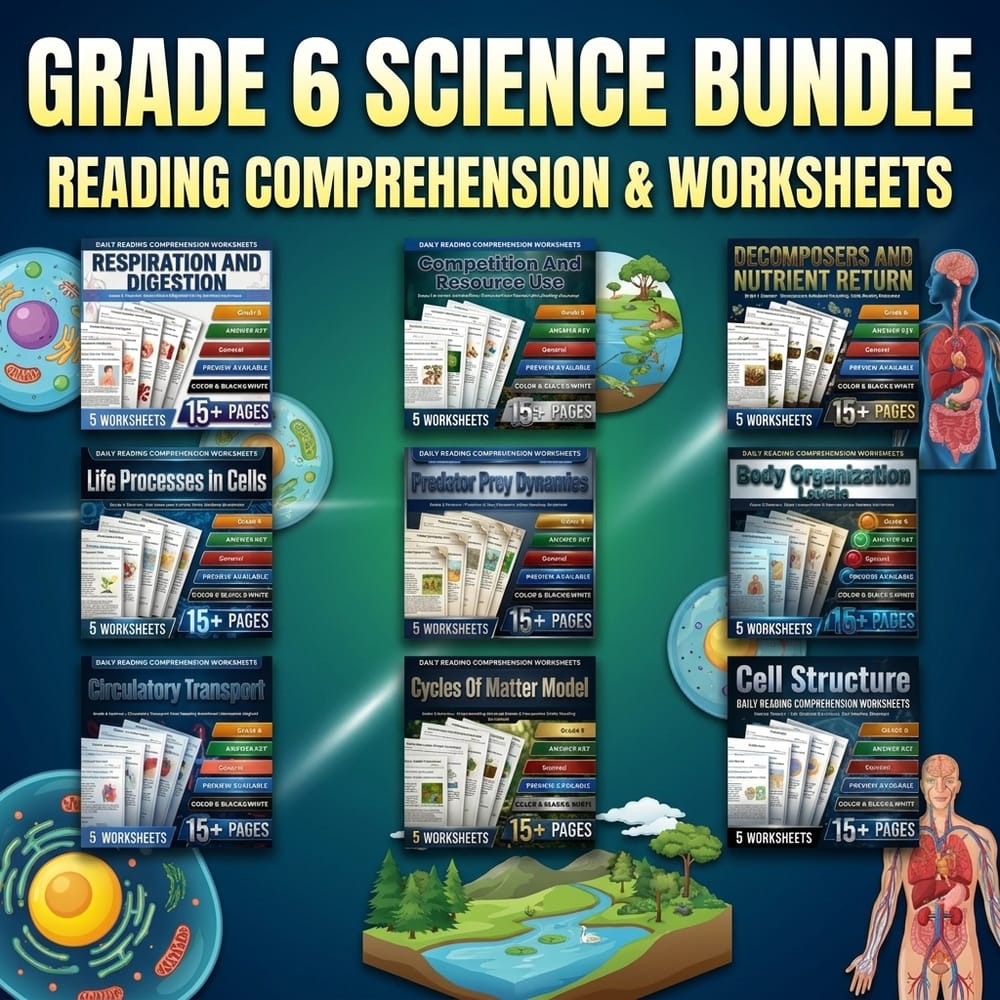
Life Processes Grade 6 Science Daily Reading Worksheets Lesson Bundle | General
$28.80$36.00Save $7.20
Bright Mind Resources
New·1 followers·12 sales
SubjectScienceGradeGrade 6
What’s included
9 worksheets · Save $7.20 (20%) · prices shown inside the bundle
 Grade 6 Science – Respiration & Digestion | Daily Reading Worksheet
- Understand the structure and function of the respiratory system, especially the lungs.
- Learn how gases are exchanged in the lungs through diffusion.
- Understand the role of the respiratory and digestive systems in supporting cellular energy.
$3.20$4.00 Grade 6 Science – Competition & Resource Use in Nature | Daily Reading Worksheet
- Identify different types of competition among organisms
- Understand how competition influences survival and population dynamics
- Analyze examples of competition in various ecosystems
$3.20$4.00 Grade 6 Science – Decomposers & Nutrient Recycling | Daily Reading Worksheet
- Identify different decomposers such as fungi and bacteria
- Explain how decomposers break down dead organisms and waste
- Understand the role of decomposers in returning nutrients to ecosystems
$3.20$4.00 Grade 6 Science – Life Processes in Cells | Daily Reading Worksheet
- Understand the process of photosynthesis in plants.
- Identify the role of sunlight and gases in photosynthesis.
- Explain how plants produce food and energy.
$3.20$4.00 Grade 6 Science – Predator & Prey Dynamics | Daily Reading Worksheet
- Understand the basic concepts of predator and prey relationships in ecosystems.
- Identify examples of predator and prey interactions from descriptions.
- Describe how predator populations influence prey populations and vice versa.
$3.20$4.00 Grade 6 Science – Body Organization & Systems | Daily Reading Worksheet
- Understand the different levels of body organization: cells, tissues, organs, and systems.
- Identify the functions of each level in maintaining health and supporting bodily functions.
- Describe how small structures build larger systems and affect overall body performance.
$3.20$4.00 Grade 6 Science – Circulatory Transport Reading Worksheet | Standards-Aligned
- Identify the main functions of the heart
- Understand how blood is transported through arteries, veins, and capillaries
- Explain how heart structure and pumping action move blood
$3.20$4.00 Grade 6 Science – Cycles of Matter & Ecosystems | Daily Reading Worksheet
- Define the concept of matter cycles in ecosystems.
- Identify key elements involved in matter cycles, such as carbon and water.
- Describe how matter moves among air, soil, water, and living organisms.
$3.20$4.00 Grade 6 Science – Cell Structure & Function | Daily Reading Worksheet
- Identify the main parts of a cell and their functions
- Understand the role of cell membranes, cytoplasm, nucleus, and organelles
- Explain how cell parts work together to support life processes
$3.20$4.00
Reviews & Feedback
Loading reviews...
Questions & Answers
Loading questions…
About this bundle
Related categories
Frequently asked questions
Who is Life Processes Grade 6 Science Daily Reading Worksheets Lesson Bundle | General designed for?
Life Processes Grade 6 Science Daily Reading Worksheets Lesson Bundle | General is designed for Grade 6 students and Science learners and can be used in classrooms, homeschool, or independent practice.
How do I download Life Processes Grade 6 Science Daily Reading Worksheets Lesson Bundle | General?
Add it to your cart and complete checkout. After payment, you can download immediately from your account, and you'll also receive a download link by email.
Similar Products

Grade 11 Cell Systems Life Science Daily Reading Lesson Bundle | TEKS
$25.60$32.00

Grade 6 Science Lesson Group | Body Systems and Life Processes Worksheet Bundle
$21.60$27.00

Grade 6 Science Full Year Bundle | Weather, Water, Space & Life Processes
$84.00$120.00

Life Science Grade 10 Science Daily Reading Worksheets Lesson Bundle | FL NGSSS
$51.20$64.00