
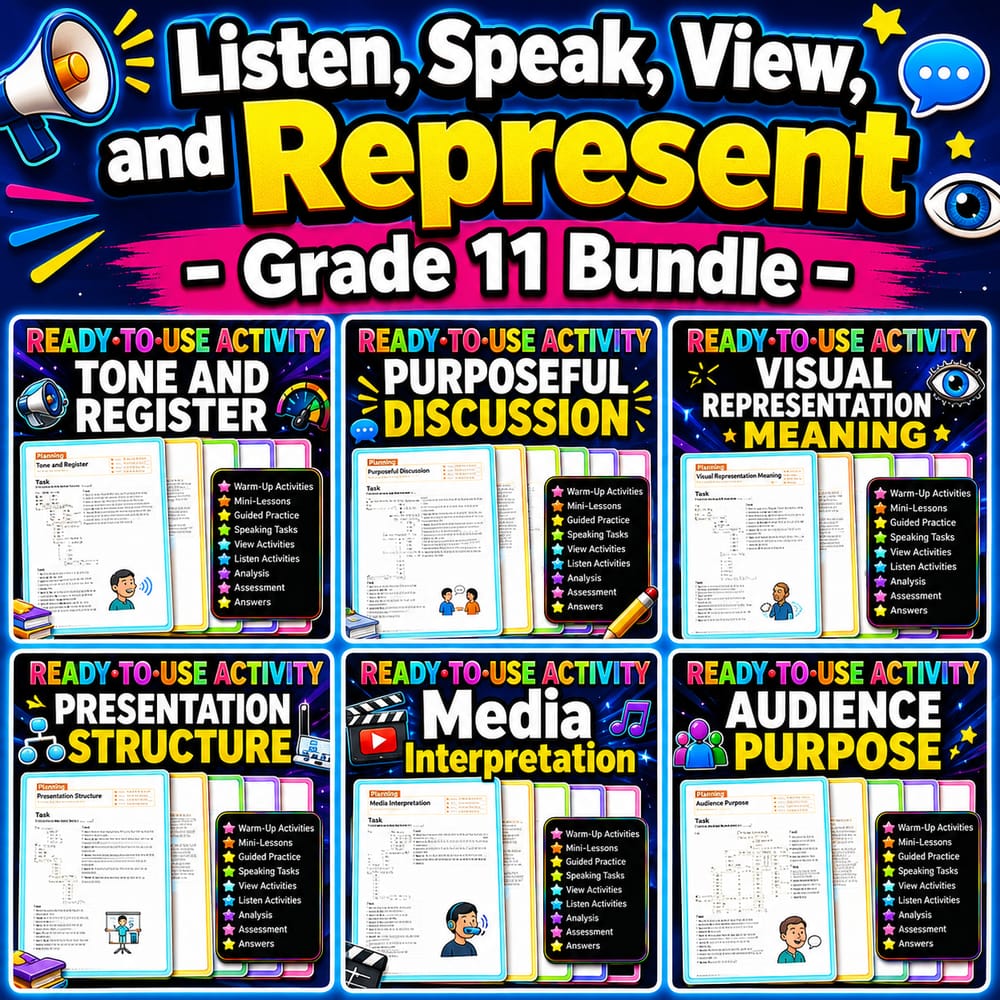
Listen, Speak, View, and Represent Lesson Bundle | Grade 11 ELA | Alberta
$14.40$18.00Save $3.60
Sunny Desk Resources
·2 followers·18 sales
SubjectELAGradeGrade 11Pages66 Pages
What’s included
6 worksheets · 66 pages · Save $3.60 (20%) · prices shown inside the bundle
 Tone and Register Worksheet Pack | Grade 11 ELA Practice
- Identify how tone and register shape audience expectations and meaning in speech.
- Adjust word choice and sentence style to match formal and informal contexts without losing clarity.
- Explain how changes in tone signal uncertainty, agreement, emphasis, or sensitivity.
$2.40$3.00 Purposeful Discussion Worksheet Pack | Grade 11 ELA Practice
- Explain how clarifying questions help build meaning in a discussion by seeking definitions, reasons, or evidence.
- Use follow-up questions and idea-building paraphrases to connect new ideas to earlier points.
- Demonstrate respectful listening behaviors that support turn-taking and shared understanding.
$2.40$3.00 Visual Representation Meaning Worksheet Pack | Grade 11 ELA Practice
- Explain how purposeful visual choices (labels, scales, categories) create meaning in diagrams and graphics.
- Interpret relationships in visuals, including comparisons and cause-and-effect.
- Use evidence from visuals to support claims and responses in discussion.
$2.40$3.00 Presentation Structure Worksheet Pack | Grade 11 ELA Activities
- Identify how signposting (preview statements and connective phrases) guides an audience through major points.
- Explain how transitions show cause-and-effect or logical relationships between ideas in a presentation.
- Analyze how grouping supporting details improves clarity and reduces unrelated information.
$2.40$3.00 Media Interpretation Worksheet Pack | Grade 11 ELA Practice
- Interpret how visual elements (captions, labels, scales, framing, and imagery) shape the meaning and credibility of a message in media.
- Identify the main idea of a visual/data message by connecting stated information to implied meanings and evidence.
- Evaluate how media choices (such as chart type, color, and perspective) emphasize or minimize certain points.
$2.40$3.00 Audience Purpose Worksheet Pack | Grade 11 ELA Practice
- Explain how oral presentations use a clear purpose to organize an understandable message for a specific audience
- Identify the parts of an organized presentation: introduction with a central claim, logical supporting points, and a closing that reinforces the takeaway
- Apply audience-fit by selecting relevant details and adjusting background information to match listeners’ needs
$2.40$3.00
Reviews & Feedback
Loading reviews...
Questions & Answers
Loading questions…
About this bundle
Related categories
Frequently asked questions
Who is Listen, Speak, View, and Represent Lesson Bundle | Grade 11 ELA | Alberta designed for?
Listen, Speak, View, and Represent Lesson Bundle | Grade 11 ELA | Alberta is designed for Grade 11 students and ELA learners and can be used in classrooms, homeschool, or independent practice.
How do I download Listen, Speak, View, and Represent Lesson Bundle | Grade 11 ELA | Alberta?
Add it to your cart and complete checkout. After payment, you can download immediately from your account, and you'll also receive a download link by email.
Similar Products

Grade 6 ELA Speaking & Listening Worksheets Alberta Bundle
$28.00$35.00

Grade 11 Listen, Speak, View, Represent ELA Lesson Bundle | Alberta
$19.20$24.00

Grade 4 Speaking and Listening ELA Lesson Bundle – Alberta Standards
$22.40$28.00

Grade 5 Speaking & Listening ELA Lesson Bundle | Alberta Test Prep
$20.00$25.00

Grade 9 Speaking and Listening Lesson Bundle | Alberta ELA
$19.20$24.00