
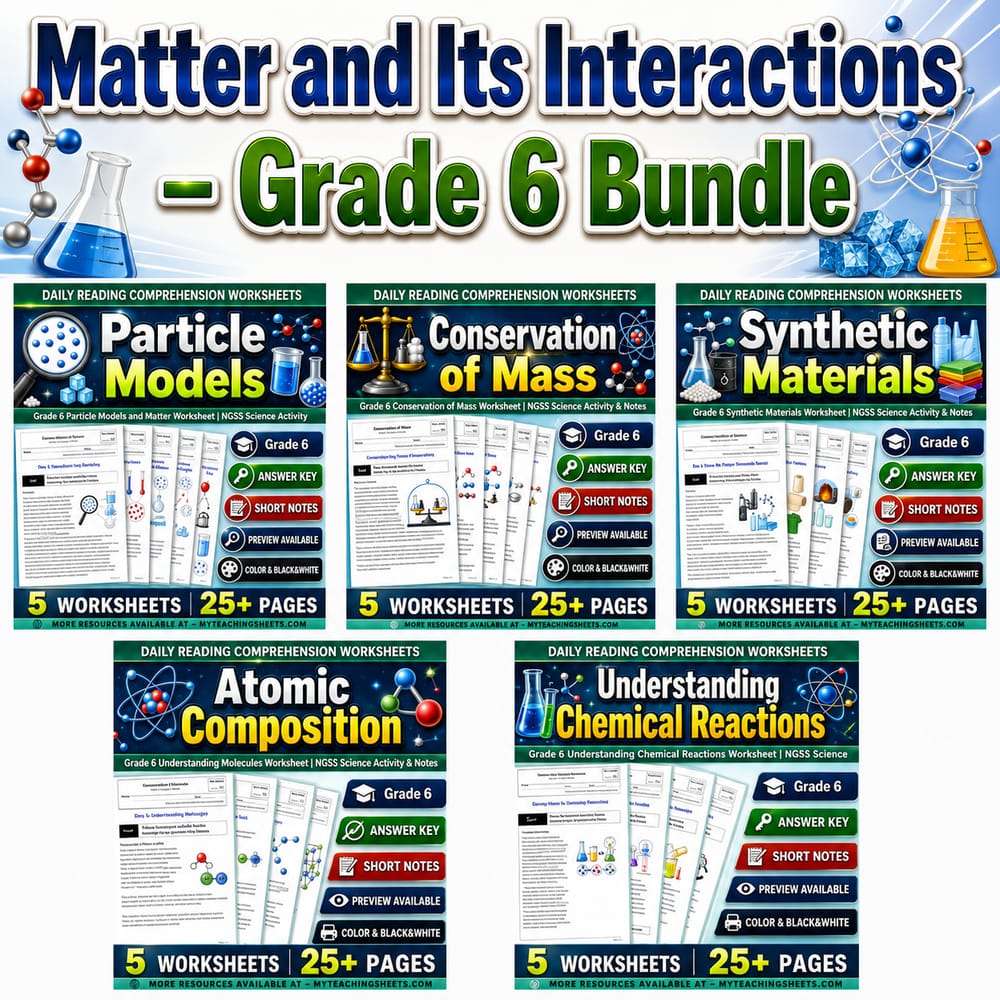
Matter and Its Interactions Grade 6 Science Lesson Bundle | NGSS
$36.00$45.00Save $9.00
BRIGHT PATH RESOURCES
·3 followers·23 sales
SubjectScienceGradeGrade 6
What’s included
9 worksheets · Save $9.00 (20%) · prices shown inside the bundle
 Grade 6 Conservation of Mass Worksheet | NGSS Matter Science Activity
- Understand key concepts related to Science
- Apply knowledge through practice questions
- Demonstrate comprehension of the material
$4.00$5.00 Grade 6 Particle Models and Matter Worksheet | NGSS Science Activity
- Understand that all matter is made up of tiny particles
- Describe the behavior of particles in different states of matter
- Relate temperature and energy to particle motion
$4.00$5.00 Grade 6 Understanding Particle Models Worksheet | NGSS Science Activity
- Describe matter as composed of tiny particles
- Explain particle motion, collisions, and spacing
- Relate phase changes to particle behavior
$4.00$5.00 Grade 6 Conservation of Mass Worksheet | NGSS Science Activity & Notes
- Understand the principle of conservation of mass during physical and chemical changes.
- Trace atoms and mass through various physical processes.
- Recognize that mass remains constant even when molecules rearrange.
$4.00$5.00 Grade 6 Synthetic Materials Worksheet | NGSS Science Activity & Notes
- Identify the sources of various synthetic materials.
- Describe the manufacturing processes involved in making plastics.
- Compare properties of natural and synthetic materials for specific uses.
$4.00$5.00 Grade 6 Understanding Molecules Worksheet | NGSS Science Activity & Notes
- Identify atoms in simple molecules
- Recognize chemical formulas of common molecules
- Use models to describe molecular structures
$4.00$5.00 Grade 6 Understanding Chemical Reactions Worksheet | NGSS Science Activity
- Identify key signs of chemical reactions such as color change, gas evolution, precipitate formation, and temperature change.
- Interpret qualitative and quantitative data to determine if a chemical reaction has occurred.
- Analyze examples like acid-carbonate reactions and metal oxidation to understand reaction indicators.
$4.00$5.00 Grade 6 Synthetic Materials Worksheet | NGSS Science Activity & Practice
- Understand how plastics are made from natural resources
- Identify the origins of common synthetic materials
- Learn about properties and uses of different synthetic substances
$4.00$5.00 Grade 6 Chemical Reactions Worksheet | NGSS Physical Science Activity
- Identify indicators that suggest a chemical reaction is occurring.
- Analyze qualitative data such as color change, gas evolution, and precipitate formation.
- Interpret quantitative measurements like temperature and mass changes to determine chemical reactions.
$4.00$5.00
Reviews & Feedback
Loading reviews...
Questions & Answers
Loading questions…
About this bundle
Related categories
Frequently asked questions
Who is Matter and Its Interactions Grade 6 Science Lesson Bundle | NGSS designed for?
Matter and Its Interactions Grade 6 Science Lesson Bundle | NGSS is designed for Grade 6 students and Science learners and can be used in classrooms, homeschool, or independent practice.
How do I download Matter and Its Interactions Grade 6 Science Lesson Bundle | NGSS?
Add it to your cart and complete checkout. After payment, you can download immediately from your account, and you'll also receive a download link by email.
Similar Products

Grade 7 Science Lesson Bundle – Matter and Its Interactions NGSS-Aligned
$28.00$35.00

Grade 6 Science Matter and Its Interactions Lesson Bundle | NGSS
$16.00$20.00

Matter and Its Interactions Lesson Bundle | Grade 8 Science | NGSS
$16.00$20.00

Grade 7 Matter and Its Interactions Science Lesson Bundle NGSS Worksheets
$28.00$35.00

Grade 10 Science Matter and Its Interactions Lesson Bundle | NGSS
$16.80$21.00