
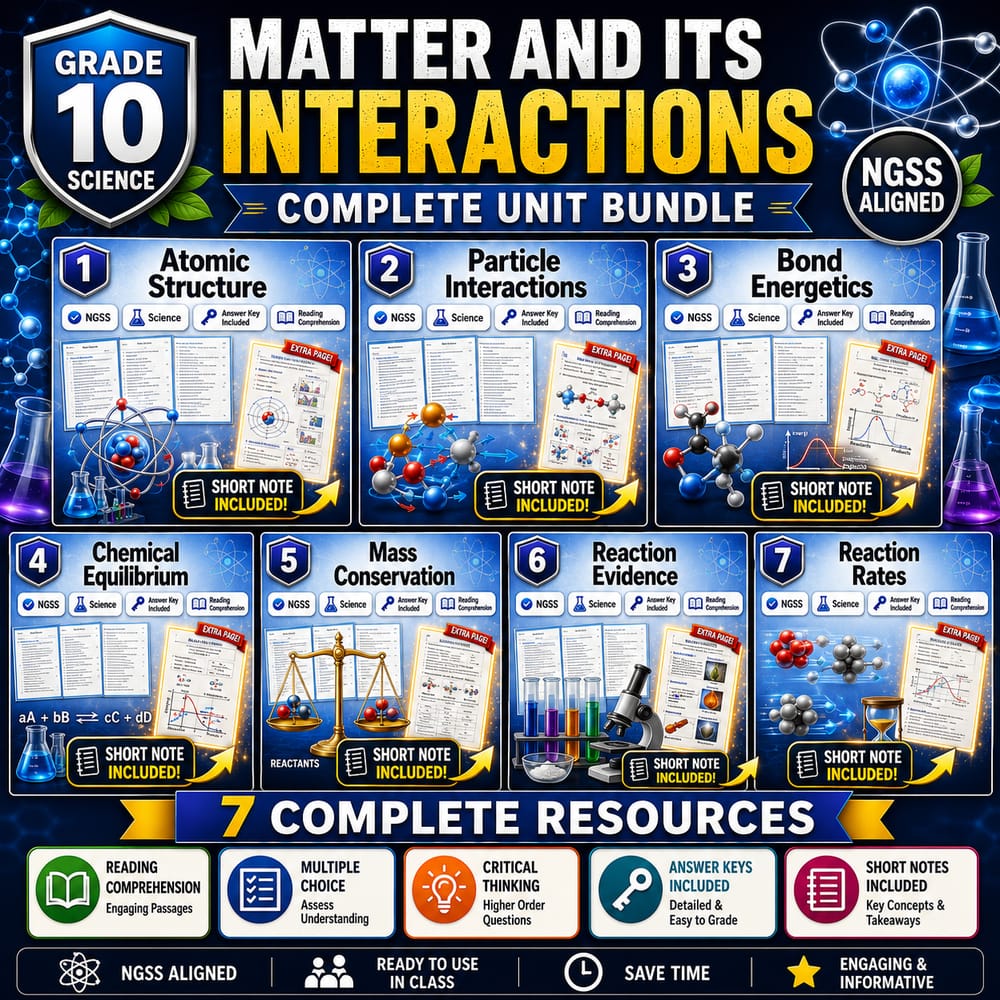
Matter and Its Interactions Lesson Bundle | Grade 10 Science | NGSS
$28.00$35.00Save $7.00
MTS Resources
New·0 followers·0 sales
SubjectScienceGradeGrade 10
What’s included
7 worksheets · Save $7.00 (20%) · prices shown inside the bundle
 Reaction Rates Worksheet | Assessment for Grade 10 Science printable PDF
- Explain reaction rates using collision theory, including effective collisions and activation energy.
- Use rate laws and qualitative relationships to predict how temperature, concentration, surface area, and catalysts affect reaction speed.
- Interpret empirical rate data by connecting collision frequency, energy distribution, and observed rate constants.
$4.00$5.00 Particle Interactions worksheet | NGSS Grade 10 Science printable PDF assessment
- Explain how crystal structure and molecular arrangement influence bulk physical properties.
- Compare ionic, metallic, and molecular solids using particle interactions and electrical conductivity.
- Use particle-level forces (lattice energy, dispersion forces, and hydrogen bonding) to predict melting points and solubility trends.
$4.00$5.00 Chemical Equilibrium Worksheet | Science Grade 10 Printable PDF Assessment
- Explain how Le Chatelier’s principle predicts shifts in equilibrium when pressure, concentration, and temperature change
- Use equilibrium concepts to describe the Haber process and factors that increase product yield
- Interpret equilibrium constants and compare qualitative vs. quantitative descriptions of equilibrium
$4.00$5.00 Reaction Evidence Worksheet | Grade 10 Science printable PDF NGSS aligned
- Use conservation of atoms and balanced equations to predict likely products of a chemical reaction
- Identify which observable evidence (gas, color, temperature, precipitate) supports specific product formation
- Connect reactant properties to observable outcomes using particle-level reasoning
$4.00$5.00 Bond Energetics Worksheet | Assessment for Grade 10 Science printable PDF
- Explain how bond formation and bond breaking are linked to energy changes during chemical reactions
- Distinguish exothermic and endothermic processes using bond enthalpy and qualitative energy diagrams
- Use relative bond strengths (single, double, triple) to predict whether reactions release or absorb heat
$4.00$5.00 Atomic Structure Worksheet for Grade 10 Science | NGSS Assessment
- Explain how atomic number and nuclear composition (protons and neutrons) relate to atomic mass and identity
- Use electron configurations and energy-level diagrams to predict valence electrons, ion formation, and trends
- Connect isotopes and average atomic mass to reactivity and expected oxidation states
$4.00$5.00 Mass Conservation Worksheet | Grade 10 Science Printable PDF Assessment
- Use balanced chemical equations to show conservation of atoms across reactants and products
- Apply mole and molar mass relationships to connect measured mass with predicted product amounts
- Use quantitative atom counts to verify invariant totals in combustion, synthesis, and precipitation reactions
$4.00$5.00
Reviews & Feedback
Loading reviews...
Questions & Answers
Loading questions…
About this bundle
Related categories
Frequently asked questions
Who is Matter and Its Interactions Lesson Bundle | Grade 10 Science | NGSS designed for?
Matter and Its Interactions Lesson Bundle | Grade 10 Science | NGSS is designed for Grade 10 students and Science learners and can be used in classrooms, homeschool, or independent practice.
How do I download Matter and Its Interactions Lesson Bundle | Grade 10 Science | NGSS?
Add it to your cart and complete checkout. After payment, you can download immediately from your account, and you'll also receive a download link by email.
Similar Products

Grade 7 Science Lesson Bundle – Matter and Its Interactions NGSS-Aligned
$28.00$35.00

Grade 6 Science Matter and Its Interactions Lesson Bundle | NGSS
$16.00$20.00

Matter and Its Interactions Lesson Bundle | Grade 8 Science | NGSS
$16.00$20.00

Grade 7 Matter and Its Interactions Science Lesson Bundle NGSS Worksheets
$28.00$35.00

Grade 10 Science Matter and Its Interactions Lesson Bundle | NGSS
$16.80$21.00