
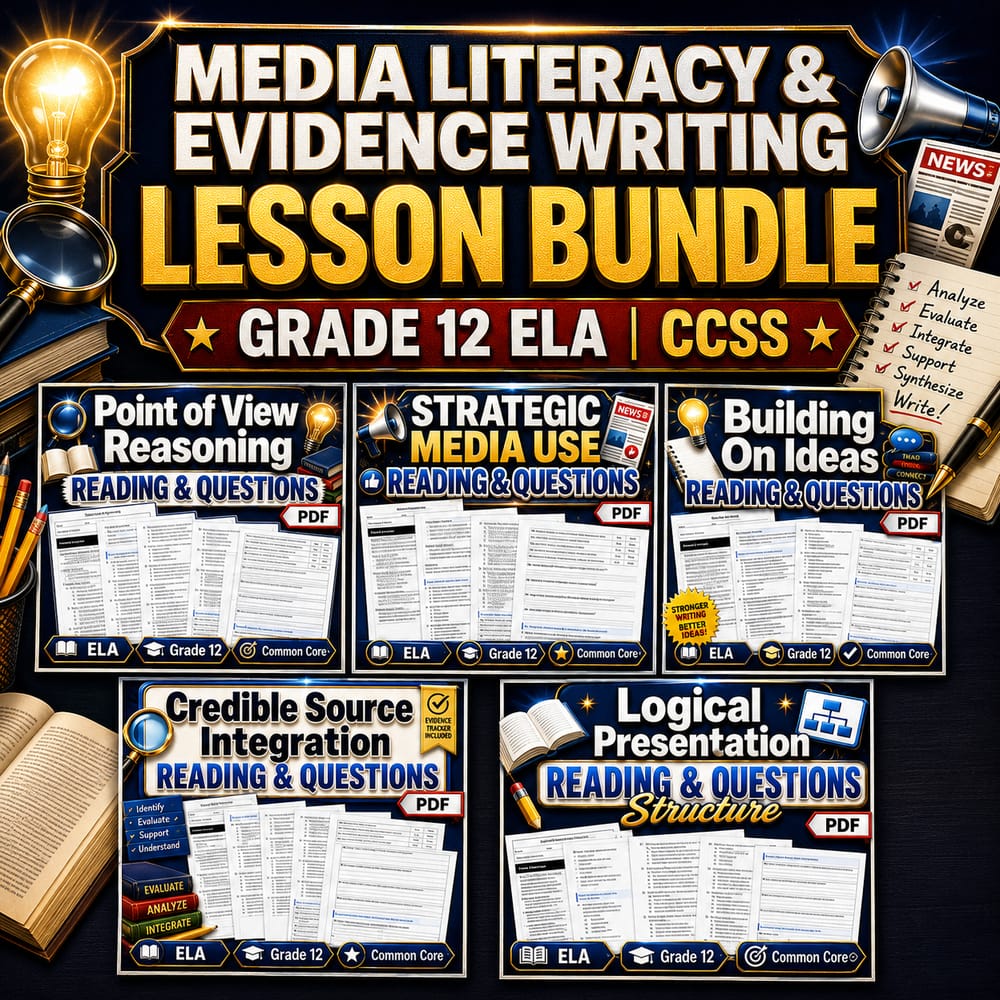
Media Literacy & Evidence Writing Lesson Bundle | Grade 12 ELA | CCSS
$16.00$20.00Save $4.00
Golden Apple Studio
New·2 followers·3 sales
SubjectELAGradeGrade 12Pages81 Pages
What’s included
5 worksheets · 81 pages · Save $4.00 (20%) · prices shown inside the bundle
 Point of View Reasoning Worksheet | Grade 12 ELA Literary Analysis
- Evaluate a speaker’s point of view by analyzing how claims are supported with evidence and reasoning.
- Distinguish evidence from opinion and identify unsupported leaps or exaggerated conclusions.
- Detect common fallacies (false cause, hasty generalization, misrepresentation, credibility attacks) and explain why they weaken arguments.
$3.20$4.00 Strategic Media Use Worksheet | Grade 12 ELA Media Literacy CCSS
- Explain how media choices (visuals, audio, digital elements) strengthen a presentation’s purpose and central line of reasoning.
- Evaluate whether media supports specific claims with credible evidence rather than functioning as decoration.
- Integrate media with clear context and accurate sourcing to avoid misleading impressions.
$3.20$4.00 Building on Ideas Worksheet | Grade 12 ELA Critical Thinking CCSS
- Use evidence-based sentence stems to respond directly to peers during a collaborative discussion.
- Demonstrate effective turn-taking by acknowledging agreement/disagreement and adding relevant information.
- Clarify misunderstandings by paraphrasing, asking targeted questions, and connecting comments to prior ideas.
$3.20$4.00 Credible Source Integration Worksheet | Grade 12 ELA Research CCSS
- Evaluate the credibility of claims by comparing evidence types, authorship, and data quality across multiple sources.
- Integrate information from written, audio, and visual materials into a clear discussion or presentation.
- Use reasoning to explain why one source is more reliable when sources agree or conflict.
$3.20$4.00 Logical Presentation Structure Worksheet | Grade 12 ELA CCSS Writing
- Analyze how claims, evidence, and explanations can be organized to create logical, coherent presentations
- Apply transitions and emphasis to connect main ideas to supporting details in a purposeful sequence
- Revise writing to strengthen the claim–evidence relationship and ensure conclusions follow directly from evidence
$3.20$4.00
Reviews & Feedback
Loading reviews...
Questions & Answers
Loading questions…
About this bundle
Related categories
Frequently asked questions
Who is Media Literacy & Evidence Writing Lesson Bundle | Grade 12 ELA | CCSS designed for?
Media Literacy & Evidence Writing Lesson Bundle | Grade 12 ELA | CCSS is designed for Grade 12 students and ELA learners and can be used in classrooms, homeschool, or independent practice.
How do I download Media Literacy & Evidence Writing Lesson Bundle | Grade 12 ELA | CCSS?
Add it to your cart and complete checkout. After payment, you can download immediately from your account, and you'll also receive a download link by email.
Similar Products

Grade 4 Media Literacy Lesson Bundle | Ontario ELA Worksheets
$12.00$15.00

Grade 6 Media Literacy and Evidence-Based ELA full-year bundle for Alberta
$140.00$200.00

Media Literacy and Reading Reasoning Lesson Bundle: Grade 12 ELA CCSS
$12.00$15.00

Grade 12 ELA Media Literacy Worksheets | Ontario Media Literacy
$14.40$18.00

Grade 6 Media Literacy Lesson Bundle | ELA BC
$12.00$15.00