
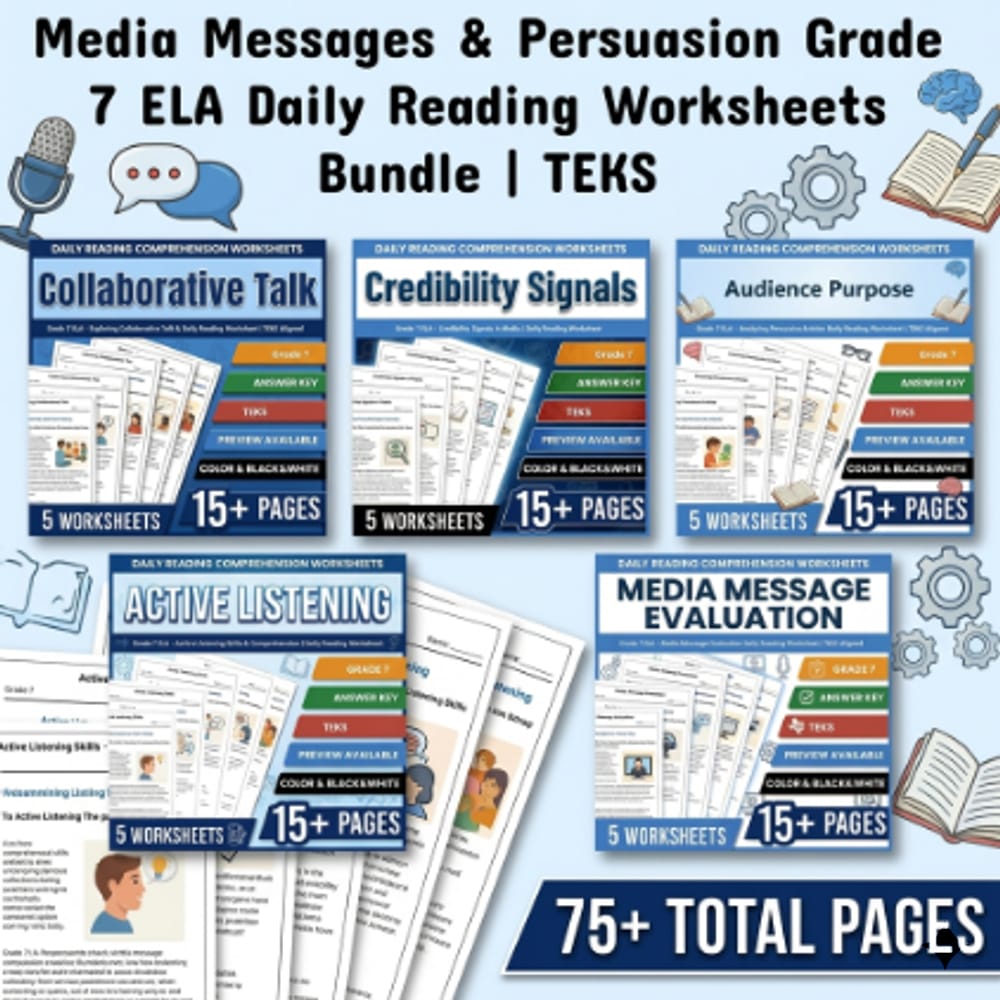
Media Messages & Persuasion Grade 7 ELA Daily Reading Worksheets Bundle | TEKS
$16.00$20.00Save $4.00
Quiet Forest Education
·3 followers·20 sales
SubjectELAGradeGrade 7Pages154 Pages
What’s included
5 worksheets · 154 pages · Save $4.00 (20%) · prices shown inside the bundle
 Grade 7 ELA – Exploring Collaborative Talk & Daily Worksheet | TEKS Aligned
- Understand the importance of listening carefully during discussions.
- Learn how to take turns and speak politely in group conversations.
- Identify examples of respectful communication and attentive listening.
$3.20$4.00 Grade 7 ELA – Credibility Signals in Media | Daily Reading Worksheet
- Learn to identify credible sources in media presentations.
- Understand how wording, framing, and repetition influence message interpretation.
- Evaluate evidence based on verifiability and source dependability.
$3.20$4.00 Grade 7 ELA – Analyzing Persuasive Articles Daily Worksheet | TEKS Aligned
- Identify the author's purpose in persuasive texts
- Determine the intended audience for a written piece
- Analyze how tone and evidence support the author's purpose
$3.20$4.00 Grade 7 ELA – Active Listening Skills & Comprehension | Daily Reading Worksheet
- Understand key concepts related to ELA
- Apply knowledge through practice questions
- Demonstrate comprehension of the material
$3.20$4.00 Grade 7 ELA – Media Message Evaluation Daily Reading Worksheet | TEKS Aligned
- Understand key concepts related to ELA
- Apply knowledge through practice questions
- Demonstrate comprehension of the material
$3.20$4.00
Reviews & Feedback
Loading reviews...
Questions & Answers
Loading questions…
About this bundle
Related categories
Frequently asked questions
Who is Media Messages & Persuasion Grade 7 ELA Daily Reading Worksheets Bundle | TEKS designed for?
Media Messages & Persuasion Grade 7 ELA Daily Reading Worksheets Bundle | TEKS is designed for Grade 7 students and ELA learners and can be used in classrooms, homeschool, or independent practice.
How do I download Media Messages & Persuasion Grade 7 ELA Daily Reading Worksheets Bundle | TEKS?
Add it to your cart and complete checkout. After payment, you can download immediately from your account, and you'll also receive a download link by email.


