
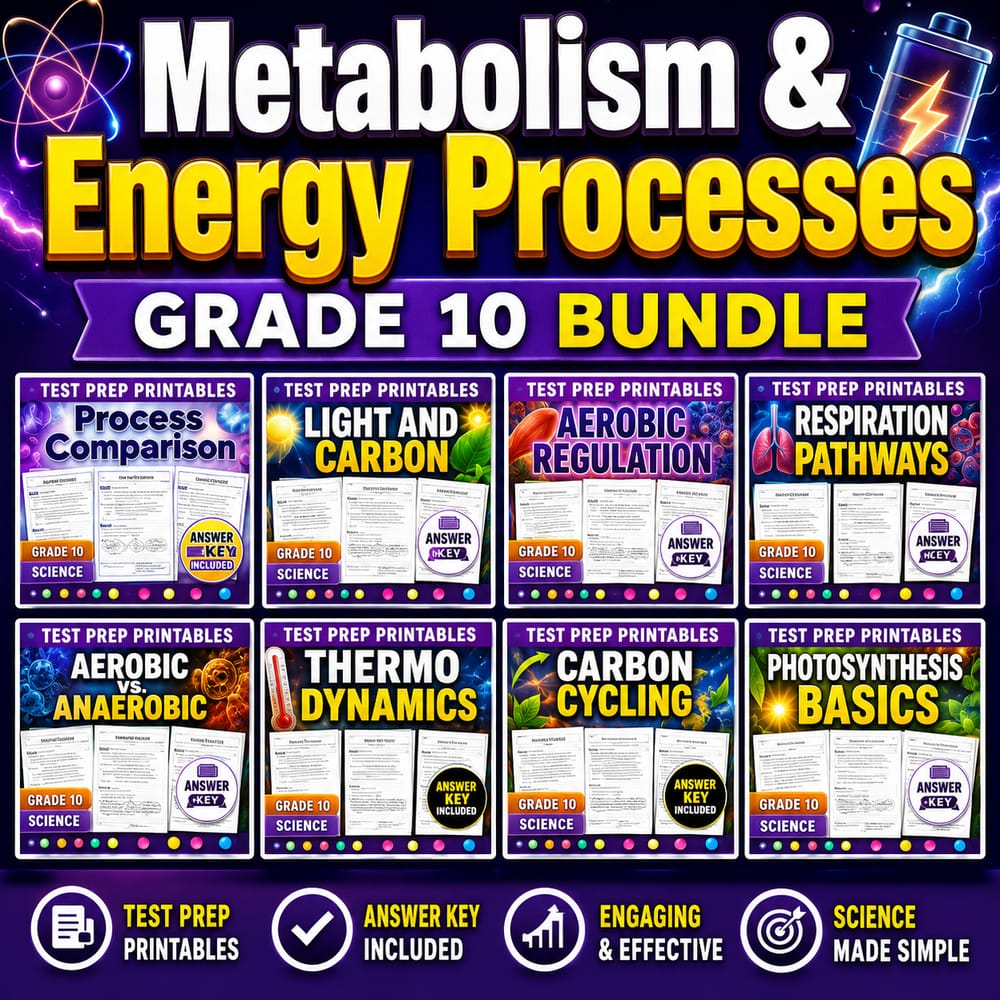
Metabolism & Energy Processes Lesson Bundle — Grade 10 Science TEKS
$40.00$50.00Save $10.00
Prism Point Learning
·2 followers·13 sales
SubjectScienceGradeGrade 10
What’s included
10 worksheets · Save $10.00 (20%) · prices shown inside the bundle
 Process Comparison Worksheet | Grade 10 Science Activities
- Compare photosynthesis and cellular respiration by identifying their inputs and outputs.
- Explain how carbon moves through biological systems in a reciprocal cycle.
- Connect energy transformations (light energy to ATP/chemical energy) across cellular and ecosystem scales.
$4.00$5.00 Light and Carbon Worksheet Pack | Grade 10 Science Activities
- Explain how the light-dependent reactions use light energy to drive electron flow, producing ATP and NADPH.
- Describe how the Calvin cycle uses ATP and NADPH to fix carbon dioxide into three-carbon sugars via RuBisCO.
- Compare how pigments and reaction location affect the efficiency of photosynthesis in different organisms.
$4.00$5.00 Metabolic Regulation Worksheet | Grade 10 Science Activities
- Explain how allosteric regulation and feedback inhibition control metabolic pathway flux.
- Describe how substrate availability and cellular signaling coordinate enzyme activity.
- Compare how covalent modification and hormonal signals (insulin and glucagon) shift metabolism.
$4.00$5.00 Respiration Pathways Worksheet | Grade 10 Science Activities
- Describe the main steps of cellular respiration and where they occur in the cell (cytosol vs. mitochondria).
- Explain how glycolysis, the citric acid cycle, and the electron transport chain help produce ATP.
- Identify the roles of electron carriers (such as NADH/FADH2) and oxygen as the final electron acceptor in aerobic respiration.
$4.00$5.00 Aerobic Versus Anaerobic Worksheet Pack | Grade 10 Science Practice
- Compare aerobic and anaerobic respiration based on oxygen use, ATP yield, and end products.
- Explain how fermentation regenerates NAD+ when oxygen is unavailable.
- Use cellular respiration concepts to predict how organisms respond to oxygen-limited conditions.
$4.00$5.00 Thermodynamics Worksheet Pack | Grade 10 Science Activities
- Explain how the first and second laws of thermodynamics apply to cellular metabolism and energy transformations.
- Describe how entropy increase relates to irreversible energy loss as heat in biological systems.
- Use Gibbs free energy ideas to predict whether a biochemical reaction is spontaneous and why coupling to ATP may be required.
$4.00$5.00 Carbon Cycling Worksheet | Grade 10 Science Activities
- Explain how carbon moves between the atmosphere, biosphere, hydrosphere, and geosphere
- Describe how photosynthesis and respiration affect the carbon cycle
- Evaluate how ocean uptake and long-term storage processes influence atmospheric CO2 over time
$4.00$5.00 Photosynthesis Basics Worksheet | Grade 10 Science Activities
- Explain how the light reactions convert light energy into ATP and NADPH in chloroplasts
- Describe how the Calvin cycle uses ATP and NADPH to convert carbon dioxide into sugars
- Connect photosynthesis to primary production and energy flow in ecosystems
$4.00$5.00 Energy Flow Worksheet | Grade 10 Science Activities
- Explain how energy moves through an ecosystem from sunlight to producers and then to consumers and decomposers.
- Describe how energy loss as heat at each trophic level affects energy transfer efficiency and food-chain length.
- Use net primary productivity to interpret how much energy becomes biomass.
$4.00$5.00 Energy Currency Worksheet | Grade 10 Science Activities
- Explain how ATP stores and releases usable energy through phosphate bond hydrolysis.
- Describe how ATP couples exergonic and endergonic reactions via phosphorylation.
- Summarize how ATP is regenerated by cellular processes such as oxidative phosphorylation and photophosphorylation.
$4.00$5.00
Reviews & Feedback
Loading reviews...
Questions & Answers
Loading questions…
About this bundle
Related categories
Frequently asked questions
Who is Metabolism & Energy Processes Lesson Bundle — Grade 10 Science TEKS designed for?
Metabolism & Energy Processes Lesson Bundle — Grade 10 Science TEKS is designed for Grade 10 students and Science learners and can be used in classrooms, homeschool, or independent practice.
How do I download Metabolism & Energy Processes Lesson Bundle — Grade 10 Science TEKS?
Add it to your cart and complete checkout. After payment, you can download immediately from your account, and you'll also receive a download link by email.
Similar Products

Grade 10 Metabolism & Energy Processes Science Worksheets Bundle | TEKS
$40.00$50.00

Grade 9 Science Lesson Group: Photosynthesis & Metabolism TEKS Bundle
$24.00$30.00

Grade 9 Metabolism and Energy Processes Biology Worksheets Bundle | TEKS
$40.00$50.00

Grade 9 Metabolism & Energy Processes Science Lesson Bundle: TEKS Framework
$40.00$50.00

Grade 9 Science | Photosynthesis & Metabolic Pathways Unit Bundle (TEKS Aligned)
$24.00$30.00