
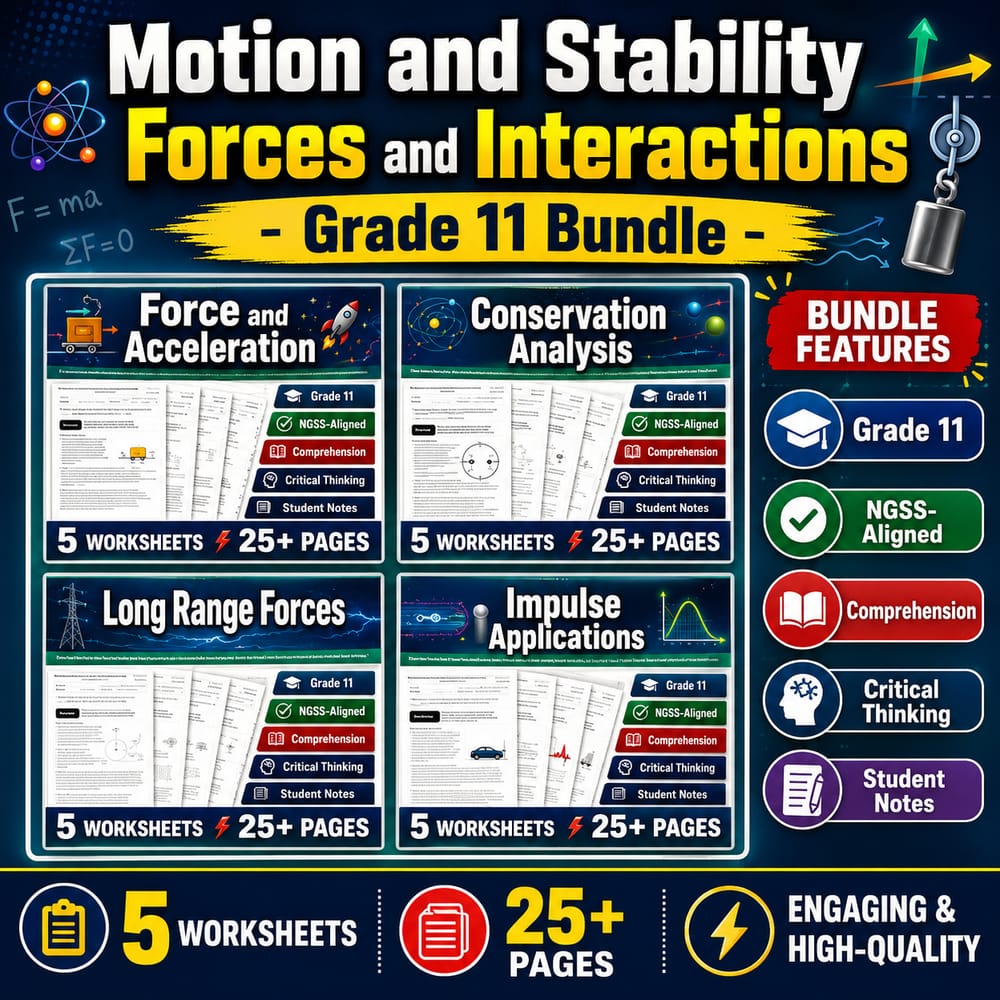
Motion Stability Forces G11 Science Daily Reading Worksheets Lesson Bundle |NGSS
$16.00$20.00Save $4.00
BRIGHT PATH RESOURCES
·3 followers·23 sales
SubjectScienceGradeGrade 11
What’s included
4 worksheets · Save $4.00 (20%) · prices shown inside the bundle
 Grade 11 Force and Acceleration Daily Reading Worksheet | NGSS Science
- Identify how net force relates to acceleration and mass using Newton’s second law.
- Distinguish net force from individual forces by interpreting direction and vector addition.
- Use concepts from the passage to explain qualitative changes in motion.
$4.00$5.00 Grade 11 Science Conservation Analysis Daily Reading Worksheet | NGSS
- Identify the closed-system assumption in a conservation problem.
- Determine which total quantity is conserved when external influences are negligible.
- Use conservation reasoning to explain pre- and post-interaction momentum changes.
$4.00$5.00 Grade 11 Science Daily Reading: Inverse-Square Forces in Action | NGSS Physics Worksheet
- Identify key facts about inverse-square force laws in a technical passage
- Use gravitational and electrostatic relationships to reason about how force changes with distance
- Interpret how vector addition helps determine the net force direction
$4.00$5.00 Grade 11 Impulse Applications Worksheet | Force, Time & Momentum | NGSS
- Explain how impulse relates to the change in momentum during a collision
- Interpret a force–time idea to predict how increasing collision time can reduce average force
- Use impulse–momentum reasoning to evaluate simple crash-protection design choices
$4.00$5.00
Reviews & Feedback
Loading reviews...
Questions & Answers
Loading questions…
About this bundle
Related categories
Frequently asked questions
Who is Motion Stability Forces G11 Science Daily Reading Worksheets Lesson Bundle |NGSS designed for?
Motion Stability Forces G11 Science Daily Reading Worksheets Lesson Bundle |NGSS is designed for Grade 11 students and Science learners and can be used in classrooms, homeschool, or independent practice.
How do I download Motion Stability Forces G11 Science Daily Reading Worksheets Lesson Bundle |NGSS?
Add it to your cart and complete checkout. After payment, you can download immediately from your account, and you'll also receive a download link by email.
Similar Products

Motion and Stability Grade 3 Science Daily Reading Worksheets Bundle | NGSS
$12.00$15.00

Grade 8 Motion Forces Energy Science Daily Reading Lesson Bundle | BC
$48.00$60.00

Grade 10 Forces & Motion Science Daily Reading Worksheets Lesson Bundle | BC
$48.00$60.00

Motion & Forces Grade 9 Science Daily Reading Worksheets Lesson Bundle | AP
$9.60$12.00

Motion & Forces Grade 11 Science Daily Reading Worksheets Lesson Bundle | BC
$48.00$60.00