
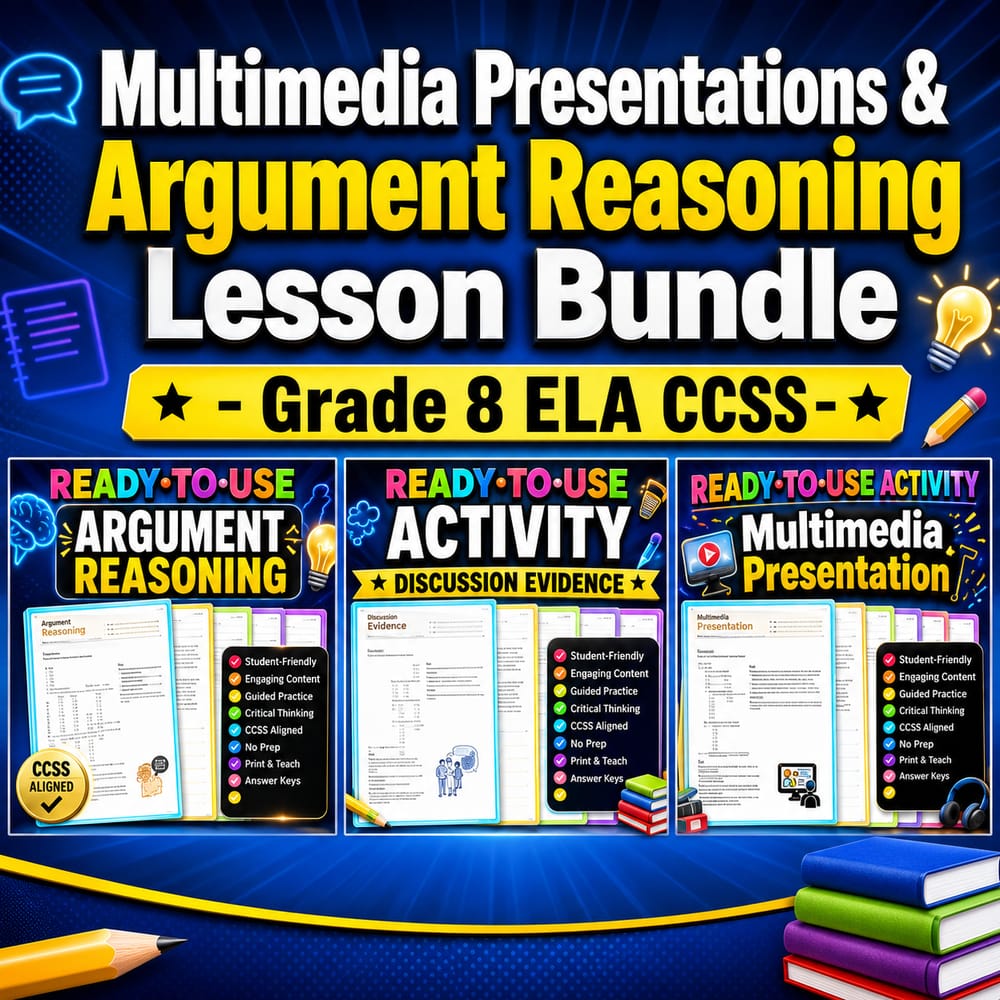
Multimedia Presentations & Argument Reasoning Lesson Bundle – Grade 8 ELA CCSS
$7.20$9.00Save $1.80
Sunny Desk Resources
·2 followers·18 sales
SubjectELAGradeGrade 8Pages33 Pages
What’s included
3 worksheets · 33 pages · Save $1.80 (20%) · prices shown inside the bundle
 Argument Reasoning Worksheet Pack | Grade 8 ELA Practice
- Identify a speaker’s main claim in an oral argument.
- Evaluate whether reasons connect logically to the claim using relevant, sufficient, and credible evidence.
- Analyze how counterpoints are addressed by assumptions, weaknesses, and missing support.
$2.40$3.00 Discussion Evidence Worksheet | Grade 8 ELA Practice and Assessment
- Use discussion stems to respond to a claim with relevant evidence from a text or referenced source
- Track how ideas connect across turns by refining, adding, or challenging details instead of repeating opinions
- Explain why evidence supports a claim using clear reasoning and polite academic language
$2.40$3.00 Multimedia Presentation Worksheet Pack | Grade 8 ELA Practice
- Identify how a strong multimedia presentation uses clear claims and connected reasoning supported by relevant evidence.
- Evaluate how organization, precise language, and multimedia visuals work together to clarify meaning and strengthen credibility and impact.
- Use effective presentation choices to address a prompt with an introduction, explanation, and conclusion that guide the audience.
$2.40$3.00
Reviews & Feedback
Loading reviews...
Questions & Answers
Loading questions…
About this bundle
Related categories
Frequently asked questions
Who is Multimedia Presentations & Argument Reasoning Lesson Bundle – Grade 8 ELA CCSS designed for?
Multimedia Presentations & Argument Reasoning Lesson Bundle – Grade 8 ELA CCSS is designed for Grade 8 students and ELA learners and can be used in classrooms, homeschool, or independent practice.
How do I download Multimedia Presentations & Argument Reasoning Lesson Bundle – Grade 8 ELA CCSS?
Add it to your cart and complete checkout. After payment, you can download immediately from your account, and you'll also receive a download link by email.
Similar Products

Grade 8 Multimedia Presentation, Argument Reasoning ELA Lesson Bundle CCSS
$7.20$9.00

Multimedia, Discussion & Argument Reasoning Lessons | Grade 8 ELA | Common Core
$9.60$12.00

Grade 5 ELA Multimedia Presentation & Discussion Lesson Bundle | CCSS
$6.40$8.00

Grade 11 Multimedia Integration & Argument Communication Lesson Bundle | General ELA
$9.60$12.00

Grade 5 ELA Multimedia Presentation & Accountable Discussion Lesson Bundle -CCSS
$4.80$6.00