
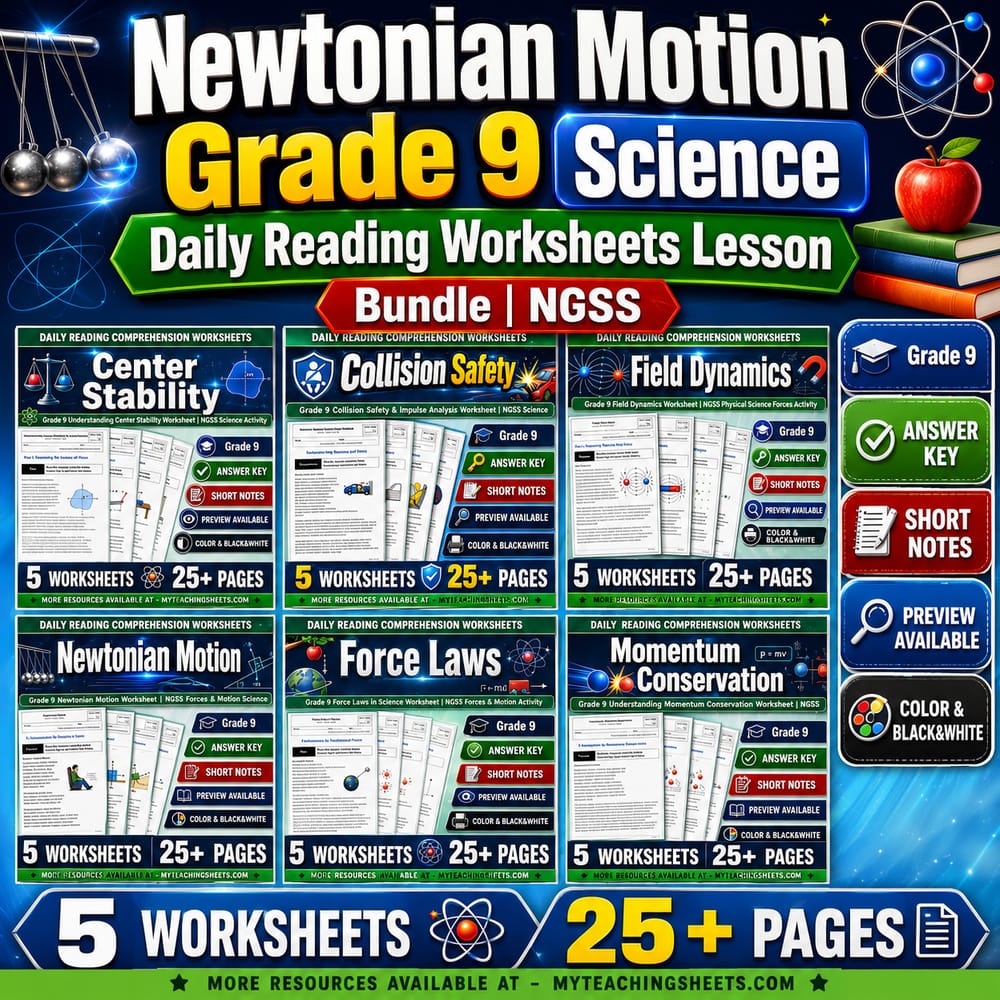
Newtonian Motion Grade 9 Science Daily Reading Worksheets Lesson Bundle | NGSS
$24.00$30.00Save $6.00
BRIGHT PATH RESOURCES
·3 followers·23 sales
SubjectScienceGradeGrade 9
What’s included
6 worksheets · Save $6.00 (20%) · prices shown inside the bundle
 Grade 9 Understanding Center Stability Worksheet | NGSS Science Activity
- Understand key concepts related to Science
- Apply knowledge through practice questions
- Demonstrate comprehension of the material
$4.00$5.00 Grade 9 Collision Safety & Impulse Analysis Worksheet | NGSS Science Activity
- Understand the concept of impulse and its relation to force and time during collisions.
- Interpret force-time graphs to analyze impact forces and interaction durations.
- Evaluate different safety features (crumple zones, airbags, helmets) in reducing peak forces during collisions.
$4.00$5.00 Grade 9 Field Dynamics Worksheet | NGSS Physical Science Forces Activity
- Understand the concept of electric field lines and how they represent force directions.
- Identify the use of field lines to determine field strength and direction.
- Analyze how magnetic fields influence moving charges and current-carrying conductors.
$4.00$5.00 Grade 9 Newtonian Motion Worksheet | NGSS Forces & Motion Science Activity
- Understand the basic concepts of Newton's first and second laws
- Analyze free-body diagrams and force components
- Relate net force to acceleration in constant mass systems
$4.00$5.00 Grade 9 Force Laws in Science Worksheet | NGSS Forces & Motion Activity
- Understand the concepts of gravitational and electrostatic forces
- Interpret and analyze inverse-square law relationships
- Calculate forces between celestial bodies and charged particles
$4.00$5.00 Grade 9 Understanding Momentum Conservation Worksheet | NGSS Physics Activity
- Define linear momentum and explain its significance in physics.
- Describe the principle of conservation of momentum in isolated systems.
- Distinguish between elastic and inelastic collisions using examples.
$4.00$5.00
Reviews & Feedback
Loading reviews...
Questions & Answers
Loading questions…
About this bundle
Related categories
Frequently asked questions
Who is Newtonian Motion Grade 9 Science Daily Reading Worksheets Lesson Bundle | NGSS designed for?
Newtonian Motion Grade 9 Science Daily Reading Worksheets Lesson Bundle | NGSS is designed for Grade 9 students and Science learners and can be used in classrooms, homeschool, or independent practice.
How do I download Newtonian Motion Grade 9 Science Daily Reading Worksheets Lesson Bundle | NGSS?
Add it to your cart and complete checkout. After payment, you can download immediately from your account, and you'll also receive a download link by email.
Similar Products

Newtonian Motion Grade 9 Science Daily Reading Worksheets Lesson Bundle | NGSS
$19.20$24.00

Grade 9 Newtonian Motion & Collisions Science Lesson Bundle NGSS
$24.00$30.00

Grade 9 Newtonian Motion and Forces Science Practice Lesson Bundle – NGSS
$24.00$30.00

Newtonian Motion, Momentum & Forces Lesson Bundle | Grade 9 Science | ngss
$19.20$24.00