Home/Product
Nutrient Cycling Worksheet for Grade 8 Science | Alberta Standards — worksheet preview unavailable

Nutrient Cycling Worksheet for Grade 8 Science | Alberta Standards

No rating yet
$5.00$8.00Save $3.00
M
MTS Resources
New·0 followers·0 sales
What you'll learn
Explain the processes involved in nutrient cycling within ecosystems.
Describe the roles of decomposers, nitrogen fixation, and sedimentation.
Analyze how environmental factors influence nutrient cycling rates.see more
Subject:Science
Grade:Grade 8
Type:Worksheet
Created 27 January 2026

Description

Overview

This Worksheet is designed for Grade 8 Science instruction and supports student learning of Nutrient Cycling. The worksheet aligns with Alberta and provides structured practice to reinforce key concepts.

Learning Objectives

  • Develop understanding of key ideas related to Nutrient Cycling
  • Strengthen subject-specific vocabulary and comprehension
  • Apply knowledge using a range of question types

What’s Included

  • Printable PDF worksheet
  • PDF answer key with rubric
  • 30 scaffolded questions

Classroom Applications

  • Independent practice
  • Whole-class instruction
  • Homework assignments
  • Review or assessment activities

Teacher Notes

This print-ready worksheet requires minimal preparation and is designed for easy classroom implementation. Clear instructions and structured questions help students work independently and confidently.

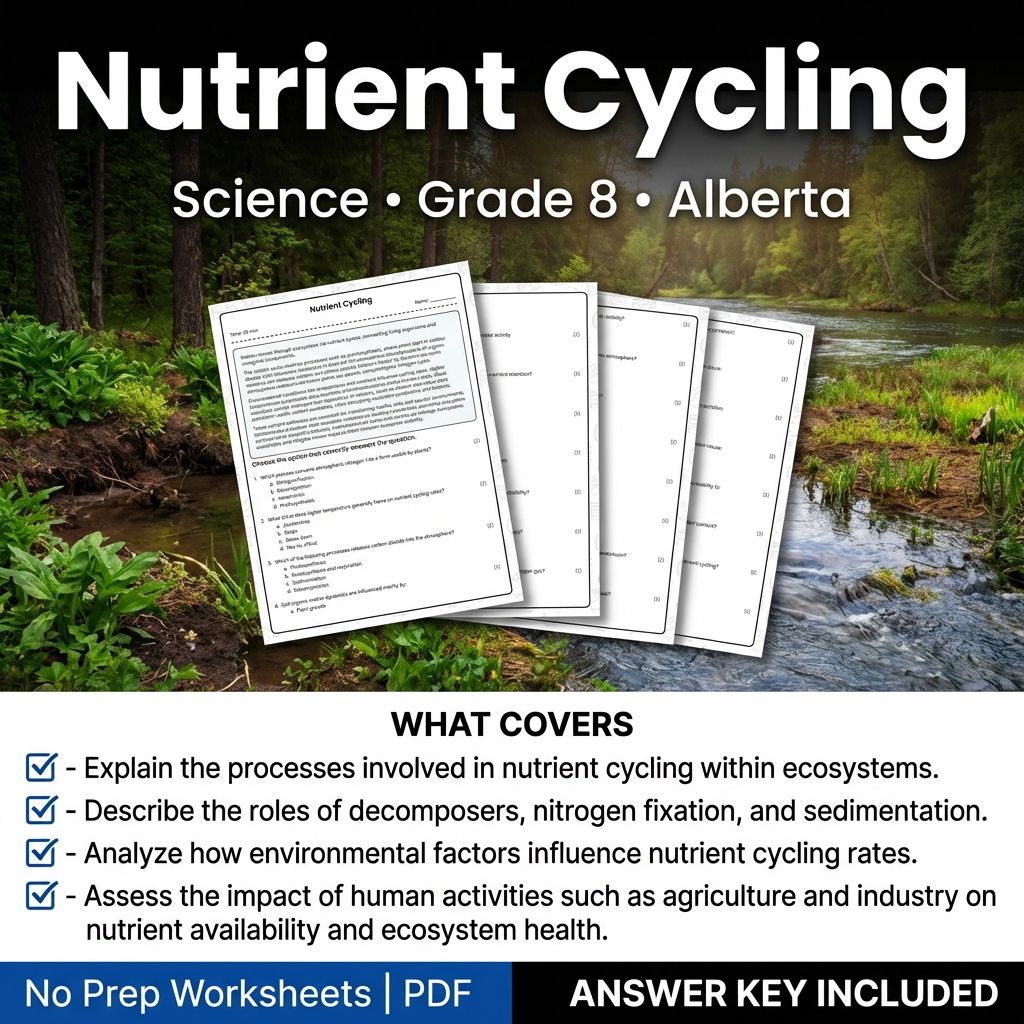
The worksheet titled Nutrient Cycling provides a comprehensive review of essential ecological processes for Grade 8 Science students. It features a variety of question types, including a reading passage and multiple-choice questions, to promote engagement and critical thinking about nutrient cycles in ecosystems.

Section 1 presents a reading passage that introduces students to matter movement through ecosystems and how nutrient cycles connect living organisms with inorganic components. This foundational text encourages students to understand the essential mechanisms behind nutrient exchange, fostering comprehension of complex ecological concepts.

Section 2 offers 30 multiple-choice questions designed to assess students’ grasp of key concepts from the passage. Questions such as, "Which process converts atmospheric nitrogen into a form usable by plants?" and "What effect does higher temperature generally have on nutrient cycling rates?" challenge students to recall and apply their knowledge effectively.

This worksheet is ideal for use as independent practice, a component of whole-class instruction, or as a review and assessment tool. Its clear layout and straightforward questions make it easy for teachers to incorporate into existing lesson plans and curricula.

The included PDF answer key with rubric supports quick grading and provides detailed assessment criteria, ensuring consistency and transparency in evaluating student responses. This resource is designed to be printed and used in the classroom with minimal setup, making it a reliable tool for busy educators.

Whether used as a homework assignment, classwork, or review activity, this worksheet helps reinforce students’ understanding of nutrient cycling, ecological interactions, and environmental science standards. Its alignment with Alberta standards ensures relevance for teachers seeking curriculum-specific resources.

About this worksheet

Related categories

Frequently asked questions

Who is Nutrient Cycling Worksheet for Grade 8 Science | Alberta Standards designed for?
Nutrient Cycling Worksheet for Grade 8 Science | Alberta Standards is designed for Grade 8 students and Science learners and can be used in classrooms, homeschool, or independent practice.
How do I download Nutrient Cycling Worksheet for Grade 8 Science | Alberta Standards?
Add the worksheet to your cart and complete checkout. After payment, you can download the PDF immediately from your account, and you'll also receive a download link by email.
What type of worksheet is this?
Nutrient Cycling Worksheet for Grade 8 Science | Alberta Standards is a worksheet worksheet for Science, suitable for Grade 8 level.

Reviews & Feedback

Loading reviews...