
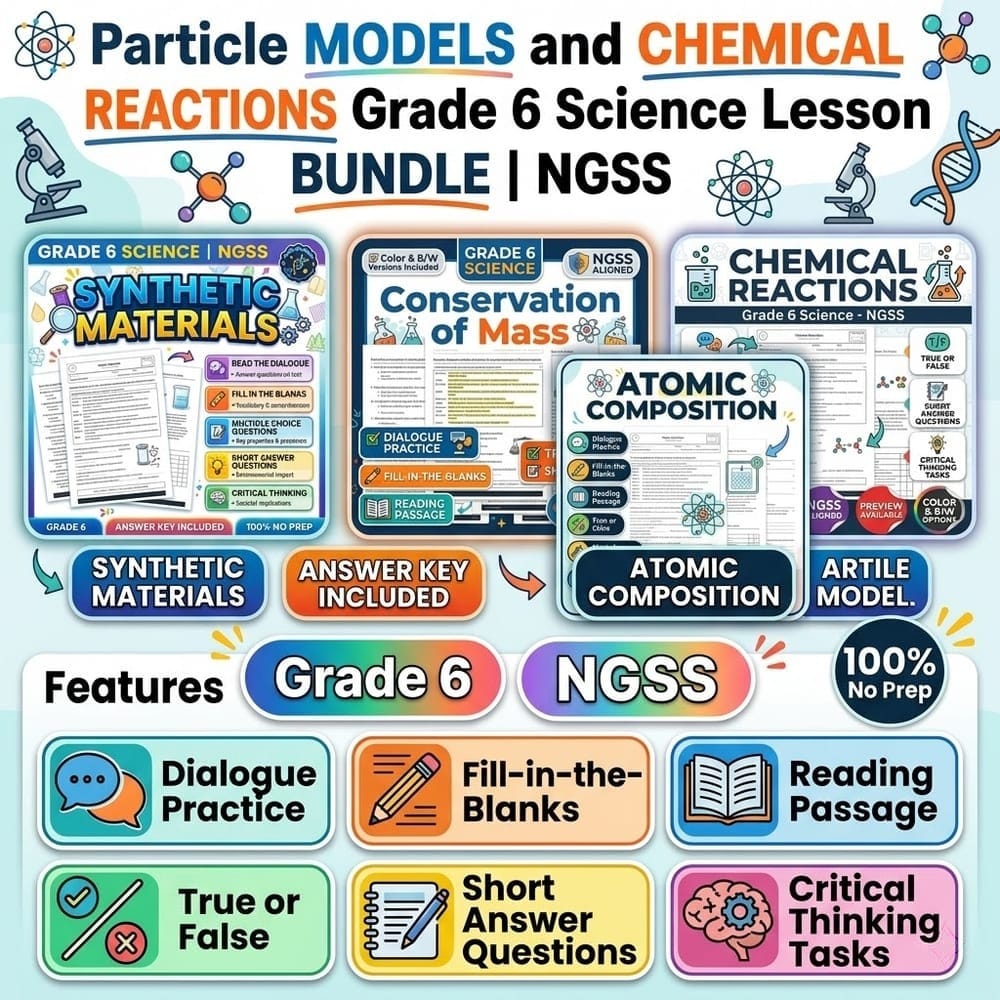
Particle Models and Chemical Reactions Grade 6 Science Lesson Bundle | NGSS
$20.00$25.00Save $5.00
J.S Sheets
New·3 followers·24 sales
SubjectScienceGradeGrade 6
What’s included
5 worksheets · Save $5.00 (20%) · prices shown inside the bundle
 Synthetic Materials Worksheet | NGSS-Aligned Grade 6 Science Practice
- Connect natural resources to the synthetic materials derived from them.
- Compare properties such as durability, flexibility, conductivity, and biodegradability of different materials.
- Describe the processes involved in resource extraction and material manufacturing.
$4.00$5.00 Conservation of Mass Worksheet | NGSS Grade 6 Science Practice
- Develop models that demonstrate the conservation of mass during physical and chemical changes.
- Trace atoms and total mass through various processes to understand matter conservation.
- Use particle-level diagrams and symbolic representations to illustrate atom counts remain constant.
$4.00$5.00 Chemical Reactions Worksheet | Standards-Aligned Practice for Grade 6 Science
- Identify key indicators that signal a chemical reaction has occurred.
- Analyze qualitative and quantitative data to determine if new substances are formed.
- Interpret measurements such as mass, temperature, and composition before and after reactions.
$4.00$5.00 Atomic Composition Worksheet | NGSS Grade 6 Science Practice
- Describe how atoms combine to form simple molecules like H2O and NaCl.
- Use models such as ball-and-stick and space-filling representations to illustrate molecules.
- Explain the relationship between molecular structure and observable patterns of matter.
$4.00$5.00 Particle Models Worksheet | NGSS Science Practice for Grade 6
- Describe matter as composed of tiny particles that are too small to see.
- Explain how particle motion, collisions, and spacing relate to phases and changes of state.
- Relate temperature and thermal energy to particle kinetic energy and pressure in gases.
$4.00$5.00
Reviews & Feedback
Loading reviews...
Questions & Answers
Loading questions…
About this bundle
Related categories
Frequently asked questions
Who is Particle Models and Chemical Reactions Grade 6 Science Lesson Bundle | NGSS designed for?
Particle Models and Chemical Reactions Grade 6 Science Lesson Bundle | NGSS is designed for Grade 6 students and Science learners and can be used in classrooms, homeschool, or independent practice.
How do I download Particle Models and Chemical Reactions Grade 6 Science Lesson Bundle | NGSS?
Add it to your cart and complete checkout. After payment, you can download immediately from your account, and you'll also receive a download link by email.
Similar Products

Grade 6 Science Unit Bundle | Chemical Reactions & Particle Models Worksheets
$8.00$10.00

Grade 6 Science | Atomic & Molecular Models, Conservation & Reactions | NGSS
$20.00$25.00

Grade 6 Particle Models Science Lesson Bundle for NGSS Assessment Worksheets
$20.00$25.00

Particle Model & Conservation Matter Grade 5 Science Lesson Bundle | NGSS
$12.00$15.00