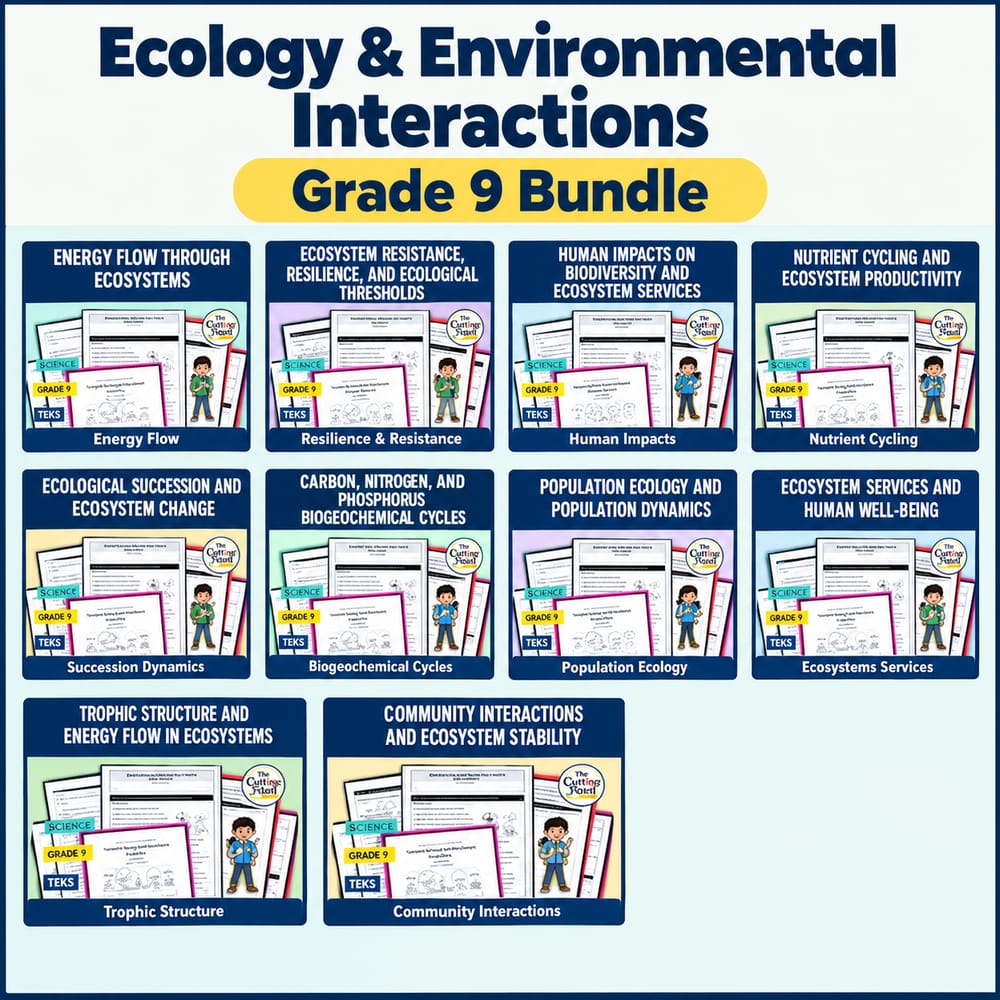
Pedigree Analysis and Genetic Inheritance Patterns Worksheet Grade 9 — bundle cover
Pedigree Analysis and Genetic Inheritance Patterns Worksheet Grade 9 — included worksheet 1
Pedigree Analysis and Genetic Inheritance Patterns Worksheet Grade 9 — included worksheet 2
Pedigree Analysis and Genetic Inheritance Patterns Worksheet Grade 9 — included worksheet 3
Pedigree Analysis and Genetic Inheritance Patterns Worksheet Grade 9 — included worksheet 4
Pedigree Analysis and Genetic Inheritance Patterns Worksheet Grade 9 — included worksheet 5
Pedigree Analysis and Genetic Inheritance Patterns Worksheet Grade 9 — included worksheet 6
Pedigree Analysis and Genetic Inheritance Patterns Worksheet Grade 9 — included worksheet 7
Pedigree Analysis and Genetic Inheritance Patterns Worksheet Grade 9 — included worksheet 8
Pedigree Analysis and Genetic Inheritance Patterns Worksheet Grade 9 — included worksheet 9
Pedigree Analysis and Genetic Inheritance Patterns Worksheet Grade 9 — included worksheet 10
Grade 9 Science worksheet — Pedigree Analysis and Genetic Inheritance Patterns Worksheet Grade 9

Description

Pedigree analysis and genetic inheritance patterns help Grade 9 Science students investigate how inherited traits appear across generations and how family history provides evidence about possible genotypes. This genetics and molecular biology worksheet guides students through pedigree symbols, inheritance modes, carrier status, probability, and the limits of conclusions drawn from family charts.

Read family patterns as genetic evidence

Students begin with a reading passage explaining how pedigrees represent biological relationships and traits. They examine the meaning of squares, circles, shaded symbols, and connecting lines, then consider why a pedigree may suggest an inheritance pattern without proving an individual's genotype. The passage introduces the distinctions between autosomal dominant and autosomal recessive inheritance, X-linked traits, mitochondrial inheritance, carriers, and incomplete penetrance.

These concepts are connected to realistic genetic reasoning. Students explore how two unaffected carrier parents can have a child who expresses an autosomal recessive condition, why mitochondrial traits are typically passed through the mother, and how patterns involving males and the absence of father-to-son transmission may provide evidence for a possible X-linked pattern. They also consider how molecular testing can add evidence to conclusions drawn from family history.

What students practise

  • Multiple-choice questions ask students to interpret pedigree symbols, distinguish inheritance patterns, identify carrier status, evaluate incomplete penetrance, and apply a recessive inheritance probability.
  • True-or-false statements reinforce the meaning of standardized pedigree symbols, the difference between carrying and expressing a recessive condition, mitochondrial inheritance, and the limits of probability estimates.
  • Short-answer prompts require students to explain how unaffected parents may have an affected child, compare X-linked and autosomal inheritance, and justify using molecular evidence alongside a pedigree.
  • A labeled-diagram activity, a categorization task, and a short-note activity provide additional ways to work with the topic.

Included with the worksheet

  • Printable student worksheet covering pedigree interpretation and inherited genetic patterns.
  • Student Notes lines at the bottom of the worksheet for recording key ideas.
  • A separate PDF answer key for checking responses.
  • A Teacher Guide inside the answer key PDF, including Learning Objectives, Teaching Tips, Discussion Questions, and Common Mistakes.

Use it for genetics instruction and review

Use this Grade 9 genetics worksheet during a lesson on heredity, as guided practice after introducing inheritance patterns, or as independent review to identify areas that need further explanation. The reading passage establishes key vocabulary before students apply it in questions and written explanations. The answer key supports response checking, while the accompanying Teacher Guide provides prompts for discussion and highlights common misconceptions to address.

The resource names TEKS as its curriculum framework, but no specific TEKS code is provided in the supplied details. Teachers can review the activities against their intended course requirements before assigning them. By combining pedigree symbols, family-chart evidence, inheritance probabilities, and molecular testing, the worksheet focuses on the reasoning students need to explain what a family pedigree can—and cannot—show.

Pedigree Analysis and Genetic Inheritance Patterns Worksheet Grade 9

$28.00$40.00Save $12.00
the curious pencil
·1 followers·3 sales
SubjectScienceGradeGrade 9Pages187 PagesSubject areaBiology, Basic Principles, ChemistryStandardsAligned to TEKS curriculumAnswer keyIncluded
Learning Objectives
Interpret standard pedigree symbols and biological relationships across generations
Distinguish autosomal, X-linked, and mitochondrial inheritance patterns
Explain how carrier status affects autosomal recessive inheritance

What’s included

10 worksheets · 187 pages · Save $12.00 (30%) · prices shown inside the bundle

  1. Energy Flow Through Ecosystems Worksheet Grade 9 Science
    Energy Flow Through Ecosystems Worksheet Grade 9 Science

    Grade 9 · Science · 18 Pages

    • Explain how photosynthesis stores light energy in organic molecules.
    • Trace energy transfer through producers and successive consumers.
    • Identify the trophic roles of herbivores, carnivores, and decomposers.
    $2.80$4.00
  2. Ecosystem Resistance and Resilience Worksheets | Grade 9 Ecology
    Ecosystem Resistance and Resilience Worksheets | Grade 9 Ecology

    Grade 9 · Science · 20 Pages

    • Distinguish ecosystem resistance from ecosystem resilience using examples.
    • Explain how disturbance frequency and severity affect ecosystem recovery.
    • Describe how biodiversity and habitat connectivity support resilience.
    $2.80$4.00
  3. Human Impacts on Biodiversity and Ecosystem Services Worksheet Grade 9
    Human Impacts on Biodiversity and Ecosystem Services Worksheet Grade 9

    Grade 9 · Science · 18 Pages

    • Define biodiversity and identify major human pressures on ecosystems.
    • Explain how habitat fragmentation affects population connectivity and survival.
    • Describe how fertilizer runoff can change aquatic ecosystem conditions.
    $2.80$4.00
  4. Nutrient Cycling and Ecosystem Productivity Worksheet Grade 9 Science
    Nutrient Cycling and Ecosystem Productivity Worksheet Grade 9 Science

    Grade 9 · Science · 18 Pages

    • Explain how nitrogen and phosphorus move through ecosystems.
    • Describe nitrogen fixation, assimilation, mineralization, and denitrification.
    • Distinguish the major pathways of nitrogen and phosphorus cycling.
    $2.80$4.00
  5. Ecological Succession Worksheet: Primary and Secondary Succession Grade 9
    Ecological Succession Worksheet: Primary and Secondary Succession Grade 9

    Grade 9 · Science · 18 Pages

    • Distinguish primary succession from secondary succession using soil conditions
    • Explain how pioneer species contribute to soil development
    • Identify factors that influence community composition during succession
    $2.80$4.00
  6. Biogeochemical Cycles Worksheet: Carbon, Nitrogen & Phosphorus Grade 9
    Biogeochemical Cycles Worksheet: Carbon, Nitrogen & Phosphorus Grade 9

    Grade 9 · Science · 18 Pages

    • Identify reservoirs in the atmosphere, hydrosphere, lithosphere, and biosphere
    • Explain how photosynthesis and decomposition transfer carbon
    • Describe nitrogen fixation and its role in nitrogen cycling
    $2.80$4.00
  7. Population Ecology and Dynamics Worksheet for Grade 9 Science
    Population Ecology and Dynamics Worksheet for Grade 9 Science

    Grade 9 · Science · 20 Pages

    • Explain how reproduction, mortality, immigration, and emigration change population size
    • Describe carrying capacity in relation to available environmental resources
    • Distinguish density-dependent factors from density-independent factors
    $2.80$4.00
  8. Ecosystem Services Worksheet: Biodiversity and Human Well-Being Grade 9
    Ecosystem Services Worksheet: Biodiversity and Human Well-Being Grade 9

    Grade 9 · Science · 20 Pages

    • Classify ecosystem services by their functions and benefits.
    • Explain how biodiversity supports pollination and nutrient cycling.
    • Describe how ecosystems contribute to water purification and carbon sequestration.
    $2.80$4.00
  9. Trophic Structure and Energy Flow in Ecosystems Worksheet Grade 9
    Trophic Structure and Energy Flow in Ecosystems Worksheet Grade 9

    Grade 9 · Science · 18 Pages

    • Distinguish producers, consumers, and decomposers by their ecological roles
    • Interpret food chains and food webs to trace energy pathways
    • Explain how trophic efficiency affects biomass at higher levels
    $2.80$4.00
  10. Ecosystem Interactions Worksheet for Grade 9 Science: Ecology
    Ecosystem Interactions Worksheet for Grade 9 Science: Ecology

    Grade 9 · Science · 19 Pages

    • Identify competition, predation, herbivory, parasitism, and mutualism
    • Explain how species interactions influence population sizes and distributions
    • Describe how resource partitioning reduces direct competition
    $2.80$4.00

Reviews & Feedback

Loading reviews...

Questions & Answers

Loading questions…

About this bundle

Related categories

Frequently asked questions

Who is Pedigree Analysis and Genetic Inheritance Patterns Worksheet Grade 9 designed for?
Pedigree Analysis and Genetic Inheritance Patterns Worksheet Grade 9 is designed for Grade 9 students and Science learners and can be used in classrooms, homeschool, or independent practice.
How do I download Pedigree Analysis and Genetic Inheritance Patterns Worksheet Grade 9?
Add it to your cart and complete checkout. After payment, you can download immediately from your account, and you'll also receive a download link by email.