
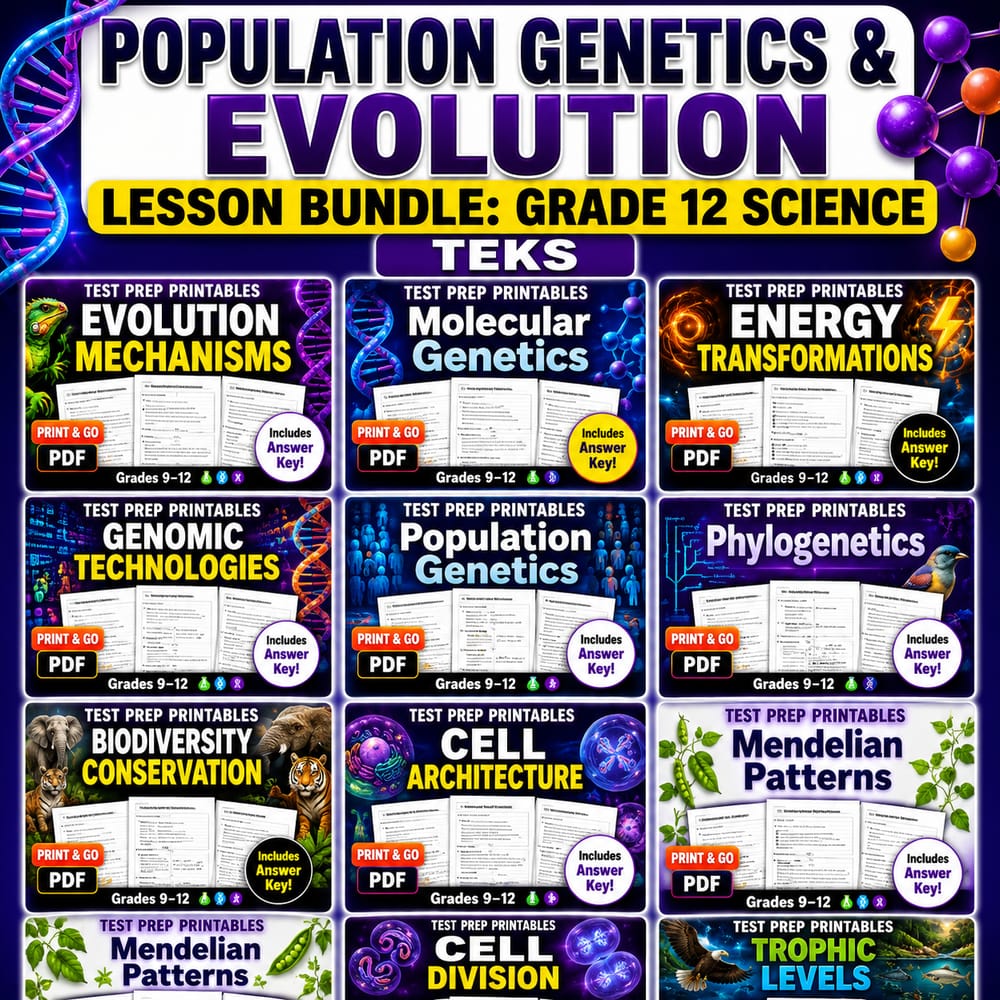
Population Genetics & Evolution Lesson Bundle: Grade 12 Science TEKS
$40.00$50.00Save $10.00
Prism Point Learning
·2 followers·13 sales
SubjectScienceGradeGrade 12
What’s included
10 worksheets · Save $10.00 (20%) · prices shown inside the bundle
 Evolution Mechanisms Worksheet | Grade 12 Science Activities
- Explain how natural selection, genetic drift, gene flow, and mutation generate biological diversity at the population level.
- Evaluate evidence for evolution using paleontology, comparative anatomy, and molecular homology.
- Apply concepts of phenotype fitness and selection pressures to predict changes in allele frequencies over time.
$4.00$5.00 Molecular Genetics Worksheet | Grade 12 Science Activities
- Explain how DNA sequence information is converted into protein function through replication, transcription, and translation.
- Analyze how mutations (point, frameshift, and chromosomal rearrangements) can change genotype-to-phenotype outcomes.
- Describe how gene expression regulation and epigenetic modifications influence when and where genes are expressed.
$4.00$5.00 Energy Transformations Worksheet | Grade 12 Science Practice
- Explain how photosynthetic light reactions and dark reactions convert energy and manage electron flow.
- Compare aerobic and anaerobic cellular respiration in terms of energy yield and end products.
- Describe how electron transport chains and chemiosmosis drive ATP synthesis across membranes.
$4.00$5.00 Genomic Technologies Worksheet | Grade 12 Science Practice
- Explain how PCR, DNA sequencing, cloning, and CRISPR–Cas editing are used to analyze and modify genetic material
- Interpret genomic data by linking sequencing errors, SNPs, and copy number variation to inheritance and diagnosis
- Evaluate ethical considerations and limitations when using genomic technologies
$4.00$5.00 Population Genetics Worksheet | Grade 12 Science Practice
- Use Hardy–Weinberg equilibrium to connect allele and genotype frequencies to microevolutionary change
- Explain how selection, genetic drift, and migration alter allele and genotype frequencies over generations
- Interpret heterozygosity, effective population size, and fixation indices as measures of genetic variation
$4.00$5.00 Phylogenetics Worksheet | Grade 12 Science Activities
- Explain how molecular data and morphological characters can be combined to infer evolutionary relationships
- Describe how sequence alignment, cladogram/phylogram inference, and substitution model selection are used in phylogenetic analysis
- Interpret monophyly, paraphyly, and polyphyly and connect them to taxonomic revision
$4.00$5.00 Cell Division Worksheet | Grade 12 Science Activities
- Explain how mitosis and meiosis produce different chromosome outcomes and support different biological roles
- Describe how chromosome segregation, homologous recombination, and cell-cycle checkpoints maintain genomic integrity
- Interpret karyotypes and nondisjunction consequences to predict changes in inheritance and phenotype
$4.00$5.00 Biodiversity Conservation Worksheet | Grade 12 Science Activities
- Explain major patterns and causes of biodiversity loss, including habitat fragmentation, invasive species, overexploitation, and climate change.
- Distinguish measures of biodiversity such as species richness, evenness, and functional and genetic diversity.
- Evaluate conservation strategies including protected areas, restoration ecology, and genetic management.
$4.00$5.00 Cell Architecture Worksheet | Grade 12 Science Practice TEKS
- Compare structural features of prokaryotic and eukaryotic cells and relate them to specific functions.
- Explain how membrane composition and compartmentalization influence subcellular processes.
- Use microscopy and localization ideas to interpret organelle morphology and macromolecule distribution.
$4.00$5.00 Mendelian Patterns Worksheet | Grade 12 Science Assessments
- Distinguish classical Mendelian inheritance from extended inheritance models such as incomplete dominance, codominance, polygenic inheritance, and sex-linked traits
- Interpret genotype expectations from Punnett squares and explain how dominance, dominance hierarchies, and environmental effects can change outcomes
- Use pedigree patterns and linkage/recombination concepts to predict and evaluate trait transmission
$4.00$5.00
Reviews & Feedback
Loading reviews...
Questions & Answers
Loading questions…
About this bundle
Related categories
Frequently asked questions
Who is Population Genetics & Evolution Lesson Bundle: Grade 12 Science TEKS designed for?
Population Genetics & Evolution Lesson Bundle: Grade 12 Science TEKS is designed for Grade 12 students and Science learners and can be used in classrooms, homeschool, or independent practice.
How do I download Population Genetics & Evolution Lesson Bundle: Grade 12 Science TEKS?
Add it to your cart and complete checkout. After payment, you can download immediately from your account, and you'll also receive a download link by email.
Similar Products

Evolution & Population Genetics Lesson Bundle – Grade 11 Science NGSS
$11.20$16.00

Grade 10 Population, Genetics, and Cellular Processes Science Lesson Bundle AP
$44.00$55.00

Grade 11 Science | Biological Evolution & Population Genetics Worksheet Bundle
$6.40$8.00

Grade 11 Science - Evolution & Population Genetics NGSS Assessment Bundle
$16.00$20.00

Grade 11 Population, Genetics & Energy Systems Science Lesson Bundle: Florida NGSSS
$48.00$60.00