
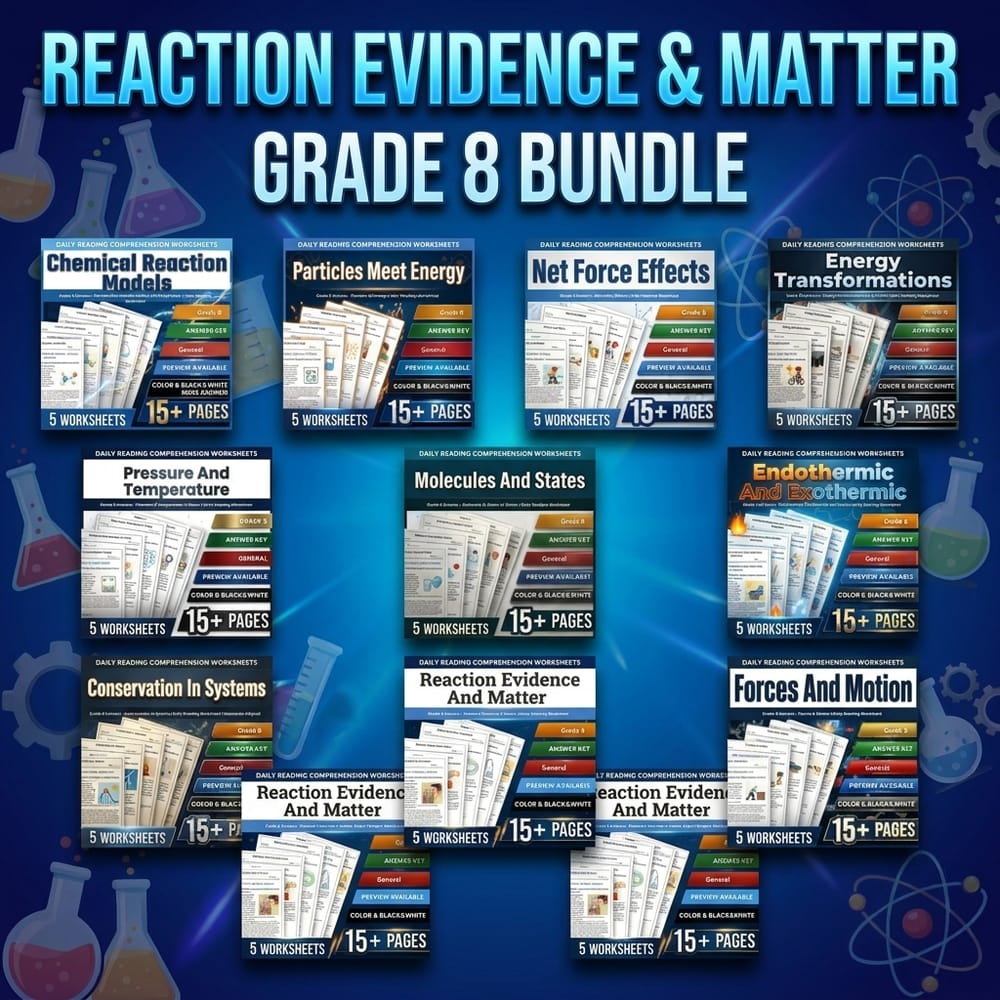
Reaction Evidence & Matter Grade 8 Science Lesson Bundle | General Framework
$32.00$40.00Save $8.00
Bright Mind Resources
New·1 followers·12 sales
SubjectScienceGradeGrade 8
What’s included
10 worksheets · Save $8.00 (20%) · prices shown inside the bundle
 Grade 8 Science – Chemical Reaction Models & Concept Review | Reading Worksheet
- Understand how particle models explain chemical reactions.
- Identify changes in atom bonding during reactions.
- Describe how energy changes are related to observable evidence.
$3.20$4.00 Grade 8 Science – Particles & Energy | Daily Reading Worksheet
- Understand how particles change during chemical reactions
- Identify energy changes associated with reactions
- Explain the relationship between particle rearrangements and temperature changes
$3.20$4.00 Grade 8 Science – Net Force Effects | Daily Reading Worksheet
- Understand the concept of net force and how it influences motion.
- Identify various forces acting on an object, such as weight and friction.
- Describe how forces that are balanced or unbalanced affect an object's movement.
$3.20$4.00 Grade 8 Science – Energy Transformations & Forms | Daily Reading Worksheet
- Identify different types of energy involved in physical processes
- Describe how energy transforms from one form to another
- Illustrate real-life examples of energy transfer and transformation
$3.20$4.00 Grade 8 Science – Pressure & Temperature in Gases | Daily Reading Worksheet
- Understand how gas particles move and collide.
- Explain the relationship between particle motion, pressure, and temperature.
- Describe how temperature affects the speed of gas particles.
$3.20$4.00 Grade 8 Science – Molecules & States of Matter | Daily Reading Worksheet
- Understand the different states of matter: solids, liquids, and gases.
- Describe how particles are arranged and move in each state.
- Explain how temperature affects particle motion and state changes.
$3.20$4.00 Grade 8 Science – Endothermic & Exothermic Reactions | Daily Reading Worksheet
- Define endothermic and exothermic reactions.
- Identify examples of each reaction type.
- Explain energy changes in particle motion and bonding.
$3.20$4.00 Grade 8 Science – Conservation In Systems Reading Worksheet | Standards-Aligned
- Understand the principle of energy conservation in physical systems
- Identify how energy transforms between different forms during motion
- Explain real-world examples of energy conservation such as roller coasters
$3.20$4.00 Grade 8 Science – Reaction Evidence & Matter | Daily Reading Worksheet
- Identify signs indicating a chemical reaction
- Understand that atoms are conserved during reactions
- Recognize physical evidence of chemical changes
$3.20$4.00 Grade 8 Science – Forces & Motion | Daily Reading Worksheet
- Understand the definition of force and its characteristics.
- Identify different types of forces such as push, pull, gravity, and friction.
- Explain how forces affect the motion of objects.
$3.20$4.00
Reviews & Feedback
Loading reviews...
Questions & Answers
Loading questions…
About this bundle
Related categories
Frequently asked questions
Who is Reaction Evidence & Matter Grade 8 Science Lesson Bundle | General Framework designed for?
Reaction Evidence & Matter Grade 8 Science Lesson Bundle | General Framework is designed for Grade 8 students and Science learners and can be used in classrooms, homeschool, or independent practice.
How do I download Reaction Evidence & Matter Grade 8 Science Lesson Bundle | General Framework?
Add it to your cart and complete checkout. After payment, you can download immediately from your account, and you'll also receive a download link by email.
Similar Products

Grade 8 Science Lesson – Reaction Types & Evidence Assessment Bundle
$60.00$75.00

Grade 7 Science Lesson Bundle | BC Framework on Matter & Reactions Worksheets
$36.00$45.00

Grade 9 Chemical Reactions Science Lesson Bundle: Alberta Framework
$60.00$75.00

Grade 12 Matter and Energy Science Lesson Bundle: General Framework
$36.00$45.00