
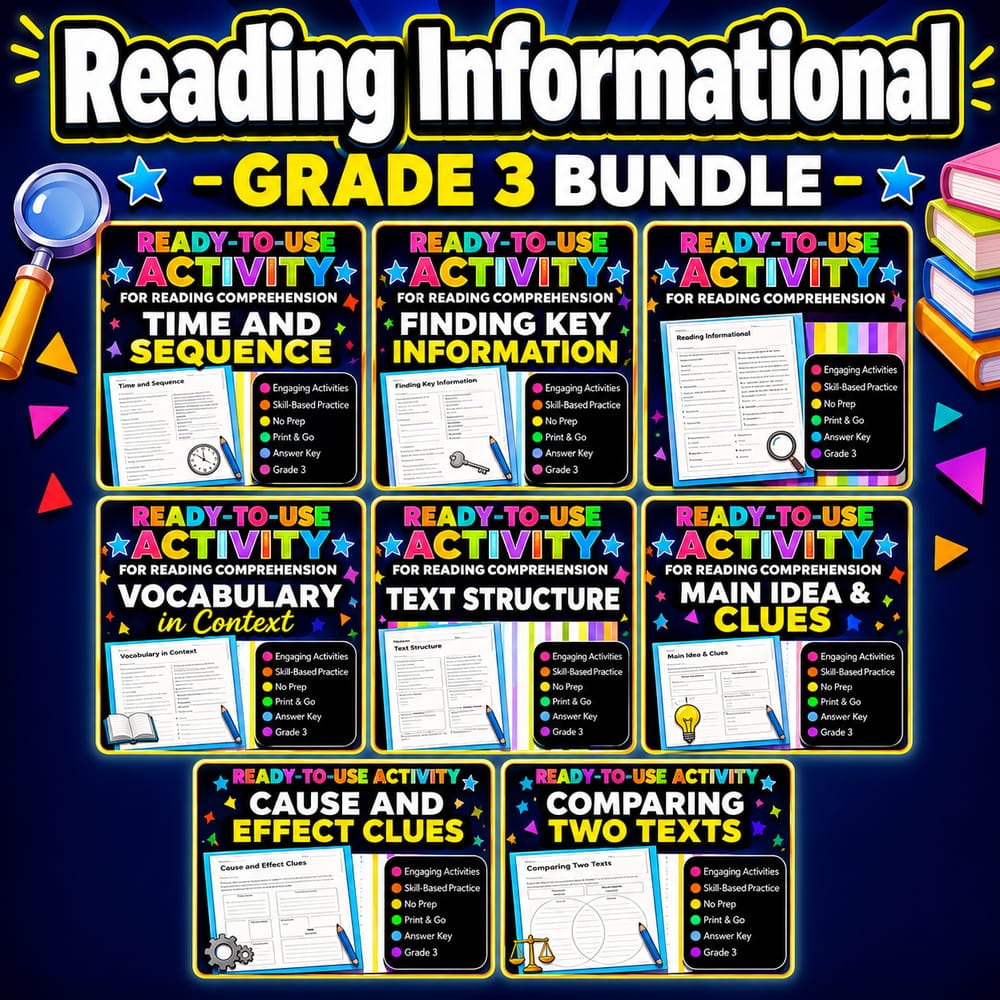
Reading Informational Lesson Bundle | Grade 3 ELA | CCSS
$19.20$24.00Save $4.80
Sunny Desk Resources
·2 followers·18 sales
SubjectELAGradeGrade 3Pages88 Pages
What’s included
8 worksheets · 88 pages · Save $4.80 (20%) · prices shown inside the bundle
 Time and Sequence Worksheet Pack | Grade 3 ELA Activities
- Use time and sequence words (first, next, then, after) to explain the order of events or steps.
- Identify time-order clues (before, after, earlier, later, during) in informational text.
- Write and revise short explanations so the details match the correct moment in time.
$2.40$3.00 Finding Key Information Worksheet Pack | Grade 3 ELA Practice
- Identify how text features (headings, subheadings, captions, bold terms, diagrams, and glossary entries) help readers locate key information in informational texts.
- Use a table of contents, index, and (if available) a search function to find answers to specific questions.
- Verify that the information you find matches your information need by rereading the surrounding text.
$2.40$3.00 Word Meaning Across Texts Worksheet Pack | Grade 3 ELA Practice
- Explain how context helps refine the meaning of a word across different texts
- Compare how the same term is used in two texts to decide whether the meaning stays the same or changes
- Use evidence from definitions, examples, and descriptions to support word-meaning choices
$2.40$3.00 Vocabulary in Context Worksheet Pack | Grade 3 ELA Practice
- Use surrounding sentences (context clues) to determine the meaning of unknown vocabulary words.
- Identify common context clue types such as examples, comparisons, and restatements.
- Choose the correct meaning of a word when it has more than one definition.
$2.40$3.00 Text Based Questions Worksheet Pack | Grade 3 ELA Practice
- Ask and answer questions about an informational text using details found in the text.
- Use text evidence to explain facts, definitions, and reasons stated in the passage.
- Distinguish between ideas that are stated in the text and ideas that are only implied.
$2.40$3.00 Main Idea Clues Worksheet Pack | Grade 3 ELA Practice
- Identify the main idea of an informational text using clues such as headings, topic sentences, and repeated ideas
- Explain how key details support and develop the main idea
- Use main-idea clues and key details to write a clear summary
$2.40$3.00 Cause Effect Links Worksheet Pack | Grade 3 ELA Practice
- Explain how a cause and its effect connect using informational signal words.
- Identify signal words such as because, so, therefore, and as a result in a short text.
- Write cause-and-effect statements that link an action to an outcome.
$2.40$3.00 Comparing Two Texts Worksheet Pack | Grade 3 ELA Practice
- Identify key points and key details in two informational texts.
- Compare similarities and differences using shared categories (such as time of day).
- Use text evidence to explain how two texts handle related ideas in different ways.
$2.40$3.00
Reviews & Feedback
Loading reviews...
Questions & Answers
Loading questions…
About this bundle
Related categories
Frequently asked questions
Who is Reading Informational Lesson Bundle | Grade 3 ELA | CCSS designed for?
Reading Informational Lesson Bundle | Grade 3 ELA | CCSS is designed for Grade 3 students and ELA learners and can be used in classrooms, homeschool, or independent practice.
How do I download Reading Informational Lesson Bundle | Grade 3 ELA | CCSS?
Add it to your cart and complete checkout. After payment, you can download immediately from your account, and you'll also receive a download link by email.
Similar Products

Grade 12 Reading Informational ELA Lesson Bundle for Daily Reading | General ELA
$19.20$24.00

Reading Informational Lesson Bundle | Grade 9 ELA | General ELA
$19.20$24.00

Grade 12 Reading Informational Text ELA Lesson Bundle | CCSS Daily Worksheets
$25.60$32.00

Grade 3 ELA Reading Comprehension & Vocabulary Lesson Bundle | CCSS
$25.60$32.00

Grade 11 Reading Informational Text ELA Lesson Bundle – CCSS Daily Worksheets
$22.40$28.00