
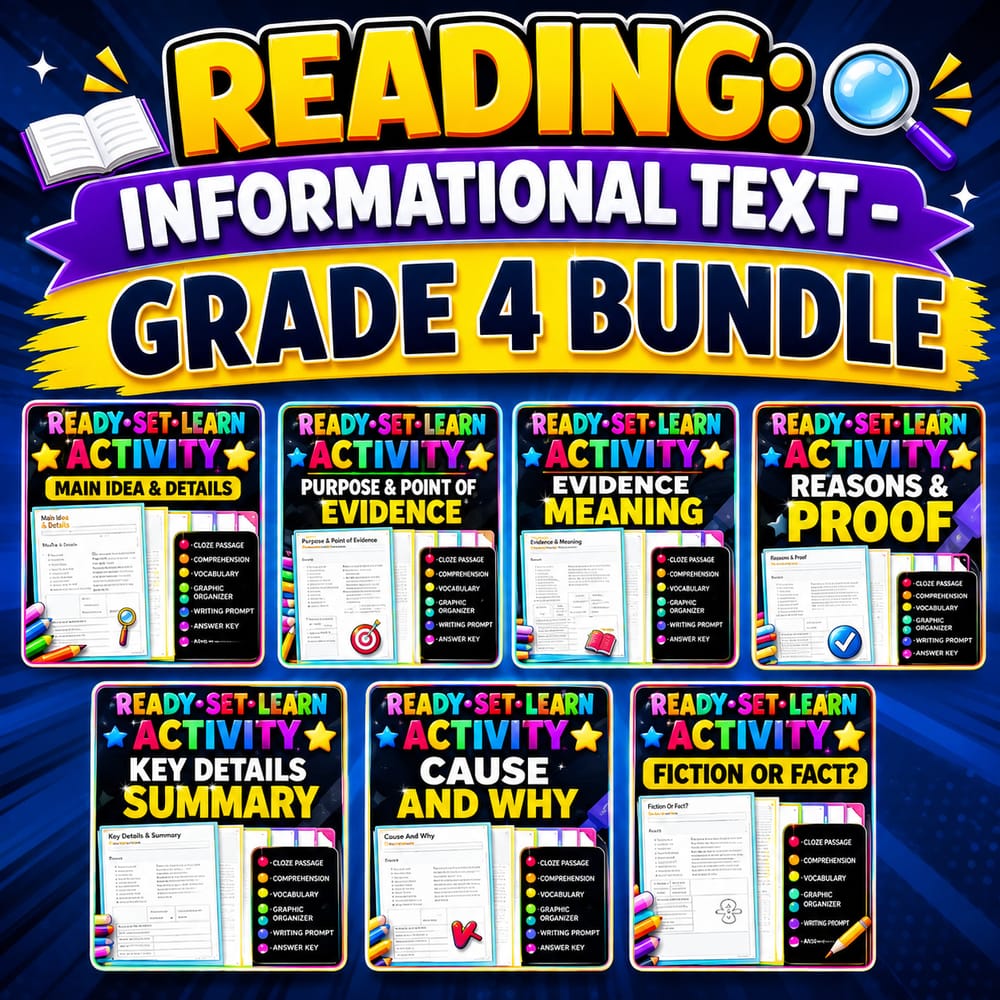
Reading: Informational Text Lesson Bundle | Grade 4 ELA | Common Core
$19.20$24.00Save $4.80
Sunny Desk Resources
·2 followers·18 sales
SubjectELAGradeGrade 4Pages88 Pages
What’s included
8 worksheets · 88 pages · Save $4.80 (20%) · prices shown inside the bundle
 Main Idea Support Worksheet Pack | Grade 4 ELA Practice & Review
- Identify the main idea of an informational text
- Distinguish main-idea-supporting details from less important side details
- Explain how key details help clarify or develop the main idea
$2.40$3.00 Purpose and Evidence Worksheet Pack | Grade 4 ELA Activities
- Explain the difference between an author’s reason and the evidence that supports it
- Identify an author’s purpose (to inform, persuade, or clarify) using evidence from the text
- Connect specific details from a passage to the claim or point the author is supporting
$2.40$3.00 Evidence for Meaning Worksheet | Grade 4 ELA Practice and Assessment
- Identify explicit information in a text using stated facts, definitions, and examples
- Use evidence from the text to support an inference about an animal’s survival
- Explain how quoted or paraphrased details help connect claims to textual support
$2.40$3.00 Reasons and Proof Worksheet | Grade 4 ELA Practice
- Identify reasons and evidence in a persuasive informational text
- Explain how evidence supports a claim and strengthens an author’s conclusion
- Distinguish between a statement of opinion and proof supported by examples, facts, or definitions
$2.40$3.00 Chronology Connections Worksheet Pack | Grade 4 ELA Practice
- Identify sequence and chronology words (first, next, then, finally) in a text.
- Explain how one step in a process connects to the next in time order.
- Use an ordered structure to better understand a technical process.
$2.40$3.00 Key Details Summary ELA Worksheet | Grade 4 Practice
- Identify key details that best support the main idea of a text.
- Distinguish key details from less important supporting information.
- Write a summary that connects important information in a logical order using paraphrased ideas.
$2.40$3.00 Cause and Why Worksheet Pack | Grade 4 ELA Practice
- Identify causes and effects in informational texts by locating relevant details
- Explain the “why” behind an event or procedure using evidence from a passage
- Use cause-and-effect words (because, so, therefore, since) to describe relationships
$2.40$3.00 Structure and Meaning Worksheet Pack | Grade 4 ELA Practice
- Identify common text structures (cause-and-effect and compare-contrast) and explain how they connect ideas.
- Use signal words, headings, and topic sentences to interpret the author’s intended meaning.
- Explain how recognizing structure helps readers understand relationships among events and ideas.
$2.40$3.00
Reviews & Feedback
Loading reviews...
Questions & Answers
Loading questions…
About this bundle
Related categories
Frequently asked questions
Who is Reading: Informational Text Lesson Bundle | Grade 4 ELA | Common Core designed for?
Reading: Informational Text Lesson Bundle | Grade 4 ELA | Common Core is designed for Grade 4 students and ELA learners and can be used in classrooms, homeschool, or independent practice.
How do I download Reading: Informational Text Lesson Bundle | Grade 4 ELA | Common Core?
Add it to your cart and complete checkout. After payment, you can download immediately from your account, and you'll also receive a download link by email.
Similar Products

Grade 12 Reading Informational ELA Lesson Bundle for Daily Reading | General ELA
$19.20$24.00

Grade 5 Reading & Text Evidence ELA Lesson Bundle | Common Core (CCSS)
$21.60$27.00

Reading Informational Text Lesson Bundle | Grade 7 ELA | Common Core CCSS
$19.20$24.00

Reading Informational Lesson Bundle | Grade 9 ELA | Common Core
$22.40$28.00

Reading Informational Lesson Bundle | Grade 9 ELA | General ELA
$19.20$24.00