
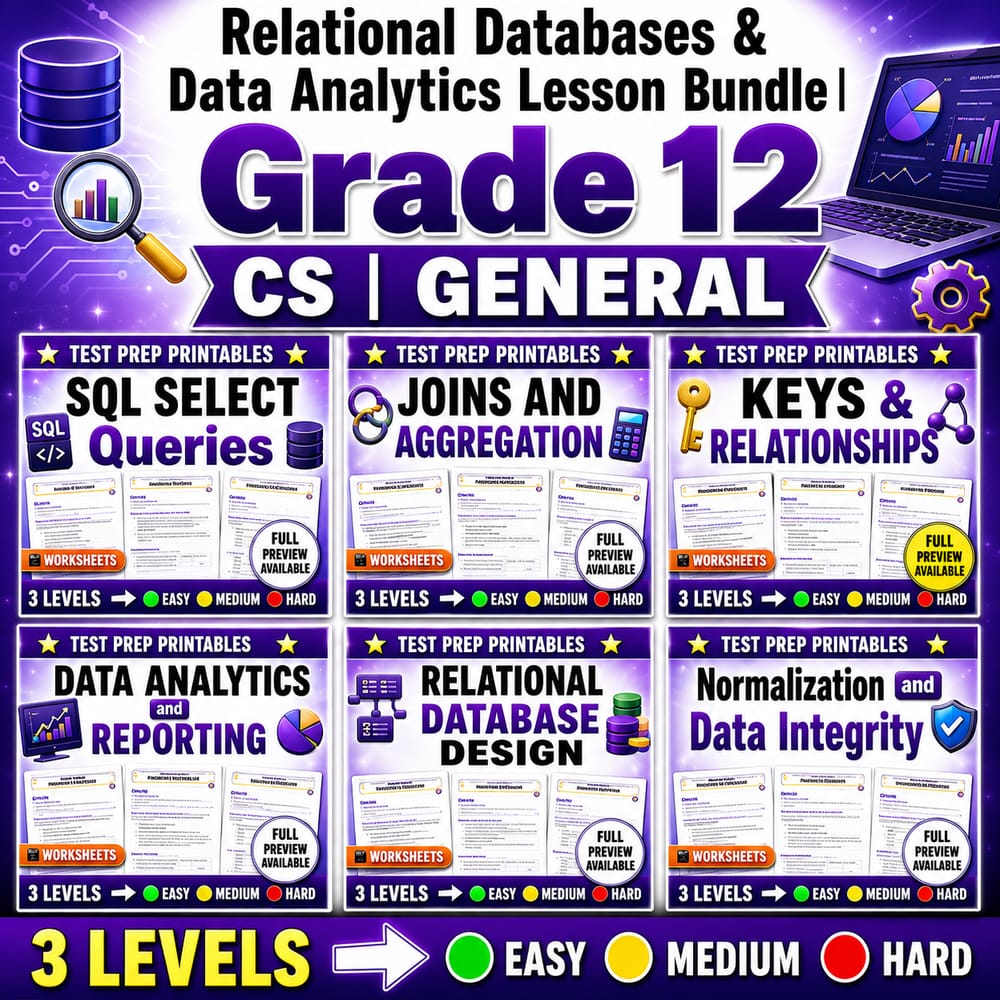
Relational Databases & Data Analytics Lesson Bundle | Grade 12 CS | General
$24.00$30.00Save $6.00
Prism Point Learning
·2 followers·13 sales
SubjectComputer ScienceGradeGrade 12Pages187 Pages
What’s included
6 worksheets · 187 pages · Save $6.00 (20%) · prices shown inside the bundle
 SQL SELECT Queries Worksheet | Grade 12 Computer Science Database Skills
- Identify how SELECT queries filter rows using WHERE conditions.
- Use ORDER BY to sort query results and predict the output order.
- Interpret SQL syntax to determine which columns are returned.
$4.00$5.00 Joins and Aggregation in Relational Databases Worksheet | Grade 12 CS
- Explain how SQL joins combine rows from multiple tables and when to use different join types.
- Interpret SQL queries that use GROUP BY and aggregate functions to summarize data.
- Predict query results by reasoning about matching keys, grouping, and filtering.
$4.00$5.00 Keys and Relationships in Databases Worksheet | Grade 12 Computer Science
- Explain how primary keys uniquely identify records in a table.
- Describe how foreign keys create relationships between tables.
- Interpret relationships to understand how connected data preserves structure.
$4.00$5.00 Data Analytics and Reporting Worksheet | Grade 12 Computer Science
- Explain how databases support reporting by selecting, filtering, and aggregating stored data.
- Describe how analytics can reveal trends and compare groups using grouped results and clear charts.
- Evaluate whether a report’s summary accurately reflects the underlying records.
$4.00$5.00 Relational Database Design Worksheet | Grade 12 Computer Science
- Explain how relational databases use tables, keys, and relationships to model real-world information.
- Identify good database design practices that reduce redundancy and improve data integrity.
- Evaluate statements about normalization, primary keys, and foreign keys in relational schemas.
$4.00$5.00 Normalization and Data Integrity Worksheet | Grade 12 Computer Science
- Explain how normalization reduces redundancy and improves update behavior in relational tables.
- Identify integrity problems caused by poor table design (insertion, update, and deletion anomalies).
- Apply rules of data integrity to keep records accurate, complete, and consistent over time.
$4.00$5.00
Reviews & Feedback
Loading reviews...
Questions & Answers
Loading questions…
About this bundle
Related categories
Frequently asked questions
Who is Relational Databases & Data Analytics Lesson Bundle | Grade 12 CS | General designed for?
Relational Databases & Data Analytics Lesson Bundle | Grade 12 CS | General is designed for Grade 12 students and Computer Science learners and can be used in classrooms, homeschool, or independent practice.
How do I download Relational Databases & Data Analytics Lesson Bundle | Grade 12 CS | General?
Add it to your cart and complete checkout. After payment, you can download immediately from your account, and you'll also receive a download link by email.