
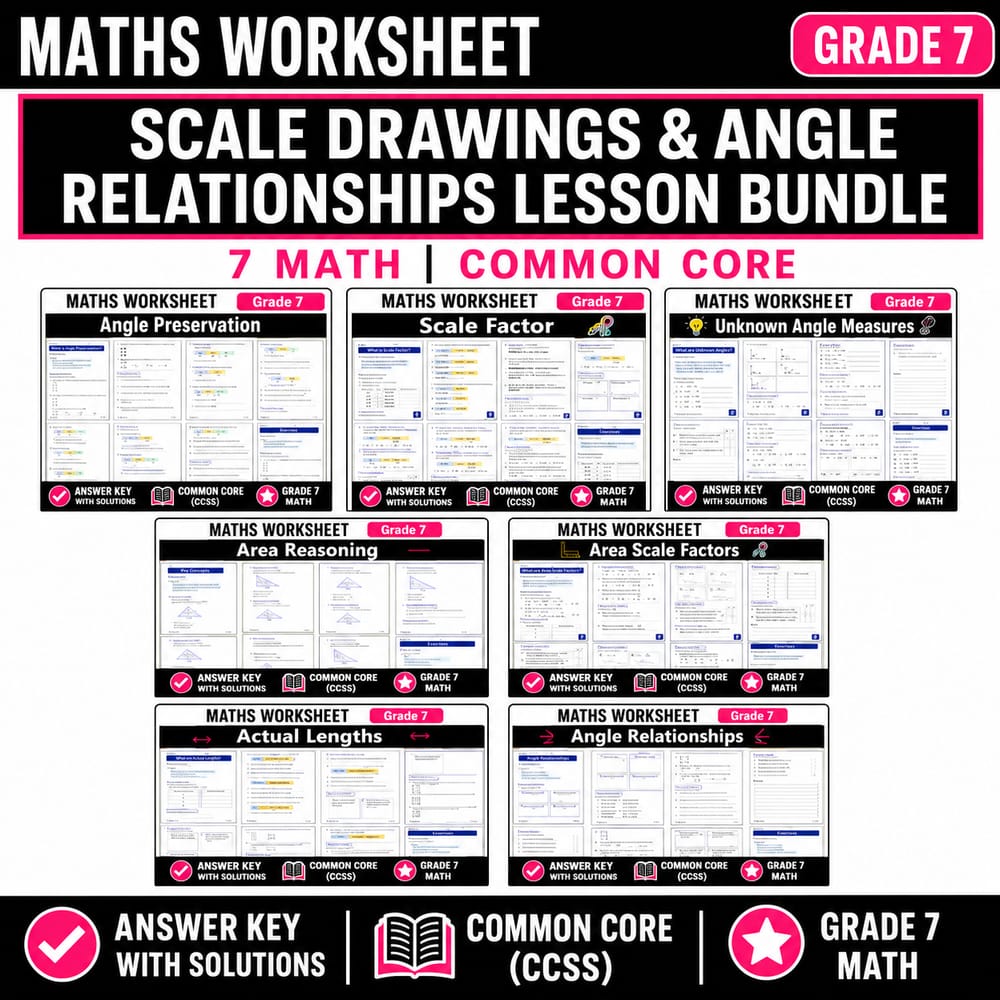
Scale Drawings & Angle Relationships Lesson Bundle | Grade 7 Math | Common Core
$28.00$35.00Save $7.00
BRIGHT PATH RESOURCES
·3 followers·23 sales
SubjectMathsGradeGrade 7Pages82 Pages
What’s included
7 worksheets · 82 pages · Save $7.00 (20%) · prices shown inside the bundle
 Grade 7 Maths Worksheet | Angle Preservation in Scale Drawings Standard
- Explain why corresponding angle measures stay the same when making a scale drawing.
- Use angle preservation to find the actual angle from the angle shown on the drawing.
- Justify that scaling changes lengths but not the opening between intersecting rays.
$4.00$5.00 Scale Factor Worksheet Grade 7 | Maths Worksheet for Mastery | CCSS
- Interpret lengths on a scale drawing and identify corresponding drawing and actual lengths
- Find a scale factor as a ratio (actual ÷ drawing) and use it consistently
- Use the scale factor to calculate missing drawing or actual lengths
$4.00$5.00 Grade 7 Maths Worksheet | Unknown Angle Measures & Standard CCSS
- Use vertical angle relationships to set up equations that show two angles are equal
- Use linear pair (supplementary) relationships to set up equations that add to 180°
- Solve equations to find unknown angle measures and explain why the equation matches the diagram
$4.00$5.00 Area Reasoning Worksheet for Grade 7 | Maths Worksheet with Answer Key
- Use the triangle area formula A = (1/2)bh to find the area of a geometric component on a scale drawing.
- Apply a uniform scale factor to relate drawing areas to actual areas.
- Use additive area relationships to combine areas of parts to get a total actual area.
$4.00$5.00 Area Scale Factors Worksheet for Grade 7 | Maths Practice and Answer Key
- Determine the area scale factor when all lengths in a scale drawing are multiplied by the same scale factor
- Use the rule area scale factor = (length scale factor)² to find missing areas
- Interpret how changing linear dimensions affects surface coverage on a scale drawing
$4.00$5.00 Grade 7 Actual Lengths Math Worksheet | Common Core Maths Practice
- Use a scale factor to convert a drawing length to an actual length in a scale drawing.
- Set up and use a consistent correspondence between matching segments to find missing lengths.
- Solve simple equations that model proportional relationships in scale drawings.
$4.00$5.00 Angle Relationships Worksheet | Grade 7 Maths | Common Core CCSS
- Use vertical angles to find unknown angle measures in intersecting lines.
- Use linear pair relationships to solve for unknown angles on a straight line.
- Recognise and apply the idea of supplementary angles formed by adjacent angles.
$4.00$5.00
Reviews & Feedback
Loading reviews...
Questions & Answers
Loading questions…
About this bundle
Related categories
Frequently asked questions
Who is Scale Drawings & Angle Relationships Lesson Bundle | Grade 7 Math | Common Core designed for?
Scale Drawings & Angle Relationships Lesson Bundle | Grade 7 Math | Common Core is designed for Grade 7 students and Maths learners and can be used in classrooms, homeschool, or independent practice.
How do I download Scale Drawings & Angle Relationships Lesson Bundle | Grade 7 Math | Common Core?
Add it to your cart and complete checkout. After payment, you can download immediately from your account, and you'll also receive a download link by email.