
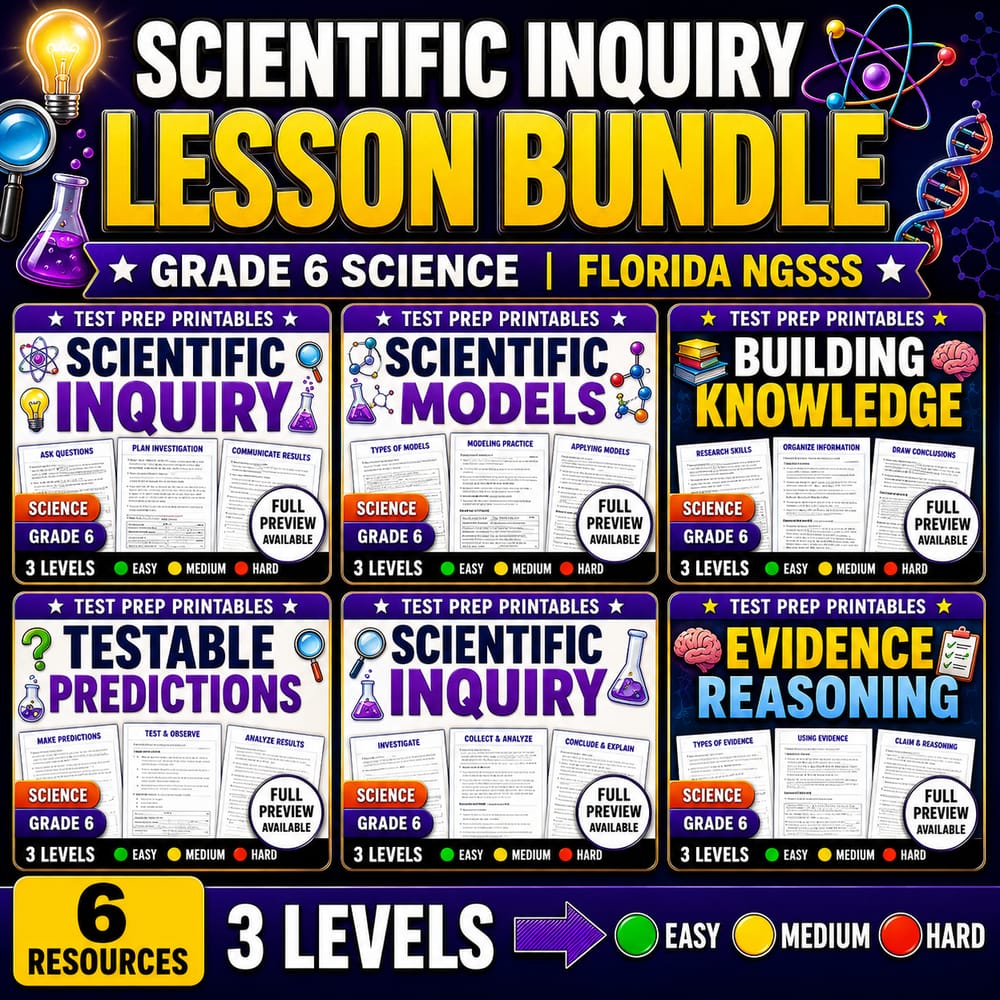
Scientific Inquiry Lesson Bundle | Grade 6 Science | Florida NGSSS
$24.00$30.00Save $6.00
Prism Point Learning
·2 followers·13 sales
SubjectScienceGradeGrade 6Pages181 Pages
What’s included
6 worksheets · 181 pages · Save $6.00 (20%) · prices shown inside the bundle
 Scientific Inquiry Worksheet | Grade 6 Science Activities
- Explain how observations lead to scientific questions and investigations
- Use evidence and logical reasoning to support or reject an explanation
- Apply measurement and observation vocabulary to describe changes over time
$4.00$5.00 Scientific Models Worksheet Grade 6 Science NGSSS Inquiry Practice
- Explain how scientific models help scientists represent systems that are too large, too small, or too complex to study directly.
- Describe how observable features and measurements provide evidence to support or refine scientific models.
- Identify the limits of a model by comparing what the model shows with real-world data.
$4.00$5.00 Building Scientific Knowledge Worksheet Grade 6 Science Florida NGSSS
- Explain how scientific knowledge becomes more reliable through iterative refinement and new evidence
- Differentiate between scientific theories and scientific laws using examples
- Describe how communication, peer evaluation, and reproducibility strengthen claims
$4.00$5.00 Testable Predictions Worksheet Grade 6 Science NGSSS Inquiry Practice
- Explain how a testable prediction connects evidence, a model, and an explanation.
- Identify how observations can support a prediction or show a mismatch that requires refinement.
- Use criteria and measurement uncertainty to communicate how strongly evidence supports a model.
$4.00$5.00 Measurement Precision Worksheet Grade 6 Science NGSSS Data Skills
- Explain the difference between precision and accuracy using measurement examples.
- Choose appropriate units and tools to improve measurement quality.
- Identify sources of error and describe how consistent procedures and calibration reduce error.
$4.00$5.00 Evidence and Reasoning Worksheet Grade 6 Science Florida NGSSS Claims
- Use evidence such as measurements and observations to support scientific claims.
- Explain why evidence must be relevant and described consistently in appropriate units or terms.
- Distinguish correlation from causation when interpreting data.
$4.00$5.00
Reviews & Feedback
Loading reviews...
Questions & Answers
Loading questions…
About this bundle
Related categories
Frequently asked questions
Who is Scientific Inquiry Lesson Bundle | Grade 6 Science | Florida NGSSS designed for?
Scientific Inquiry Lesson Bundle | Grade 6 Science | Florida NGSSS is designed for Grade 6 students and Science learners and can be used in classrooms, homeschool, or independent practice.
How do I download Scientific Inquiry Lesson Bundle | Grade 6 Science | Florida NGSSS?
Add it to your cart and complete checkout. After payment, you can download immediately from your account, and you'll also receive a download link by email.
Similar Products

Grade 8 Scientific Inquiry & CER Lesson Bundle – Florida NGSSS Science
$32.00$40.00

Grade 8 Evidence-Based Scientific Inquiry Science Lesson Bundle | Florida NGSSS
$32.00$40.00

Lesson Bundle: Grade 8 Science Scientific Inquiry Evidence | Florida NGSSS
$32.00$40.00

Scientific Inquiry Grade 8 Science Daily Reading Worksheets | Lesson | FL NGSSS
$25.60$32.00

Grade 9 Scientific Inquiry & Evidence Science Lesson Bundle | Florida (NGSSS)
$20.00$25.00