
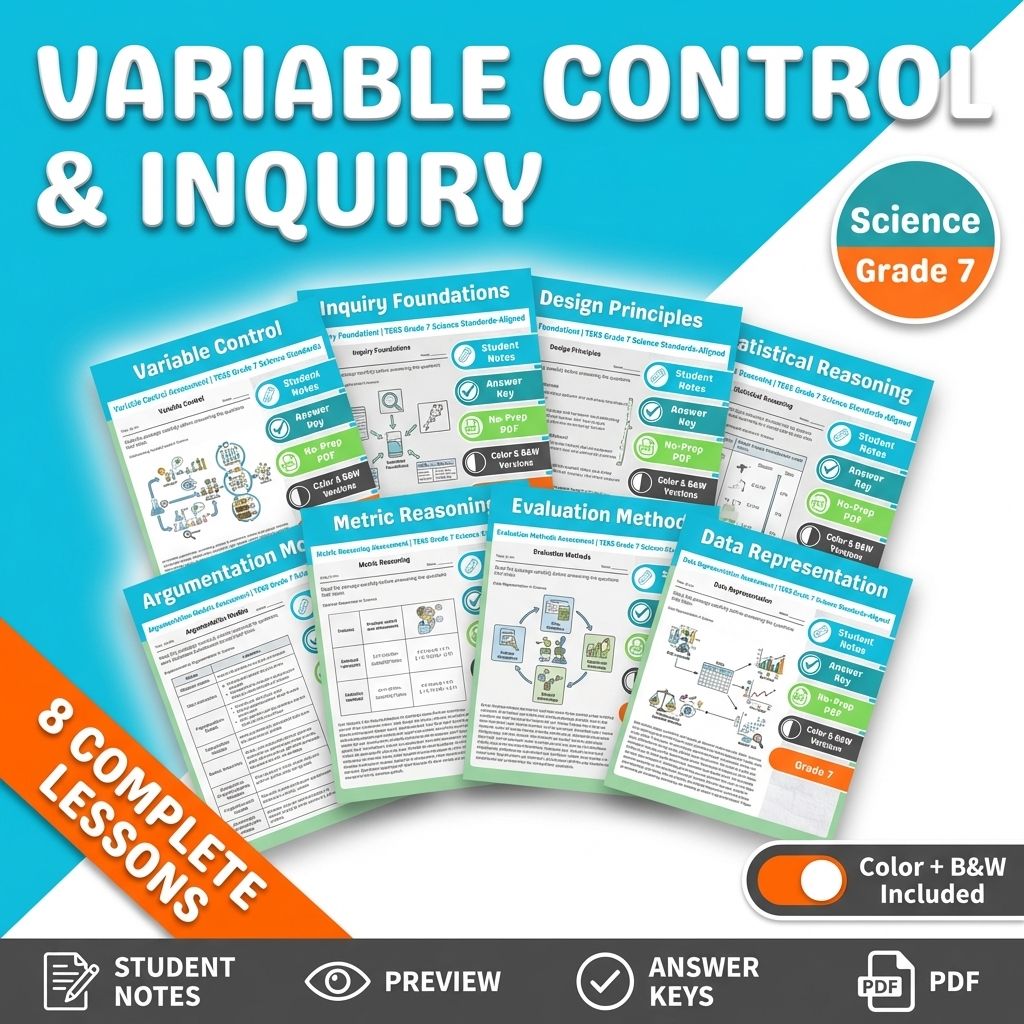
Scientific Inquiry Reasoning Grade 7 Science Lesson Bundle TEKS Unit
$32.00$40.00Save $8.00
Prism Point Learning
·2 followers·14 sales
SubjectScienceGradeGrade 7
What’s included
8 worksheets · Save $8.00 (20%) · prices shown inside the bundle
 Argumentation Models Assessment | TEKS Grade 7 Science Standards-Aligned
- Understand the components of evidence-based arguments, including claims, evidence, and reasoning.
- Evaluate the logical coherence and clarity of constructed arguments.
- Construct and critique arguments using quantitative data, graphical representations, and models.
$4.00$5.00 Data Representation Assessment | TEKS Grade 7 Science Standards-Aligned
- Understand various methods of organizing and displaying data to identify trends and relationships.
- Select appropriate graph types for different data sets and interpret their features.
- Calculate summary statistics such as mean and median to analyze data sets.
$4.00$5.00 Design Principles Assessment | TEKS Grade 7 Science Standards-Aligned
- Understand key concepts of designing fair and reproducible experiments.
- Identify variables, operational definitions, and control conditions in experiments.
- Recognize ethical, safety, and sample size considerations in research design.
$4.00$5.00 Metric Reasoning Assessment | TEKS Grade 7 Science Standard-Aligned
- Understand and apply metric prefixes for measurement precision
- Calibrate balances and graduated cylinders accurately
- Estimate and propagate measurement uncertainty in calculations
$4.00$5.00 Statistical Reasoning Assessment for Grade 7 Science TEKS Standards
- Interpret variability and assess the reliability of data sets using measures such as mean, median, and range.
- Analyze graphical representations like histograms and box plots to evaluate data spread and identify possible misconceptions.
- Compare data sets through replicated trials and proportional reasoning to determine consistency and significance of findings.
$4.00$5.00 Evaluation Methods Assessment | TEKS Grade 7 Science Standards-Aligned
- Understand how to critically evaluate scientific explanations and evidence.
- Identify logical fallacies, correlations, and limitations in data and models.
- Distinguish between causation and correlation in explanations.
$4.00$5.00 Variable Control Assessment | TEKS Grade 7 Science Standards
- Understand the importance of controlling variables in scientific experiments
- Identify different types of variables and methods to manage them
- Explain the concepts of control groups, replication, and randomization in experiments
$4.00$5.00 Inquiry Foundations Assessment | TEKS Grade 7 Science Standards-Aligned
- Understand key concepts related to Science
- Apply knowledge through practice questions
- Demonstrate comprehension of the material
$4.00$5.00
Reviews & Feedback
Loading reviews...
Questions & Answers
Loading questions…
About this bundle
Related categories
Frequently asked questions
Who is Scientific Inquiry Reasoning Grade 7 Science Lesson Bundle TEKS Unit designed for?
Scientific Inquiry Reasoning Grade 7 Science Lesson Bundle TEKS Unit is designed for Grade 7 students and Science learners and can be used in classrooms, homeschool, or independent practice.
How do I download Scientific Inquiry Reasoning Grade 7 Science Lesson Bundle TEKS Unit?
Add it to your cart and complete checkout. After payment, you can download immediately from your account, and you'll also receive a download link by email.
Similar Products

Grade 10 Scientific Inquiry & Data Reasoning Science Lesson Bundle: Ontario
$38.40$48.00

Grade 6 Scientific Inquiry Evidence Reasoning Science Lesson Bundle
$24.00$30.00

Grade 12 Scientific Inquiry & Data Analysis Science Lesson Bundle | TEKS
$32.00$40.00

Grade 8 Scientific Inquiry & Data Analysis Science Lesson Bundle TEKS
$60.00$75.00

Grade 7 Science Scientific Inquiry & Data Analysis Lesson Bundle | Ontario
$48.00$60.00