
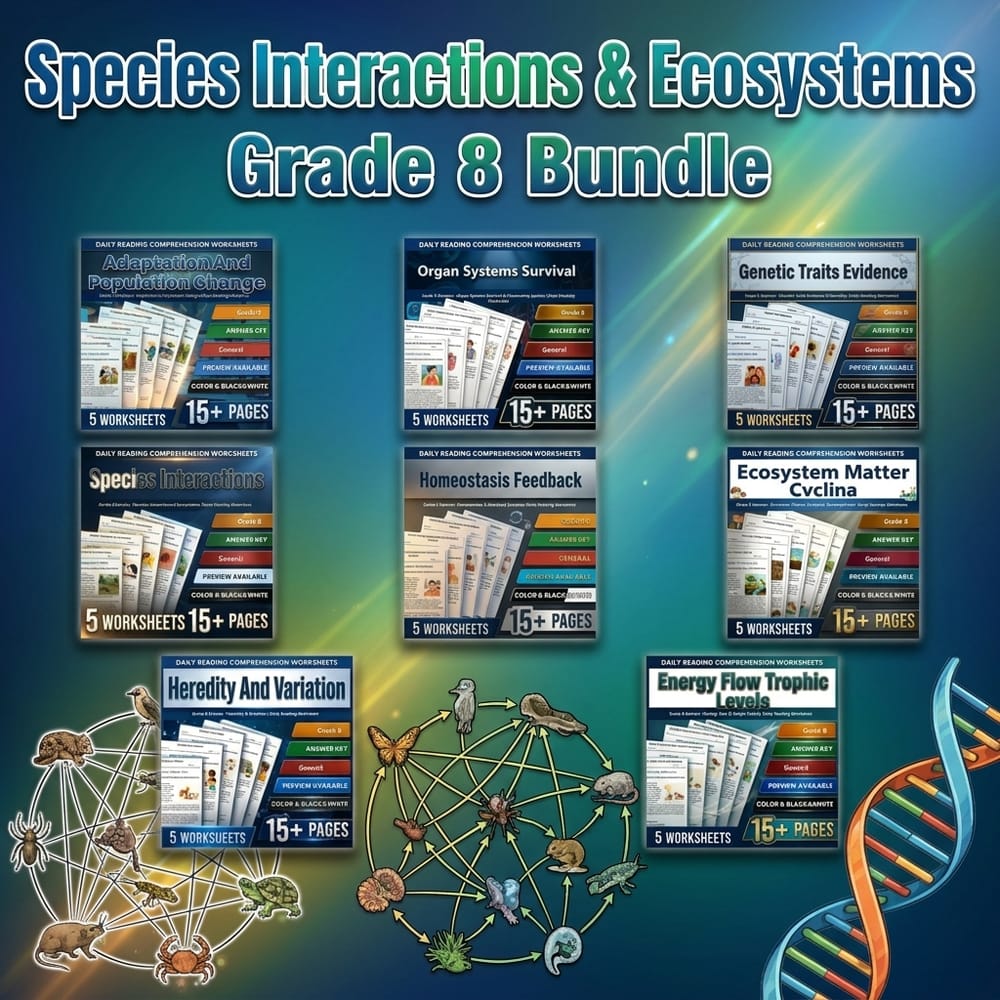
Species Interactions & Ecosystems Grade 8 Reading Lesson Bundle | General
$25.60$32.00Save $6.40
Bright Mind Resources
New·1 followers·12 sales
SubjectScienceGradeGrade 8
What’s included
8 worksheets · Save $6.40 (20%) · prices shown inside the bundle
 Grade 8 Science – Adaptation & Population Change | Daily Reading Worksheet
- Understand the concept of adaptation in organisms
- Identify different types of environmental pressures
- Recognize examples of adaptation such as pesticide resistance and beak variation
$3.20$4.00 Grade 8 Science – Organ Systems Survival & Respiratory System | Worksheet
- Understand how the respiratory system exchanges gases to support life.
- Identify key organs involved in respiration activities.
- Describe the process of breathing and gas exchange in the lungs.
$3.20$4.00 Grade 8 Science – Genetic Traits Evidence & Heredity | Daily Reading Worksheet
- Understand how observable traits are inherited through genetic instructions.
- Identify different forms of genes and their influence on physical traits.
- Explain patterns of dominant and recessive traits and their inheritance in families.
$3.20$4.00 Grade 8 Science – Species Interactions & Ecosystems | Daily Reading Worksheet
- Understand the concept of predation and its role in ecosystems
- Identify different types of species interactions such as mutualism, parasitism, and competition
- Analyze how these interactions influence population dynamics and community structure
$3.20$4.00 Grade 8 Science – Homeostasis & Feedback Systems | Daily Reading Worksheet
- Define homeostasis and explain its importance in living organisms.
- Identify the roles of receptors, control centers, and effectors in feedback mechanisms.
- Describe how body systems regulate internal conditions to maintain balance.
$3.20$4.00 Grade 8 Science – Ecosystem Matter Cycling & Decomposition - Reading Worksheet
- Understand how matter moves through ecosystems
- Identify processes such as decomposition, gas exchange, and nutrient transformation
- Explain how atoms cycle through different organisms and environmental components
$3.20$4.00 Grade 8 Science – Heredity & Variation | Daily Reading Worksheet
- Understand how genetic traits are inherited from parents
- Identify examples of genetic variation in organisms
- Explain the process of recombination during reproduction
$3.20$4.00 Grade 8 Science – Energy Flow & Trophic Levels | Daily Reading Worksheet
- Identify different trophic levels in an ecosystem.
- Understand how energy flows through food chains and webs.
- Explain why energy decreases along a food chain.
$3.20$4.00
Reviews & Feedback
Loading reviews...
Questions & Answers
Loading questions…
About this bundle
Related categories
Frequently asked questions
Who is Species Interactions & Ecosystems Grade 8 Reading Lesson Bundle | General designed for?
Species Interactions & Ecosystems Grade 8 Reading Lesson Bundle | General is designed for Grade 8 students and Science learners and can be used in classrooms, homeschool, or independent practice.
How do I download Species Interactions & Ecosystems Grade 8 Reading Lesson Bundle | General?
Add it to your cart and complete checkout. After payment, you can download immediately from your account, and you'll also receive a download link by email.
