
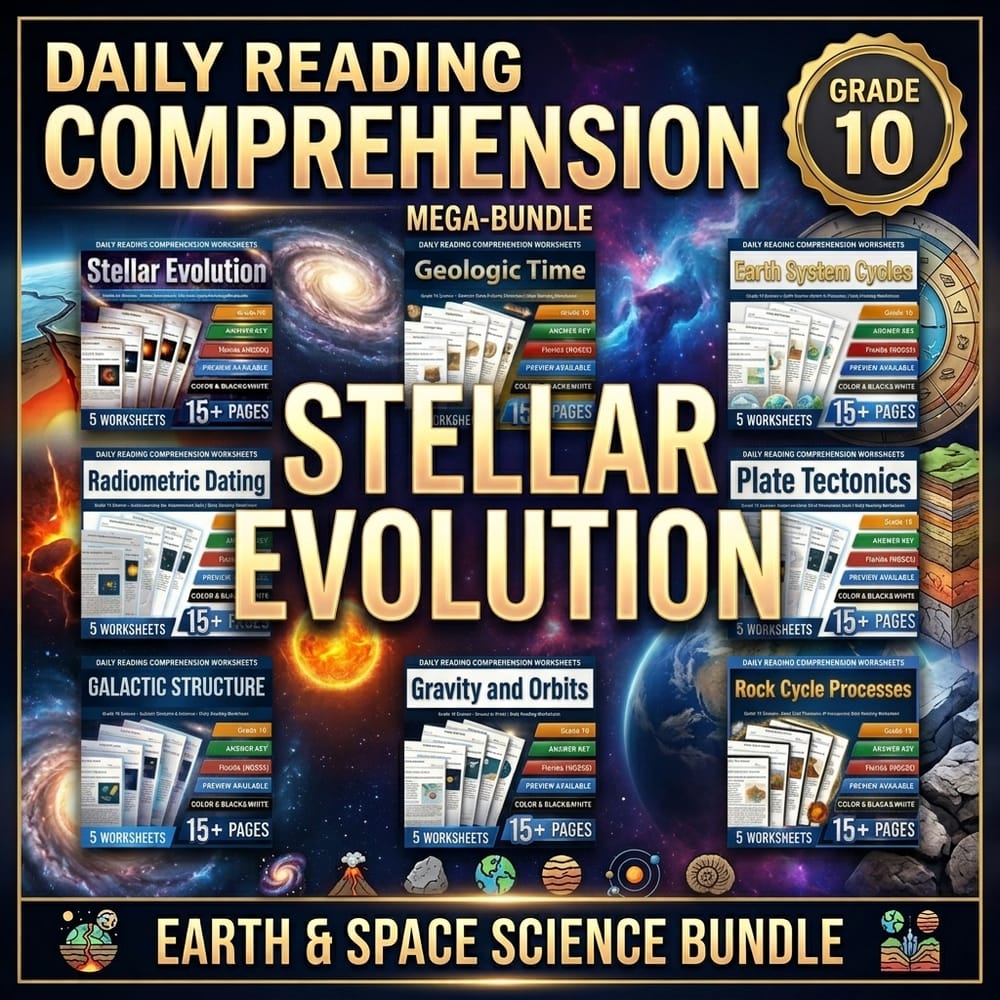
Stellar Evolution Grade 10 Science Daily Reading Worksheets Bundle | FL NGSSS
$28.80$36.00Save $7.20
Bright Mind Resources
New·1 followers·12 sales
SubjectScienceGradeGrade 10
What’s included
9 worksheets · Save $7.20 (20%) · prices shown inside the bundle
 Grade 10 Science – Stellar Evolution & Life Cycle | Daily Reading Worksheet
- Understand how stars form from nebulae
- Identify the stages in a star's birth and early development
- Recognize key features of star formation and initial stabilization
$3.20$4.00 Grade 10 Science – Earth System Cycles & Processes | Daily Reading Worksheet
- Understand the processes of the water cycle
- Identify key components and mechanisms of the water cycle
- Recognize how the water cycle influences weather and climate
$3.20$4.00 Grade 10 Science – Geologic Time & Dating Principles | Daily Reading Worksheet
- Understand the principles of relative dating in geology.
- Identify key features of the rock record.
- Recognize the significance of fossils and unconformities.
$3.20$4.00 Grade 10 Science – Plate Tectonics & Earth's Surface | Daily Reading Worksheet
- Describe the main types of plate boundaries and their features.
- Explain how Earth's lithosphere moves and causes surface changes.
- Identify evidence supporting the theory of plate tectonics.
$3.20$4.00 Grade 10 Science – Galactic Structure & Universe | Daily Reading Worksheet
- Understand the basic features of different types of galaxies
- Explain the significance of redshift and spectral lines in galaxy observation
- Describe how brightness and intrinsic luminosity influence galaxy appearance
$3.20$4.00 Grade 10 Science – Rock Cycle Processes & Weathering Daily Reading Worksheet
- Understand the processes of weathering and erosion
- Identify how surface processes modify rocks
- Describe the role of weathering and erosion in the rock cycle
$3.20$4.00 Grade 10 Science – Astronomical Scale | Daily Reading Worksheet
- Explain the concept of astronomical units and light-years
- Compare sizes and distances of planets and other celestial objects
- Understand how scale models help visualize space phenomena
$3.20$4.00 Grade 10 Science – Radiometric Dating & Half-Life | Daily Reading Worksheet
- Understand the concept of radioactive decay and how it relates to geologic time.
- Explain the significance of half-life in dating rocks and minerals.
- Identify the assumptions underpinning radiometric dating methods.
$3.20$4.00 Grade 10 Science – Gravity & Orbits | Daily Reading Worksheet
- Understand the concept of gravity and its effects on Earth and celestial bodies
- Describe how gravity influences orbital motion of planets and satellites
- Explain the relationship between gravity, velocity, and distance in orbital paths
$3.20$4.00
Reviews & Feedback
Loading reviews...
Questions & Answers
Loading questions…
About this bundle
Related categories
Frequently asked questions
Who is Stellar Evolution Grade 10 Science Daily Reading Worksheets Bundle | FL NGSSS designed for?
Stellar Evolution Grade 10 Science Daily Reading Worksheets Bundle | FL NGSSS is designed for Grade 10 students and Science learners and can be used in classrooms, homeschool, or independent practice.
How do I download Stellar Evolution Grade 10 Science Daily Reading Worksheets Bundle | FL NGSSS?
Add it to your cart and complete checkout. After payment, you can download immediately from your account, and you'll also receive a download link by email.
