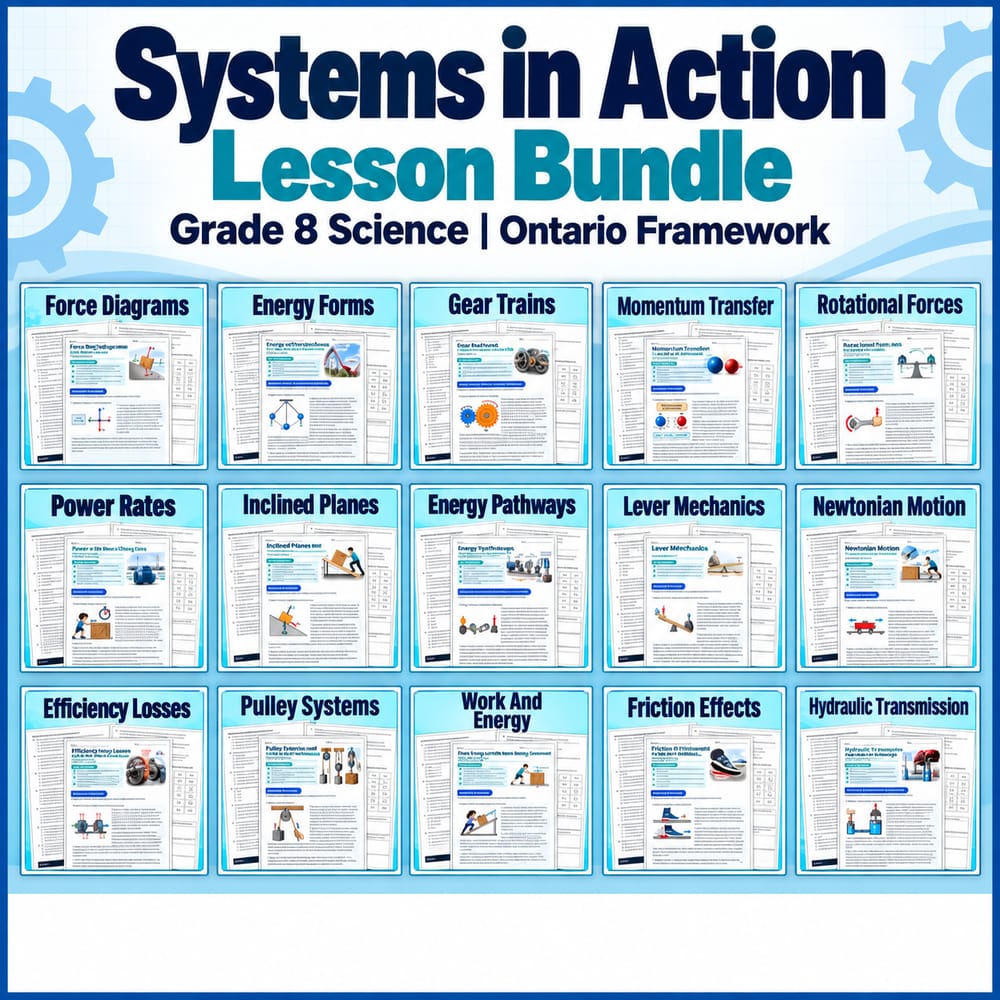
Systems in Action Lesson Bundle | Grade 8 Science | Ontario Framework — bundle cover
Systems in Action Lesson Bundle | Grade 8 Science | Ontario Framework — included worksheet 1
Systems in Action Lesson Bundle | Grade 8 Science | Ontario Framework — included worksheet 2
Systems in Action Lesson Bundle | Grade 8 Science | Ontario Framework — included worksheet 3
Systems in Action Lesson Bundle | Grade 8 Science | Ontario Framework — included worksheet 4
Systems in Action Lesson Bundle | Grade 8 Science | Ontario Framework — included worksheet 5
Systems in Action Lesson Bundle | Grade 8 Science | Ontario Framework — included worksheet 6
Systems in Action Lesson Bundle | Grade 8 Science | Ontario Framework — included worksheet 7
Systems in Action Lesson Bundle | Grade 8 Science | Ontario Framework — included worksheet 8
Systems in Action Lesson Bundle | Grade 8 Science | Ontario Framework — included worksheet 9
Systems in Action Lesson Bundle | Grade 8 Science | Ontario Framework — included worksheet 10
Systems in Action Lesson Bundle | Grade 8 Science | Ontario Framework — included worksheet 11
Systems in Action Lesson Bundle | Grade 8 Science | Ontario Framework — included worksheet 12
Systems in Action Lesson Bundle | Grade 8 Science | Ontario Framework — included worksheet 13
Systems in Action Lesson Bundle | Grade 8 Science | Ontario Framework — included worksheet 14
Systems in Action Lesson Bundle | Grade 8 Science | Ontario Framework — included worksheet 15
Grade 8 Science worksheet — Systems in Action Lesson Bundle | Grade 8 Science | Ontario Framework

Description

Overview


Systems in Action lesson bundle brings together Grade 8 Science topics in the Ontario framework—work, forces, energy transfer, and mechanical efficiency—through 15 ready-to-use worksheets designed for consistent practice and clear reasoning.

Students investigate how real mechanical systems convert forces into motion and energy, then use diagrams, equations, and evidence to explain outcomes. The unit connects key ideas in static and dynamic systems, from rotational motion and friction to hydraulic transmission and collision momentum.

Each worksheet supports guided problem solving, vocabulary use, and interpretation of results so learners can connect classroom models to everyday machines.

Worksheet count: 15

What's Included


  • ✅ Work, Energy, and Work–Energy Theorem Worksheets Grade 8 Science – Practice linking force and displacement to changes in kinetic energy.
  • ✅ Torque, Equilibrium, and Rotational Motion Worksheets Grade 8 Science – Solve for torque and analyze rotational equilibrium in modeled systems.
  • ✅ Pulley Systems and Mechanical Advantage Worksheets | Grade 8 Science – Determine how pulleys trade force for distance and predict performance.
  • ✅ Power, Work Rate and Efficiency Worksheets | Grade 8 Science – Calculate power and evaluate efficiency using work rate relationships.
  • ✅ Newton’s Laws and Quantitative Motion Worksheets | Grade 8 Science – Use quantitative reasoning with Newton’s laws to interpret motion data.
  • ✅ Impulse and Momentum in Collisions Worksheets | Grade 8 Science – Model collisions and explain changes in momentum through impulse.
  • ✅ Lever Mechanics and Mechanical Advantage Worksheets | Grade 8 – Apply lever principles to determine mechanical advantage and balance.
  • ✅ Inclined Planes and Mechanical Advantage Worksheets | Grade 8 – Analyze how an incline changes the force needed to move loads.
  • ✅ Hydraulic Force Transmission and Pascal’s Principle Worksheets | Grade 8 – Use Pascal’s principle to predict forces in fluid-based systems.
  • ✅ Gear Ratios and Torque Worksheets | Grade 8 Science – Connect gear ratios to rotational speed changes and torque transfer.
  • ✅ Friction and Drag on Motion Worksheets | Grade 8 Science – Investigate how friction and drag affect acceleration and energy loss.
  • ✅ Free-Body Diagrams and Net Force Worksheets Grade 8 Science Practice – Draw accurate free-body diagrams and determine net force from forces shown.
  • ✅ Energy Transfer Through Mechanical Systems Worksheets Grade 8 – Track energy through systems and identify where energy is stored or transformed.
  • ✅ Kinetic and Potential Energy Worksheets Grade 8 Science – Calculate energy changes and interpret graphs or scenario-based values.
  • ✅ Mechanical Efficiency and Energy Losses Worksheets Grade 8 Science – Evaluate efficiency and justify where energy is lost in real machines.

Skills & Standards


Aligned to the Ontario science framework, this unit emphasizes scientific inquiry through modeling, analysis, and evidence-based explanations. Students repeatedly practice interpreting representations (equation sets, force diagrams, and system descriptions) to make claims about how forces and energy interact.

Crosscutting concepts are reinforced through energy and conservation ideas, cause-and-effect relationships between forces and motion, and systems thinking (identifying inputs, components, and outputs in mechanical systems). Learners strengthen disciplinary core skills by:

  • Using the work–energy theorem to connect net work to changes in kinetic energy.
  • Analyzing rotational motion with torque and equilibrium relationships.
  • Applying mechanical advantage concepts to pulleys, levers, and inclined planes.
  • Reasoning with Newton’s laws to explain motion quantitatively.
  • Connecting impulse to momentum changes in collisions and explaining results with evidence.
  • Using free-body diagrams to determine net force and predict acceleration.
  • Employing Pascal’s principle to model hydraulic force transmission.
  • Calculating kinetic and potential energy and tracking energy transfer through mechanical systems.
  • Evaluating power, efficiency, and energy losses to judge system performance.

Throughout the worksheets, students are expected to show reasoning, check units, and communicate conclusions clearly—mirroring the Ontario focus on scientific communication and structured problem solving.

Perfect For


  • Teachers seeking structured instruction
  • Sub plans
  • Homework or review
  • Intervention or centers
  • Assessment preparation

How to Use


Use this as a single-unit sequence across about 1–3 weeks, depending on your pacing and how much time you allot for feedback and corrections.

  • Start each class with a 5–8 minute warm-up that reviews the previous worksheet’s key relationship (for example, work–energy, net force, or efficiency) and ends with a quick check for understanding.
  • During guided practice, model one complete problem step-by-step, then have students complete a parallel problem while you conference on free-body diagrams, torque reasoning, or unit analysis.
  • Use short exit tickets that ask for both a calculation and a short evidence-based claim (e.g., “What causes the change in motion?” or “Where does energy go?”), followed by an end-of-unit review set that mixes concepts from across the system types.

Closing


With focused practice across major mechanical systems, Systems in Action supports learners in building accurate models of forces and energy while strengthening the reasoning skills Ontario students need.

Systems in Action Lesson Bundle | Grade 8 Science | Ontario Framework

$36.00$45.00Save $9.00
Prism Point Learning
·2 followers·14 sales
SubjectScienceGradeGrade 8Pages189 Pages

What’s included

15 worksheets · 189 pages · Save $9.00 (20%) · prices shown inside the bundle

  1. Free-Body Diagrams and Net Force Worksheets Grade 8 Science Practice
    Free-Body Diagrams and Net Force Worksheets Grade 8 Science Practice

    Grade 8 · Science · 13 Pages

    • Construct free-body diagrams with gravitational, normal, tension, and friction forces
    • Determine whether forces are balanced or unbalanced from a free-body diagram
    • Calculate net force magnitude and direction for simple 1D systems
    $2.40$3.00
  2. Kinetic and Potential Energy Worksheets Grade 8 Science
    Kinetic and Potential Energy Worksheets Grade 8 Science

    Grade 8 · Science · 14 Pages

    • Identify kinetic, gravitational potential, and elastic potential energy
    • Explain energy transfers between potential and kinetic energy
    • Use energy equations to compare gravitational and kinetic energy
    $2.40$3.00
  3. Gear Ratios and Torque Worksheets | Grade 8 Science
    Gear Ratios and Torque Worksheets | Grade 8 Science

    Grade 8 · Science · 12 Pages

    • Calculate gear ratios using driver and driven gear tooth counts
    • Calculate overall ratios for compound gear trains
    • Explain how idler gears change rotational direction
    $2.40$3.00
  4. Impulse and Momentum in Collisions Worksheets | Grade 8 Science
    Impulse and Momentum in Collisions Worksheets | Grade 8 Science

    Grade 8 · Science · 13 Pages

    • Calculate momentum using mass and velocity
    • Explain conservation of momentum in closed systems
    • Relate impulse to changes in linear momentum
    $2.40$3.00
  5. Torque, Equilibrium, and Rotational Motion Worksheets Grade 8 Science
    Torque, Equilibrium, and Rotational Motion Worksheets Grade 8 Science

    Grade 8 · Science · 12 Pages

    • Explain how force and lever arm determine torque
    • Calculate simple relationships involving torque and rotational inertia
    • Identify conditions required for static rotational equilibrium
    $2.40$3.00
  6. Power, Work Rate and Efficiency Worksheets | Grade 8 Science
    Power, Work Rate and Efficiency Worksheets | Grade 8 Science

    Grade 8 · Science · 12 Pages

    • Explain power as the rate of doing work or transferring energy
    • Interpret watts as the SI unit for measuring power
    • Relate torque and rotational speed to mechanical output power
    $2.40$3.00
  7. Inclined Planes and Mechanical Advantage Worksheets | Grade 8
    Inclined Planes and Mechanical Advantage Worksheets | Grade 8

    Grade 8 · Science · 12 Pages

    • Calculate ideal mechanical advantage using ramp length and height
    • Explain how gravity components act on an inclined plane
    • Compare ramp designs using ideal mechanical advantage
    $2.40$3.00
  8. Energy Transfer Through Mechanical Systems Worksheets Grade 8
    Energy Transfer Through Mechanical Systems Worksheets Grade 8

    Grade 8 · Science · 14 Pages

    • Trace energy flow through gears, pulleys, and hydraulic components
    • Identify energy conversion points and mechanical energy losses
    • Calculate net useful energy using input energy and efficiency
    $2.40$3.00
  9. Lever Mechanics and Mechanical Advantage Worksheets | Grade 8
    Lever Mechanics and Mechanical Advantage Worksheets | Grade 8

    Grade 8 · Science · 12 Pages

    • Classify levers using the positions of fulcrum, effort, and load
    • Calculate mechanical advantage using effort and load arm lengths
    • Explain how fulcrum placement changes force amplification and motion
    $2.40$3.00
  10. Newton’s Laws and Quantitative Motion Worksheets | Grade 8 Science
    Newton’s Laws and Quantitative Motion Worksheets | Grade 8 Science

    Grade 8 · Science · 12 Pages

    • Explain Newton’s three laws using clear cause-and-effect language
    • Calculate force, mass, or acceleration using F = ma
    • Determine net force from forces acting in opposite directions
    $2.40$3.00

Reviews & Feedback

Loading reviews...

Questions & Answers

Loading questions…

About this bundle

Related categories

Frequently asked questions

Who is Systems in Action Lesson Bundle | Grade 8 Science | Ontario Framework designed for?
Systems in Action Lesson Bundle | Grade 8 Science | Ontario Framework is designed for Grade 8 students and Science learners and can be used in classrooms, homeschool, or independent practice.
How do I download Systems in Action Lesson Bundle | Grade 8 Science | Ontario Framework?
Add it to your cart and complete checkout. After payment, you can download immediately from your account, and you'll also receive a download link by email.