
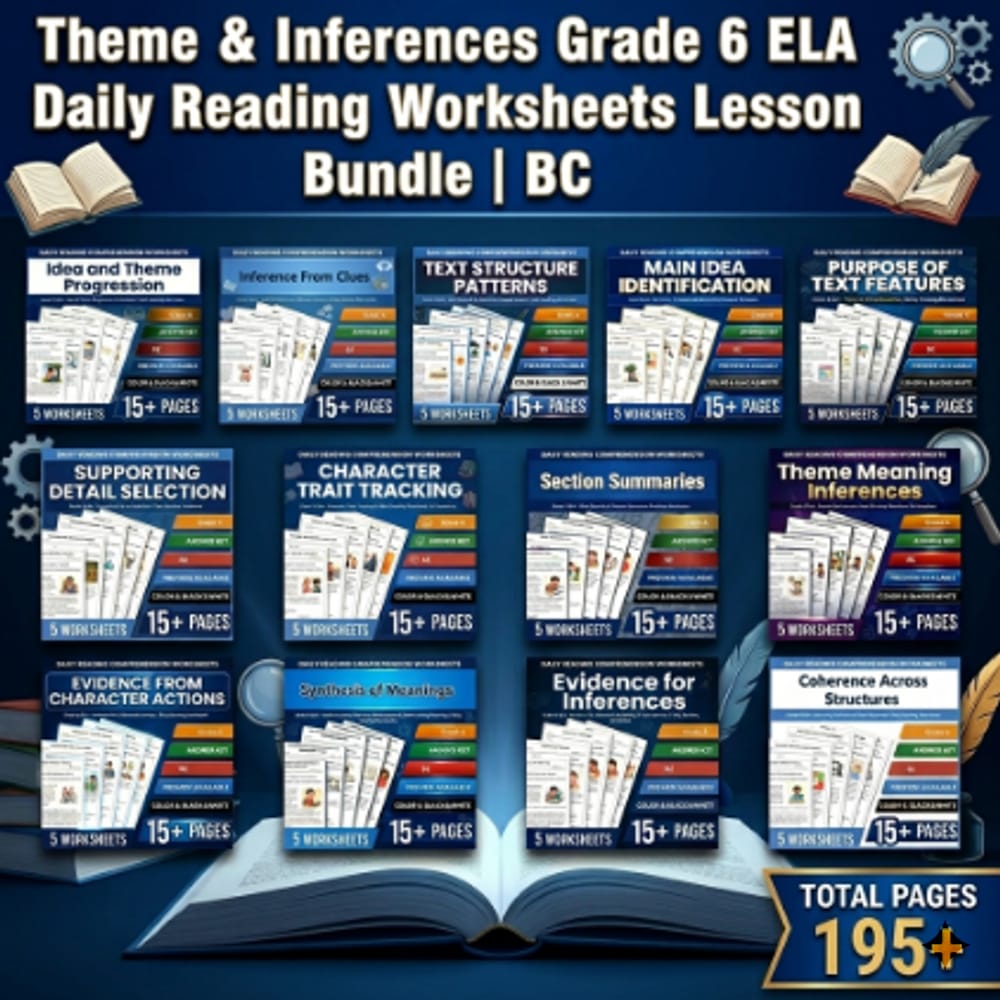


Theme & Inferences Grade 6 ELA Daily Reading Worksheets Lesson Bundle | BC
$41.60$52.00Save $10.40
Quiet Forest Education
·3 followers·20 sales
SubjectELAGradeGrade 6Pages394 Pages
What’s included
13 worksheets · 394 pages · Save $10.40 (20%) · prices shown inside the bundle
 Grade 6 ELA – Idea & Theme Progression in Literature | Daily Reading Worksheet
- Identify how themes develop across different parts of a story
- Recognize recurring symbols and contrasting viewpoints that shape themes
- Analyze how early ideas are strengthened or challenged later in the text
$3.20$4.00 Grade 6 ELA – Making Inferences & Comprehension | Daily Reading Worksheet
- Understand key concepts related to ELA
- Apply knowledge through practice questions
- Demonstrate comprehension of the material
$3.20$4.00 Grade 6 ELA – Text Structure & Nonfiction Passage Practice | Daily Worksheet
- Understand key concepts related to ELA
- Apply knowledge through practice questions
- Demonstrate comprehension of the material
$3.20$4.00 Grade 6 ELA – Main Idea & Supporting Details | Daily Reading Worksheet
- Understand key concepts related to ELA
- Apply knowledge through practice questions
- Demonstrate comprehension of the material
$3.20$4.00 Grade 6 ELA – Purpose of Text Features | Daily Reading Worksheet
- Identify the purpose of titles and subtitles in texts
- Understand how text features like captions and diagrams support comprehension
- Recognize how layout and labeling contribute to understanding informational texts
$3.20$4.00 Grade 6 ELA – Supporting Detail Selection | Daily Reading Worksheet
- Identify supporting details that strengthen the main idea in a text.
- Distinguish relevant facts, definitions, examples, quotations, and descriptive information.
- Understand how supporting details clarify the meaning of the main idea.
$3.20$4.00 Grade 6 ELA – Character Trait Tracking & Daily Reading Worksheet | BC Standards
- Identify character traits through actions and dialogue
- Analyze how characters develop over time in a story
- Recognize changes in behavior, decisions, and relationships that reveal character traits
$3.20$4.00 Grade 6 ELA – Daily Reading & Section Summaries Practice | Worksheet
- Understand key concepts related to ELA
- Apply knowledge through practice questions
- Demonstrate comprehension of the material
$3.20$4.00 Grade 6 ELA – Theme & Inferences | Daily Reading Worksheet BC Standards
- Understand how to use inference to identify themes in stories.
- Recognize recurring concepts, decisions, and conflicts that reveal underlying messages.
- Interpret relationships between explicit statements and broader implications.
$3.20$4.00 Grade 6 ELA – Evidence From Character Actions | Daily Reading Worksheet
- Understand key concepts related to ELA
- Apply knowledge through practice questions
- Demonstrate comprehension of the material
$3.20$4.00
Reviews & Feedback
Loading reviews...
Questions & Answers
Loading questions…
About this bundle
Related categories
Frequently asked questions
Who is Theme & Inferences Grade 6 ELA Daily Reading Worksheets Lesson Bundle | BC designed for?
Theme & Inferences Grade 6 ELA Daily Reading Worksheets Lesson Bundle | BC is designed for Grade 6 students and ELA learners and can be used in classrooms, homeschool, or independent practice.
How do I download Theme & Inferences Grade 6 ELA Daily Reading Worksheets Lesson Bundle | BC?
Add it to your cart and complete checkout. After payment, you can download immediately from your account, and you'll also receive a download link by email.
Similar Products

Grade 9 ELA Reading Worksheets Bundle: Theme & Evidence | Alberta
$44.00$55.00

Grade 8 ELA Reading Worksheets Bundle: Theme & Evidence | Alberta
$44.00$55.00

Grade 12 Theme & Evidence ELA lesson bundle for Daily Reading | BC
$44.80$56.00

Grade 7 ELA Reading Worksheets | Text Features, Theme & Author Craft
$31.20$39.00

Grade 3 Theme, Main Idea, and Evidence ELA Lesson Bundle - Alberta
$40.00$50.00