
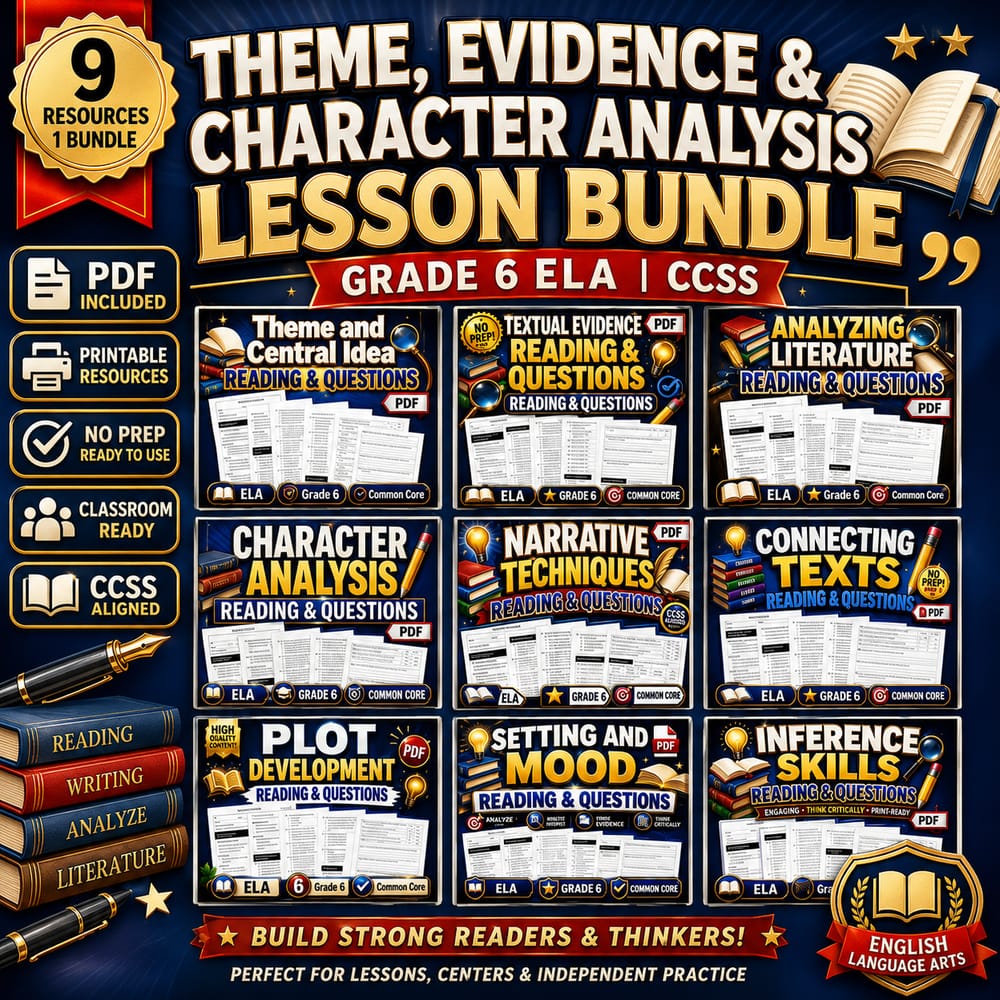
Theme, Evidence & Character Analysis Lesson Bundle | Grade 6 ELA | CCSS
$28.80$36.00Save $7.20
Golden Apple Studio
New·2 followers·3 sales
SubjectELAGradeGrade 6Pages139 Pages
What’s included
9 worksheets · 139 pages · Save $7.20 (20%) · prices shown inside the bundle
 6th Grade ELA | Theme and Central Idea Worksheet (PDF) – CCSS
- Identify a story’s central idea by tracing how details work together across plot and characters.
- Explain how authors develop theme through character choices, conflicts, and setting.
- Use textual clues (evidence) to support interpretations of recurring messages or morals.
$3.20$4.00 6th Grade ELA – Textual Evidence Worksheet (CCSS) Practice Set
- Locate specific details in a text to support an inference about character, setting, or plot.
- Use evidence-based reasoning to explain how details confirm or clarify central ideas.
- Write and choose claims that match the evidence found in the passage.
$3.20$4.00 6th Grade ELA Worksheet | Analyzing Literature Common Core (PDF)
- Identify how literary devices contribute to meaning in a text.
- Analyze character interactions and narrative voice to infer central ideas.
- Use evidence from a passage to support interpretations.
$3.20$4.00 6th Grade ELA Character Analysis Worksheet (CCSS) | Reading & Writing Practice (PDF)
- Identify character traits and motivations in a narrative by analyzing what characters say and do.
- Infer how a character’s actions and decisions influence the plot and the story’s themes.
- Use textual evidence to support interpretations about a character’s personality and growth.
$3.20$4.00 6th Grade ELA | Narrative Techniques Worksheet (CCSS) (PDF)
- Identify how point of view shapes what a reader knows and feels in a story.
- Explain how flashbacks and dialogue develop character, plot, and theme.
- Analyze how different narrative techniques work together to create meaning.
$3.20$4.00 6th Grade ELA – Connecting Texts Worksheet (CCSS) Practice Set (PDF)
- Compare themes across two literary texts by using evidence from each text.
- Analyze how characters’ choices reveal identity, resilience, or conflict.
- Integrate ideas from multiple texts to form a broader claim about the message of the texts.
$3.20$4.00 6th Grade ELA Plot Development Worksheet (PDF) – Common Core Standards
- Identify the major parts of plot (exposition, rising action, climax, falling action, resolution) in a story
- Explain how events are connected and how cause-and-effect drives the story forward
- Sequence plot events and justify how the conflict moves toward a resolution
$3.20$4.00 6th Grade ELA | Setting and Mood Worksheet (PDF) – CCSS Aligned
- Analyze how a story’s setting (time, place, and context) creates mood and atmosphere.
- Use descriptive details from the setting to infer the story’s tone.
- Explain how setting connects to theme and influences characters’ choices and plot events.
$3.20$4.00 6th Grade ELA – Inference Skills Worksheet (Common Core CCSS) (Practice Set)
- Use clues from a text to make logical inferences and draw conclusions.
- Determine character motives and likely feelings using dialogue and descriptive details.
- Identify themes or messages suggested by events, even when they are not explicitly stated.
$3.20$4.00
Reviews & Feedback
Loading reviews...
Questions & Answers
Loading questions…
About this bundle
Related categories
Frequently asked questions
Who is Theme, Evidence & Character Analysis Lesson Bundle | Grade 6 ELA | CCSS designed for?
Theme, Evidence & Character Analysis Lesson Bundle | Grade 6 ELA | CCSS is designed for Grade 6 students and ELA learners and can be used in classrooms, homeschool, or independent practice.
How do I download Theme, Evidence & Character Analysis Lesson Bundle | Grade 6 ELA | CCSS?
Add it to your cart and complete checkout. After payment, you can download immediately from your account, and you'll also receive a download link by email.
Similar Products

Grade 11 Theme & Character Analysis Lesson Bundle | General ELA
$19.20$24.00

Grade 10 Theme, Evidence & Character: ELA Lesson Bundle, Common Core (CCSS)
$19.20$24.00

Literary Analysis Theme, Structure & Character Lesson Bundle | Grade 11 ELA | Common Core
$21.60$27.00

Grade 12 Theme & Evidence ELA lesson bundle for Daily Reading | BC
$44.80$56.00

Grade 5 ELA Theme, Characters & Text Evidence Lesson Bundle | CCSS
$35.20$44.00