
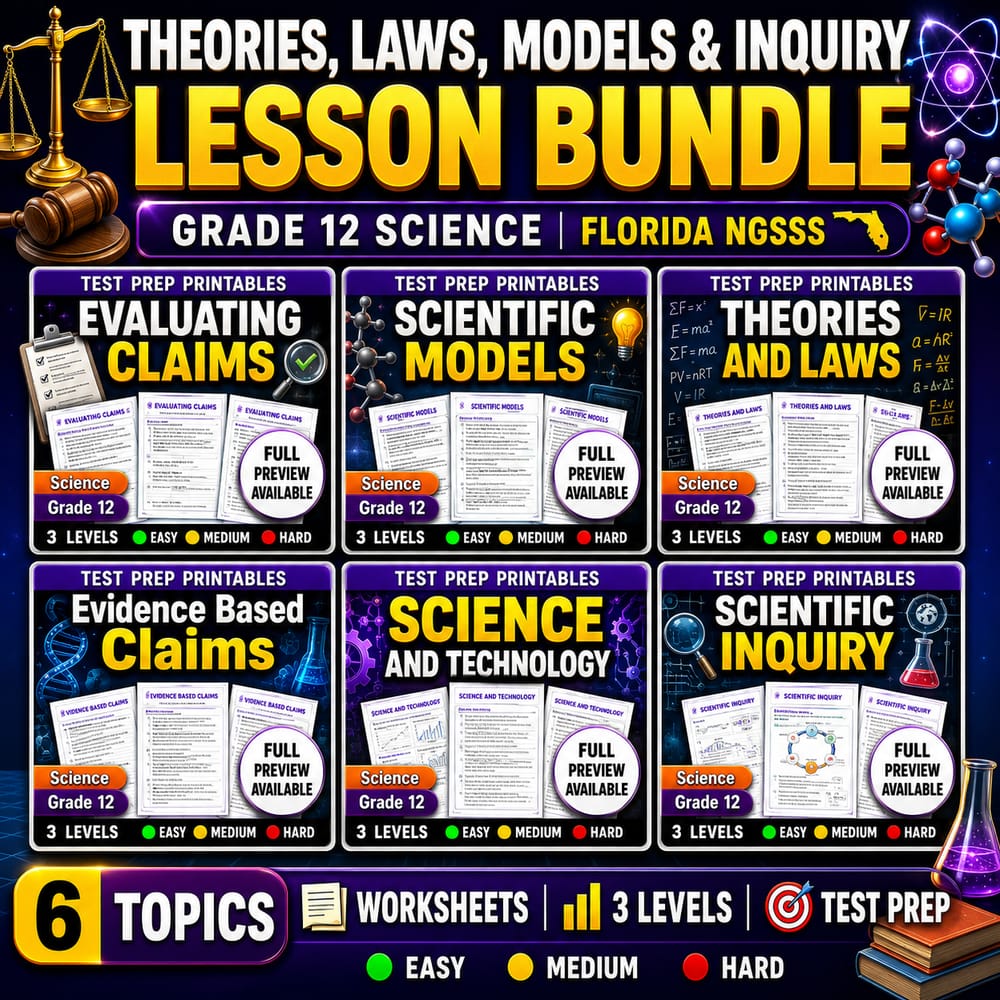
Theories, Laws, Models & Inquiry Lesson Bundle | Grade 12 Science | Florida NGSSS
$20.00$25.00Save $5.00
Prism Point Learning
·2 followers·14 sales
SubjectScienceGradeGrade 12
What’s included
6 worksheets · Save $5.00 (20%) · prices shown inside the bundle
 Evaluating Claims Worksheet Pack | Grade 12 Science Practice
- Identify scientific claims and evaluate whether they are supported by empirical evidence
- Distinguish scientific reasoning from pseudoscience by checking assumptions, bias, and overgeneralization
- Explain how peer evaluation and replication increase confidence in scientific results
$4.00$5.00 Scientific Models Worksheet Grade 12 Science NGSSS Practice Pack
- Explain how scientific models represent systems and link observations to explanations
- Identify assumptions and limitations in a model and describe when models should be revised
- Use models to make and evaluate predictions under new conditions
$4.00$5.00 Theories and Laws Worksheet Grade 12 Science NGSSS Practice Pack
- Distinguish the roles of scientific laws and scientific theories in describing natural phenomena
- Explain how evidence supports both laws and theories, and how improved evidence can change scientific ideas
- Identify common misconceptions such as treating early explanations as settled facts
Free Evidence Based Claims Worksheet Pack | Grade 12 Science Skills
- Explain how scientific claims rely on empirical evidence and logical reasoning.
- Distinguish evidence-based explanations from opinions that are not supported by data.
- Evaluate how mechanisms and predictions connect to evidence in scientific arguments.
$4.00$5.00 Science vs Technology Worksheet Pack | Grade 12 NGSSS Practice
- Explain how science and technology differ in purpose even when they use similar tools and knowledge.
- Describe how evidence, models, and constraints shape scientific understanding and technological design.
- Evaluate examples of how scientific discoveries can be used to create safer, more effective technologies.
$4.00$5.00 Scientific Inquiry Worksheet Pack | Grade 12 NGSSS Science Skills
- Explain how scientific inquiry uses questions, observations, measurements, and logical reasoning to support claims with evidence.
- Evaluate whether a claim is supported by data and whether alternative explanations have been considered.
- Use evidence to identify patterns and justify conclusions that can be independently tested.
$4.00$5.00
Reviews & Feedback
Loading reviews...
Questions & Answers
Loading questions…
About this bundle
Related categories
Frequently asked questions
Who is Theories, Laws, Models & Inquiry Lesson Bundle | Grade 12 Science | Florida NGSSS designed for?
Theories, Laws, Models & Inquiry Lesson Bundle | Grade 12 Science | Florida NGSSS is designed for Grade 12 students and Science learners and can be used in classrooms, homeschool, or independent practice.
How do I download Theories, Laws, Models & Inquiry Lesson Bundle | Grade 12 Science | Florida NGSSS?
Add it to your cart and complete checkout. After payment, you can download immediately from your account, and you'll also receive a download link by email.
