
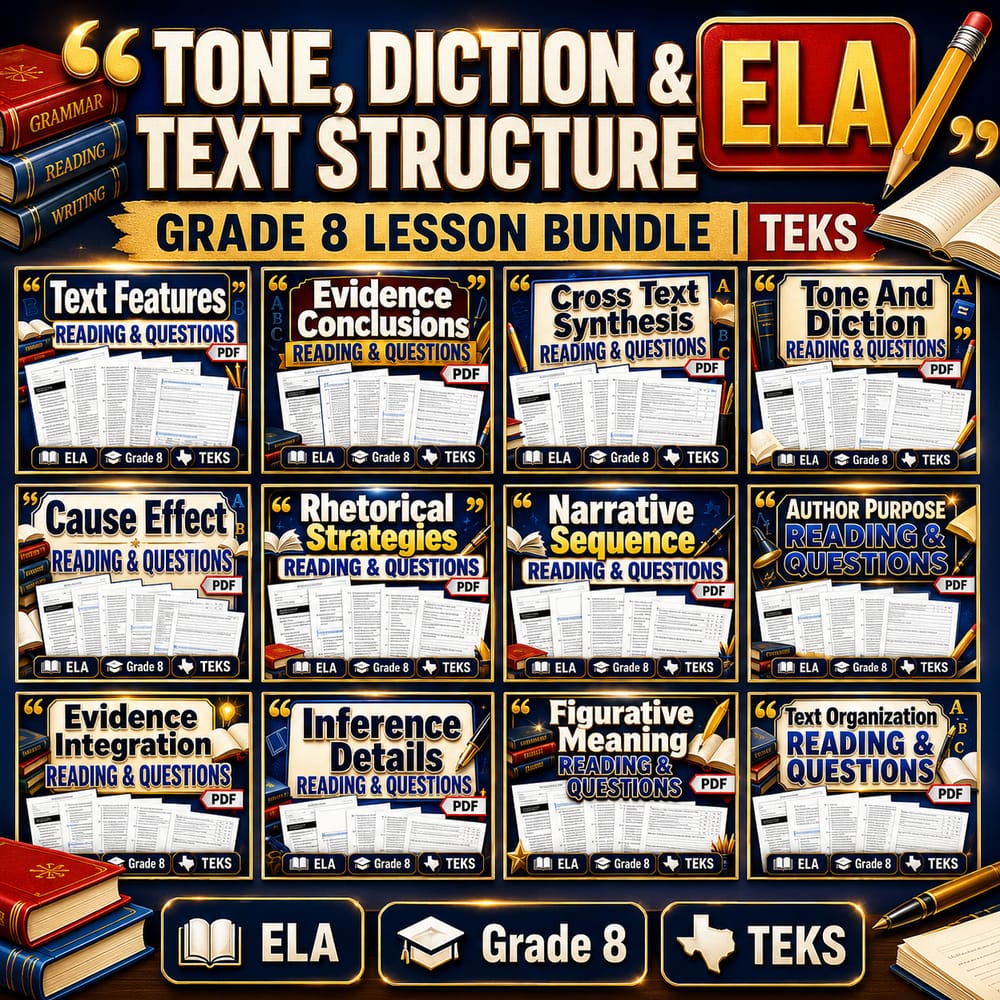


Tone, Diction & Text Structure ELA | Grade 8 Lesson Bundle | TEKS
$38.40$48.00Save $9.60
Golden Apple Studio
New·2 followers·3 sales
SubjectELAGradeGrade 8Pages186 Pages
What’s included
12 worksheets · 186 pages · Save $9.60 (20%) · prices shown inside the bundle
 Grade 8 Text Features Worksheet TEKS Reading Comprehension Activity
- Identify common text features (headings, subheadings, captions, charts, diagrams, maps, and bold terms) and explain what each feature helps the reader understand
- Use information from text features to make accurate inferences about relationships among ideas in paragraphs
- Determine how a text feature supports or clarifies the main text, especially when visuals summarize, compare, or show processes
$3.20$4.00 Grade 8 Evidence Conclusions Worksheet TEKS Reading Comprehension
- Explain how conclusions go beyond inference by using multiple pieces of text evidence and reasoning.
- Write evidence-based conclusions about a character’s likely outcome, a central idea, or a topic claim.
- Distinguish between what a writer directly states and what the reader can reasonably infer or imply.
$3.20$4.00 Grade 8 Cross Text Synthesis Worksheet | TEKS Reading Analysis Skills
- Identify how two authors organize ideas and how structure affects emphasis, clarity, and tone.
- Synthesize information across texts to build claims supported by evidence from both sources.
- Make and justify inferences by connecting shared themes and contrasting author perspectives.
$3.20$4.00 Grade 8 Tone and Diction Worksheet TEKS Literary Analysis Activity
- Explain how an author’s tone can be identified through word choice (diction).
- Analyze how connotation, word intensity, and figurative language contribute to shifts in tone.
- Support tone and diction claims with specific evidence from a text.
$3.20$4.00 Grade 8 Cause and Effect Worksheet TEKS Reading Comprehension Activity
- Identify causes and effects by tracing clues across sentences and paragraphs.
- Use inference to explain how evidence in a text supports a claim about outcomes.
- Distinguish between true textual support for causation and mere correlation.
$3.20$4.00 Grade 8 Rhetorical Strategies Worksheet | TEKS Literary Analysis Skills
- Identify rhetorical strategies authors use to achieve a purpose in persuasive and informational texts.
- Explain how different strategies (appeals to logic/emotion, examples, repetition, and counterclaims) shape a reader’s interpretation.
- Evaluate claims by connecting evidence and tone to the author’s intended effect.
$3.20$4.00 Grade 8 Narrative Sequence Worksheet TEKS Story Structure Activity
- Identify how chronological order, flashbacks, and foreshadowing change a story’s meaning.
- Analyze how framed narratives and turning points affect conflict, suspense, and character development.
- Use evidence from a text to explain how the author’s sequence shapes the reader’s understanding.
$3.20$4.00 Grade 8 Author Purpose Worksheet | TEKS Reading Comprehension Skills
- Identify an author’s purpose (to inform, persuade, entertain, or express a perspective) based on textual evidence.
- Connect author’s craft choices (evidence, formality, focus, and balance) to the message the author wants readers to understand.
- Explain how an intended message shapes a reader’s understanding of events, ideas, or issues.
$3.20$4.00 Grade 8 Evidence Integration Worksheet | TEKS Reading & Writing Skills
- Select multiple relevant details from a text to support a coherent interpretation
- Connect evidence to claims using reasoning that reflects the author’s development
- Avoid overreliance on a single quote by integrating context and multiple parts of the text
$3.20$4.00 Grade 8 Inference Details Worksheet | TEKS Reading Comprehension Skills
- Use textual clues (word choice, dialogue, sensory details, and factual statements) to make reasonable inferences.
- Distinguish between evidence-supported interpretations and unsupported guessing.
- Explain how multiple details work together to suggest a theme, motive, or implied meaning.
$3.20$4.00
Reviews & Feedback
Loading reviews...
Questions & Answers
Loading questions…
About this bundle
Related categories
Frequently asked questions
Who is Tone, Diction & Text Structure ELA | Grade 8 Lesson Bundle | TEKS designed for?
Tone, Diction & Text Structure ELA | Grade 8 Lesson Bundle | TEKS is designed for Grade 8 students and ELA learners and can be used in classrooms, homeschool, or independent practice.
How do I download Tone, Diction & Text Structure ELA | Grade 8 Lesson Bundle | TEKS?
Add it to your cart and complete checkout. After payment, you can download immediately from your account, and you'll also receive a download link by email.
Similar Products

Tone & Diction Grade 12 ELA Daily Reading Worksheets Lesson Bundle | Ontario
$44.80$56.00

Grade 6 Tone, Theme, and Evidence ELA Skills Lesson Bundle (TEKS)
$38.40$48.00

Grade 7 Voice, Thesis, and Coherence Writing in ELA Lesson Bundle – TEKS
$24.00$30.00

Grade 11 ELA Tone, Theme, and Evidence Lesson Bundle | Alberta
$21.60$27.00