
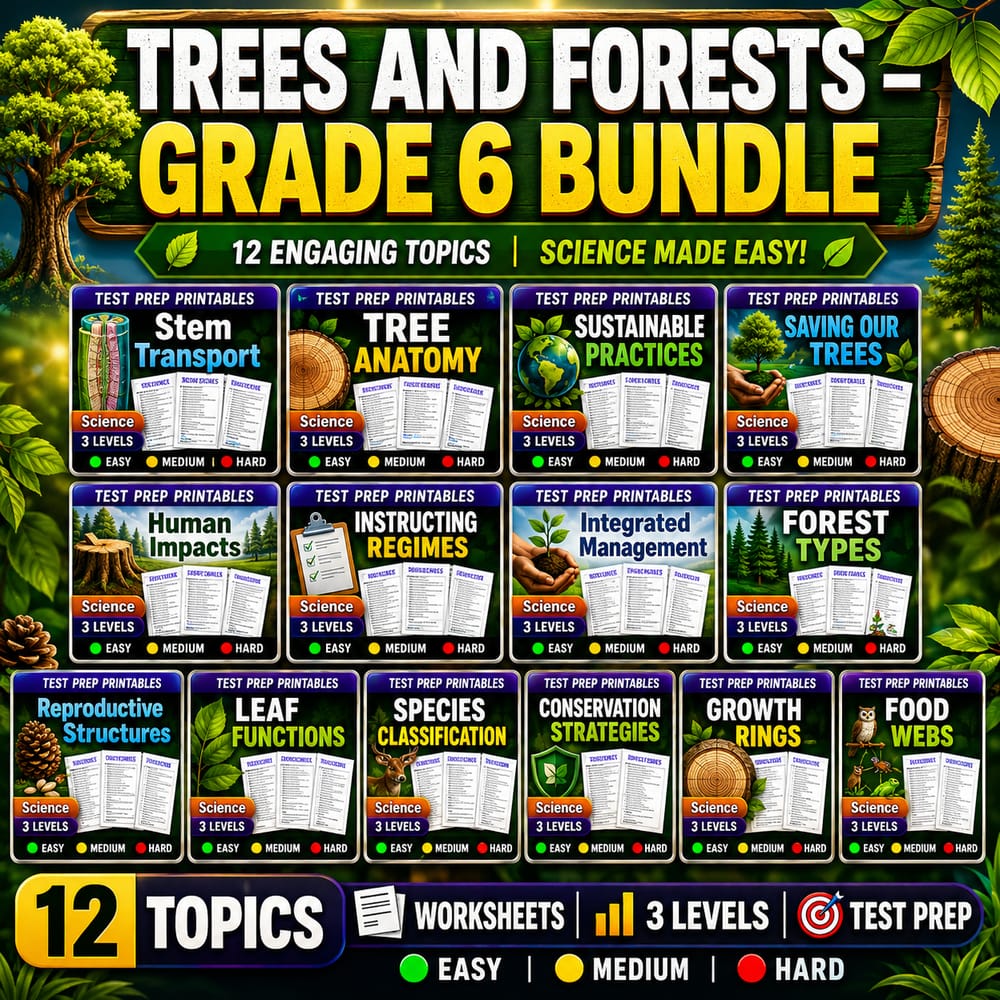


Trees and Forests Lesson Bundle | Grade 6 Science | Alberta Framework
$56.00$70.00Save $14.00
Prism Point Learning
·2 followers·13 sales
SubjectScienceGradeGrade 6
What’s included
15 worksheets · Save $14.00 (20%) · prices shown inside the bundle
 Stem Transport Worksheet | Grade 6 Science Activities
- Explain how xylem and phloem transport water, minerals, and sugars in plants.
- Describe how freeze–thaw cycles, drought, and pest damage can affect sap flow and plant survival.
- Connect bark characteristics to protection from herbivores and fire.
$4.00$5.00 Tree Anatomy Worksheet | Grade 6 Science Practice
- Identify major parts of a tree (roots, trunk, branches, leaves, buds, and bark) and describe their functions.
- Explain how form–function relationships help trees survive in different habitats.
- Use tree anatomy vocabulary to answer science questions accurately.
$4.00$5.00 Stewardship Practices Worksheet | Grade 6 Science Assessment
- Describe key stewardship practices used to care for forests and land in Alberta (e.g., shelterbelts, planting, urban canopy programs, and restoration).
- Explain how stewardship actions help ecosystems by supporting habitat, reducing erosion, and regulating water.
- Connect local land-care choices to broader regional benefits such as carbon storage and healthier landscapes.
$4.00$5.00 Roots and Water Worksheet | Grade 6 Science Activities
- Explain how different root systems (taproots and lateral roots) help trees survive in their environment.
- Describe how roots and root-associated fungi support water and nutrient uptake, especially during drought.
- Connect belowground root processes to aboveground tree health and recovery after disturbance.
$4.00$5.00 Human Impacts Worksheet Pack 6th Grade Science Activities
- Describe major human impacts on forests (land conversion, extraction, fragmentation, pollution, and invasive species).
- Explain how these impacts can change habitat connectivity, soil and water quality, and species composition.
- Identify cumulative effects and why they matter for landscape-level planning.
$4.00$5.00 Disturbance Regimes Worksheet | Grade 6 Science Activities
- Describe how different disturbances (fire, insects, windthrow, flooding, and human activity) shape forest structure and succession.
- Explain how frequency, intensity, and spatial extent influence regeneration patterns and habitat mosaics.
- Connect disturbance regime characteristics to long-term ecosystem change under climate and land-use shifts.
$4.00$5.00 Integrated Management Worksheet | Grade 6 Science Activities
- Explain how integrated management balances ecological, economic, and social goals in forest planning.
- Describe how ecosystem-based management, adaptive harvest planning, and monitoring help manage risks like wildfire and mountain pine beetle.
- Use stakeholder collaboration and landscape-scale thinking to support long-term forest resilience.
$4.00$5.00 Forest Types Worksheet | Grade 6 Science Practice
- Identify major forest types and describe how their species composition differs.
- Explain how abiotic factors such as elevation, soil moisture, and fire history affect where forests grow.
- Use forest types to predict likely habitat conditions and ecosystem services.
$4.00$5.00 Reproductive Structures Worksheet Grade 6 Science | Practice
- Explain how reproductive structures (flowers, cones, and seeds) support plant reproduction and regeneration
- Describe how seed dispersal mechanisms (wind, animals, gravity) influence colonization patterns
- Compare vegetative propagation with seed-based reproduction using Alberta examples
$4.00$5.00 Leaf Functions Worksheet | Grade 6 Science Assessments
- Explain how leaf structure supports gas exchange, photosynthesis, and transpiration
- Compare broadleaf deciduous and needlelike conifer leaves in terms of water use and seasonal effects
- Describe how stomatal regulation, leaf area, and chlorophyll influence growth and carbon balance
Free
Reviews & Feedback
Loading reviews...
Questions & Answers
Loading questions…
About this bundle
Related categories
Frequently asked questions
Who is Trees and Forests Lesson Bundle | Grade 6 Science | Alberta Framework designed for?
Trees and Forests Lesson Bundle | Grade 6 Science | Alberta Framework is designed for Grade 6 students and Science learners and can be used in classrooms, homeschool, or independent practice.
How do I download Trees and Forests Lesson Bundle | Grade 6 Science | Alberta Framework?
Add it to your cart and complete checkout. After payment, you can download immediately from your account, and you'll also receive a download link by email.
Similar Products

Trees and Forests Lesson Bundle | Grade 6 Science | Alberta
$60.00$75.00

Grade 6 Alberta Science Trees and Forests Learning Stations Bundle
$48.00$60.00

Trees and Forests Grade 6 Alberta Science Worksheets Bundle
$36.00$45.00

Grade 6 Science | Trees and Forests Unit Worksheet Bundle – Alberta Curriculum
$36.00$45.00

Grade 6 Science | Trees and Forests Unit Bundle for Alberta (Worksheet Pack)
$36.00$45.00