
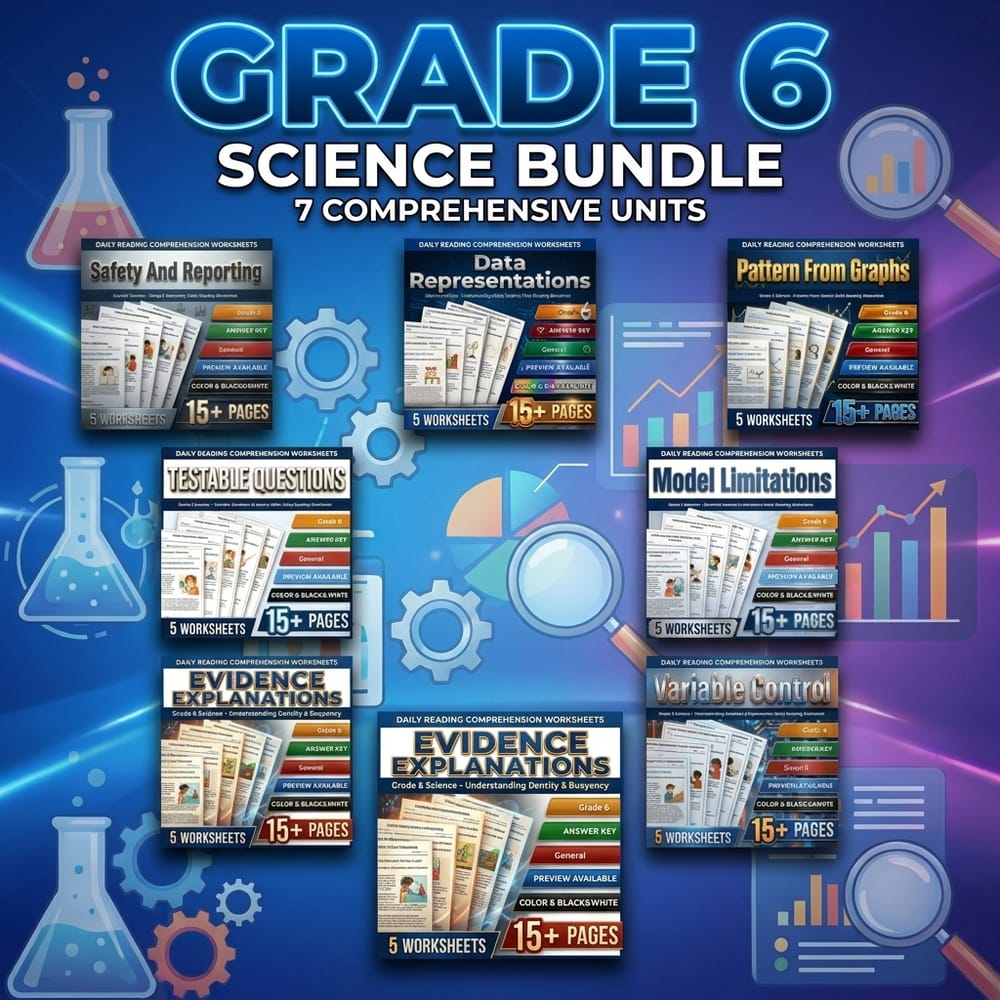
Variables & Experiments Data Grade 6 Science Worksheets Lesson Bundle | General
$22.40$28.00Save $5.60
Bright Mind Resources
New·1 followers·12 sales
SubjectScienceGradeGrade 6
What’s included
7 worksheets · Save $5.60 (20%) · prices shown inside the bundle
 Grade 6 Science – Safety & Reporting | Daily Reading Worksheet
- Understand and identify proper safety practices in a laboratory setting
- Learn how to communicate scientific results safely and ethically
- Recognize the importance of reporting data accurately and responsibly
$3.20$4.00 Grade 6 Science – Understanding Data & Graphs | Daily Reading Worksheet
- Learn how to organize observations into tables.
- Interpret data from tables and graphs.
- Understand the importance of labels, units, and scales.
$3.20$4.00 Grade 6 Science – Pattern From Graphs Daily Reading Worksheet
- Identify steady or constant trends in graphs.
- Describe patterns such as increasing, decreasing, and steady lines.
- Analyze graph shapes to understand relationships between variables.
$3.20$4.00 Grade 6 Science – Testable Questions & Inquiry Skills | Daily Reading Worksheet
- Understand what makes a question testable in scientific experiments.
- Learn how to identify variables and measurable outcomes in questions.
- Develop skills to formulate testable scientific questions from observations.
$3.20$4.00 Grade 6 Science – Scientific Models & Limitations Daily Reading Worksheet
- Identify assumptions made in simple scientific models.
- Explain how models are used to support scientific explanations.
- Recognize the limitations of models and how evidence refines them.
$3.20$4.00 Grade 6 Science – Understanding Density & Buoyancy | Daily Reading Worksheet
- Understand key concepts related to Science
- Apply knowledge through practice questions
- Demonstrate comprehension of the material
$3.20$4.00 Grade 6 Science – Variables & Experiments | Daily Reading Worksheet
- Define independent and controlled variables
- Identify variables in a scientific experiment
- Explain why controlling variables is important for valid results
$3.20$4.00
Reviews & Feedback
Loading reviews...
Questions & Answers
Loading questions…
About this bundle
Related categories
Frequently asked questions
Who is Variables & Experiments Data Grade 6 Science Worksheets Lesson Bundle | General designed for?
Variables & Experiments Data Grade 6 Science Worksheets Lesson Bundle | General is designed for Grade 6 students and Science learners and can be used in classrooms, homeschool, or independent practice.
How do I download Variables & Experiments Data Grade 6 Science Worksheets Lesson Bundle | General?
Add it to your cart and complete checkout. After payment, you can download immediately from your account, and you'll also receive a download link by email.


